
Readings for Education Series
Education is one of those words whose meaning is more or less clear to everyone until someone asks us, “What exactly is education?” or, even worse, “Dad, what is education?” or “Teacher, what does it really mean to educate?”
Bad education, good education, inclusive education, environmental, distance, health… The little words are everywhere. Of the concepts of public education and private education, for example, the second term (that is, the price of entry) is precise. Still, very little can be expected from the first, from education itself. I suggest peering “deep down” because, at first glance, we can say much about what education is. However, a couple of well-posed questions are enough for us to hesitate, and a couple more can dissolve our initial certainty like a mirage. (Something similar happens with the word culture; it is an excellent challenge for anyone to define it and then endure three questions).
I confess that I tend to fantasize that all words are like that (some more than others) and that, by extension, all the knowledge is sustained in them. A simple but working analogy compares words to socks: they all show their disheveled fabric on the inside; sooner or later, they all have holes in the meaning and come to mean something different. The most beautiful thing is that words and socks come in pairs (conceptual, gender, or other types); if we (often) find one alone, it is only because its twin has been lost in the dark drawers of history.
I do not deny that this idea is a very personal perspective, a kind of philosophical fantasy that repeatedly convinces me that everything in this world has its inverse, i.e., its other truth, its opposite truth. This fantasy occurs not because words (or our mind, which administers them) want to play tricks on us but because reality itself is structured in an antinomian way (antinomies are just that, truths that admit a contrary truth): Is the universe finite or infinite? Both. Did it have a beginning or not? Yes and no. And an end? Equal. Are humans complete or incomplete beings? Both. Are we a whole or a part? Both. Are we free, or are we absolutely determined? Well, although subjective, here, too, both are true.
This very complicated philosophical fantasy (which has intrigued me since childhood and has accompanied me throughout my self-taught career) may seem crazy (a madness only mine), but it is not. To tell the truth, antinomies could be realities inherent to the known universe. All philosophies incorporate them to the extent that we think these are nothing more than attempts to resolve or at least alleviate them. For me, the reality of antinomies was so evident, even as a child, that I always thought everyone in the world grasped them. However, in the long run, I have had to admit that this is not the case, that people generally do not realize or care that the universe is finite and infinite at the same time (or at least can be, which Kant calls the First Antinomy), nor that strange things can derive from it, such as our reality simultaneously exists and does not.
One conclusion from all of the above, which is pertinent to my meaning, is that there are some people who, by a kind of origin failure, are destined to see the antinomy of the world amplified (with all the uneasiness that entails). Within this group, some privileged people are on a precipice from which they can see, on the one hand, the shattered reality, but on the other, the reality of the integrated. They are beings for whom there are not only paradoxes and contradictions in the world but also solid and (above all) unique truths. (I take the term from Umberto Eco’s book Apocalyptics and The Integrated). Those who see both shores are like boatmen who carry messages from one to the other or water carriers who deliver the precious liquid so that neither side lacks it.
In general, philosophers fulfill this function. All of them (some more, some less) have lived in the unarmed reality even for a moment and have tenaciously pushed to reach the other shore, where they only remember escaping from a world of horror and then (if they are lucky enough, that first impression is attenuated) from a place that arouses amazement, admiration, doubt, awareness of limits, a search for truth, a reason for science, and others. However, despite all these sedating perspectives, the antinomian world is still there, present in all the fundamental human questions, with its voracious hole, unfillable even by the deepest philosophies and sciences. Indeed, some have managed to describe the hole and conjecture ways to fill it, ways that, taken seriously, allow many to sit on the edge of its abyss and entertain illusions that they have tamed it. The descriptions and conjectures are usually aesthetically beautiful, ethically comforting solutions, but ultimately so ambiguous and possibly absurd that it is impossible to dismiss them entirely. (One cannot expect anything else from philosophers, given the problem they are trying to solve). The conceptions remain in the universal dialogue of philosophy as eternal rumors, like mantras we keep repeating, and they calm us.
One of these melodies is Aristotle’s principle of non-contradiction, which says, more or less, that an idea and its negation cannot be true simultaneously. This refrain is so familiar to us that, under the name of common sense, we trust it to banish from our minds overwhelming ideas like the universe has to have an end, but at the same time, it cannot end. (We all know that this world is weird, to say the least, and at worst, maddening.)
And speaking of maddening, I pause to slip here a rumor that assails me: Can it be that no matter how much we manage to distract ourselves from it, the antinomian world continues to call us with its force so that we do not forget the people who live in it full time: people who have not been able to reach the other shore; migrant children, adults, and elderly people (calling them that, avoiding the term of the mentally ill), whose misfortune is not to find anyone on the other side who heeds their call or understands their language of disheveled, perforated, antinomian phrases).
*
Like all unsolvable realities, the antinomian world finds expression in stories called myths, one of which I know best. I will recount this here to explain myself further. It’s the only one of the creation myths that I explore enough to dare to recreate it. I am referring to Adam and Eve. It goes like this: God created heaven and earth and everything that exists, including human beings, whom he put in a sheltered garden specially designed for them. Inside was a selection of animals that they would have the privilege of naming; this would also give them the prerogative to rule over them, which certainly did not mean killing, eating (Eve, Adam, and all the beasts were vegetarians), or abusing them, but, instead, taking care of them and receiving their help to cultivate the garden.
A point we always overlook when reading this fragment of Genesis is that not all of reality entered Eden, but only a part. Eden constituted a garden of delights, unequivocally named, well-tended oases in a corner of the world. But what was outside that paradise, in the newly created cosmos, that required the removal of such fragile creatures from it? If the story’s logic is followed, the answer is straightforward: what was outside was the reality we know, this universe of ours, which I have called antinomian, and into which Adam and Eve were thrown to cope with their undeveloped resources due to strange disobedience. (Chesterton compares this to the case of the princesses who open the forbidden door of the palace; in fairy tales, it seems that only God, with His invulnerable gaze, can contemplate facing this newly opened world head-on without breaking.)
Thus, through the intervention of the serpent (very similar to the worm that bites us when we think thoughts we shouldn’t), the little Eden of Eve and Adam disappeared (as if a veil fell from their eyes), and they realized then that the garden had been only a refuge, and they had lost it. From that moment, they would have to deal with actual reality, as fantastic as it was horrifying, to govern which names were useless: No matter how hard they tried to polish them, they saw time and again that as soon as they pronounced them, each produced a twin, and from each pair, another, and another, and another, until they recognized that when it came to the reality of God (divine reality, finite and infinite, possible and impossible), they could never encompass or comprehend it. (Note that at the moment they conceived this idea, the opposite also occurred to them so that they could not even resign themselves to it).
*
In the case of education, the antinomy of the world can be seen in all the meanings we have given to the concept throughout history. Recently, deciding to delve into some of these meanings, even if only slightly, I came across a pedagogical classic, which perhaps some of you already know: the book The Great Pedagogues, a compilation by the master Jean Chateau, with monographic texts on fifteen people who, in their times and places, changed the course of education from ancient times.
After reading the first chapter, I began this article intending to discuss it, but you have already seen how my fantasy led me to Adam and Eve. Now, I have little space left before my readers get bored. (However, the dissertation is relevant because, as with any text on philosophy, understanding it becomes easier if one starts from a personal way of thinking because, deep down, all authentic visions are similar enough to others to help understand them).
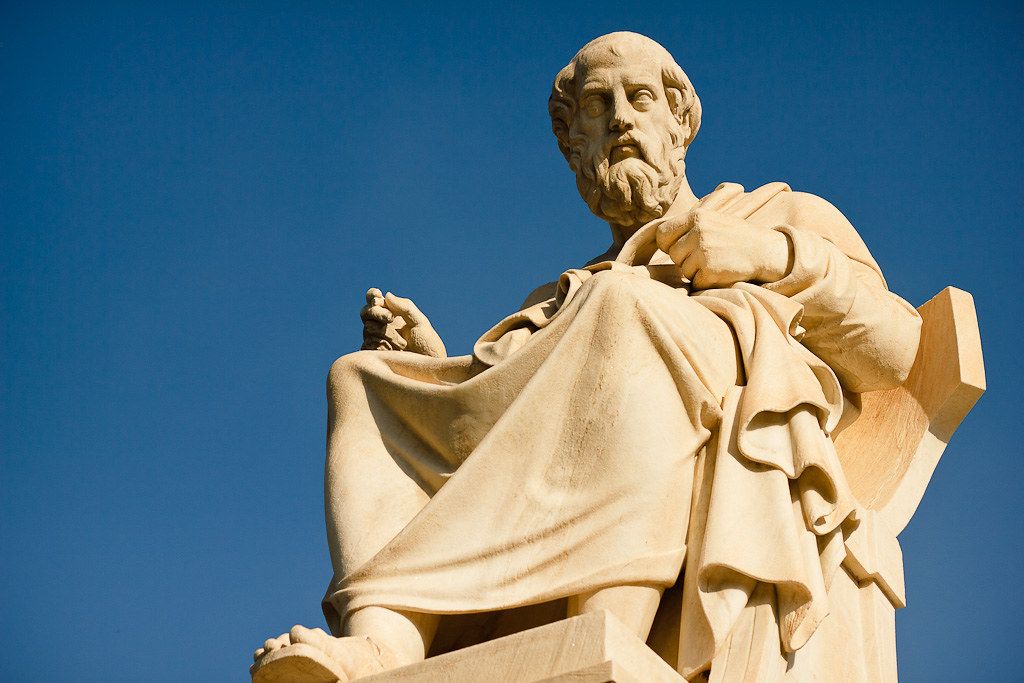
The chapter I reference is an essay entitled Plato and Education by another great teacher, Joseph Moreau. It is one of the best and simplest expositions I have read about the great Greek philosopher. Friendly, entertaining, complete, and transparent, the reader has the double pleasure of understanding a little more about Plato’s philosophy and learning something profound to reflect on the teaching.
By way of background, the author tells us how the first professional pedagogues (the sophists) tried to decipher the significant problem of the incomprehensible world and transmit to their students a firm truth that would alleviate their anguish and allow building a sensible order. For some, that truth was mathematics, which evidenced infallible realities. For others, the truth was language, which governed the intellect and could also order everything that existed differently. These two positions gave rise to contrary theories, which, in turn, supported different practices: on the one hand, technical activities (engineering, architecture) based on arithmetic and geometry, and on the other, politics and all those public tasks that required mastering the word. Finally, Protagoras, the most famous sophist, posited a third ordering truth, virtue, which by its primacy over all others would try to establish itself as the human axis…but it fell short because Protagoras could not separate it from the ancient traditions, which still served as an example to the people when they wanted guidance for their actions.
Plato, Moreau explains, was the first to try to separate virtue from that tradition, to make it independent of specific places and times, and, in a word, to universalize it. His philosophy was also based on mathematics and language, but he would try to rise above them and credit reason as the supreme resource for knowing virtue and pedagogy as the only guarantee of the scientific character of that knowledge. (The argument was that only a truth that could withstand the rigorous dialectic of teaching/learning was reliable).
In his attempt to decipher the world that I have called antinomian, Plato expressed it (perhaps more mercifully) as the imperfect reproduction of a perfect reality, of which we can only see something like a shadow. However, this ideal reality is not entirely unknown to us: we were able to ascend and see it but unable to control our flight well, so we fell off a cliff to this other material reality, where we have unfortunately forgotten that view. Only our reason still remembers, vaguely, the way back. Therefore, only when subjected to the proper pedagogical techniques can reason recognize the complete map and rise again: “… To know is not to put something strange into ourselves; it is to acquire a clear awareness of a latent treasure, to develop an implicit knowledge. Learning is nothing more than remembering again.”
Thus, through the reasoning submitted to pedagogical dialogue, Plato constructs a system to make the world intelligible and banish all error and uncertainty; a system that tries to “gradually liberate spiritual activity in search of the ideal good, overcoming all empirical ends” in which the soul is entangled.
“That infinite aspiration,” Moreau sums up, “this effort to grasp the absolute and achieve its eternity, is expressed, according to Plato, in the symbol of Love.” This love permits us to advance “from sensitive beauty, which derives from the senses to moral beauty; then we will discover a more secret beauty, which reveals itself only to mathematical intelligence, one of harmonious relations. From there, we finally will be able to rise to the principle of all harmony, to the source of all value, to the intuition of the absolute Good, to contact with the sovereign transcendence of the spirit.”
In his description of Plato’s philosophy, Moreau combines a lucid understanding of the subject with a sharp exposition and lightness of style. It is delightful to read it and discover how pedagogy began its career as a scientific discipline, one of our oldest and most profound models of thought, and how its presence became fundamental in the beginning of the history of the West.
(“Plato and the Education of Joseph Moreau” in The Great Pedagogues by Jean Chateau, published by the Economic Culture of Mexico Fund. It is available on Amazon’s Kindle, which sends the entire chapter as a free sample. This clarification seems commercial, but honestly, it is not. The Kindle books and free samples can be read in the cloud or the app and can be downloaded at no cost on the cell phone, so at least reading that first chapter is free. Try it, it’s worth it.)
Translation by Daniel Wetta