
Readings for Education
The International Day of Non-Sexist Education was celebrated on June 21. Although the date has passed, I do not want to fail to refer to it and also use the opportunity to refer to a book I recommended a few weeks ago in this magazine: The Great Pedagogues, a compilation of texts by Jean Château, which, despite being a splendid document, commits sins of omission by only including one woman among its authors, Maria Montessori, leaving out many other women who slowly, over the centuries, undermined the patriarchal academic educational system.
Historically, and with honorable exceptions, the teaching-learning processes in academia have been dominated by hegemonic groups that violently discriminate against significant sectors of the population. Although Château’s book denounces these exclusions and praises authors who have fought against them (including great promoters of non-sexist education), it makes the common mistake of narrating male mainstream history. It is a book from the 1950s, but I do not know if that exempts it from the guilt of not turning to the great feminist demands, which were already very loud then.
The truth is that honoring the women who have contributed important things to education means more than merely mentioning the names of experts who could compete with men in developing pedagogical theories; above all, it means rethinking educational models and discovering in forgotten corners the countless innovations that women promoted that are not even considered as pedagogical values by the mainstream. The search for these women and innovations must dare to include the valuable experiences and knowledge that are transmitted generationally in ways that are not only non-institutional or academic but also non-rational, non-methodical, or non-systemic. Feminism is not machismo with the inclusion of women; in my opinion, it is liberation from all the human flow that patriarchal culture subjects to its channel. This allows us to say that patriarchal culture never “excluded” women from education. Instead, it reduced the teaching-learning processes to a vision of the world that requires humanity to be divided into two groups: one of men, who should specialize in public activities, and the other of women, who should concentrate on private aspects, that is, incubating in the “bosom of the home” the values that are then reproduced in society.
In modernity, this vision includes believing that social welfare can be planned and achieved if it is reasoned correctly; for example, people must understand that development logically follows from the more advanced groups paving the way for the backward ones and the latter adhering to the interests of the former “by their free will;” i.e., accepting that objectively this capitulation will bring them the most significant benefit. In such a society, the obedient no longer have to obey divine designs (as in pre-modern times) but must only attend to “facts” that can be described by reason and science. Society is said to be a mechanism that acts by laws that can be known and taught. Of course, for this mechanism to work, it is essential that everyone occupies their place in a disciplined way and that the serious, objective, institutional, and systemic aspects prevail. The ordered family must separate itself from the community, which is always unpredictable, boisterous, and chaotic, and the frivolous and undisciplined limits their presence to parties and moments of play, which should no longer be considered as central to social life (as they were in previous centuries) but as secondary, only essential for people to regain strength and continue contributing to development. In conclusion, if humans obey these laws of nature, the well-being that springs up will inevitably spill over to everyone.
The gestation of modernity passed through several stages, having several opportunities to take a different course from utilitarian rationalism (which once triumphantly justified the worst atrocities in the name of reason and science). Considering education in Europe (which we inherited), we glimpse one of these possible turns in the sixteenth century, especially in France. There were substantial outbreaks of female emancipation, which some historians call pre-feminist or proto-feminist movements. Regarding access to knowledge, these struggles include anecdotes such as those of heroic women who went to university dressed as men or made terrific contributions to science, philosophy, and art but agreed to remain anonymous, hidden behind a man’s name.
However, the main female contributions to advancing knowledge and egalitarian teaching do not occur in institutions but precisely on their margins, linked to pleasant learning, the spontaneous exchange of information, play, humor, and permeability between genders. These attempts flourished with immense power for almost a hundred years. Eventually, they succumbed to patriarchal interests, but if they had succeeded, they would have bequeathed us a much more vital concept of education than the one we have now, much less solemn, competitive, categorical, unilateral, and hereditary. Perhaps history is where it is least possible to say, “If only…,” but it is still beautiful to imagine that things could have happened differently, like in Quentin Tarantino films where villains like Hitler die before committing their worst atrocities, and everything ends happily.
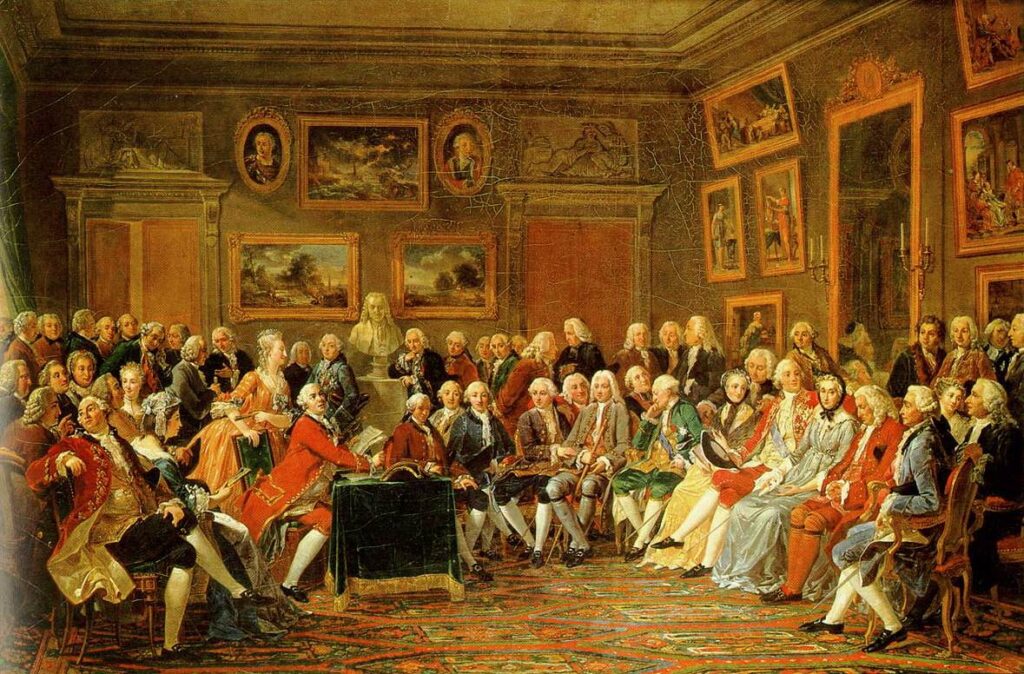
With the creation, in the sixteenth century, of specific social meeting spaces known as salons, aristocratic and high bourgeoisie women managed to change the intellectual and educational panorama of their time and lay the foundations of what is today still a rebellious way of envisioning education and communicating knowledge. We are talking about almost a hundred years after the discovery of America when universities were still stagnant in ancient wisdom and questioned any progress. Nearly all the people interested in the new sciences satisfied their curiosity outside the institutional sphere, covering their expenses and installing physics, chemistry, and biology laboratories in their homes and seeking or creating private spaces where they could share ideas and discuss their discoveries with others.
In this context, the famous salonnières women opened their homes so the new male and female sages could meet. Most were men, but the women set the tone for the meetings. The atmosphere was festive; ingenuity was valued. The playful character privileged an atmosphere of tolerance and respect for the ideas of others, thus favoring the free exchange of knowledge. The fashionable literary works, the new mathematical and scientific discoveries, and the most advanced philosophical thoughts were discussed. The conversations dealt with politics, war and diplomacy, astronomy, physics and medicine, morals, education, and art. Topics did not always clearly demarcate their borders because learning develops in conversations among equals and not from the erudition of experts. Knowledge flowed and was called into question; the participants disdained the unilateralism that prevailed in universities (and still exists today). The salons were genuine offices of the spirit where no one knew what or who they would teach; everyone was a student or teacher.
Going to a salon was prestigious, and it was discreditable to be excluded from it. The reasons for exclusion would have been expressing oneself misogynistically and being “pedantic” (i.e., conceited or complicated) in dealing with topics. It was necessary to speak simply so that everyone understood, avoiding inaccessible technical terms. A conversation could be as passionate as one wanted but always cordial and, if possible, endowed with humor and mixed with anecdotes that would make knowledge more human, closer to life.
It is said that in the salon of Marie de Gournay, the idea of creating the famous French Academy arose. Ironically, it was inaugurated decades later, with only male members. They were known as the immortals, a word that, although it alluded to the imperishability of the French language to which these academicians devoted themselves, also allows us to imagine their self-pretensions. Pedantry ended up triumphing. The salons became limited to literary gatherings, and the women could talk only to each other on non-public topics. One cannot help but feel nostalgic imagining that if the impulse of the feminine current had been preserved in the new boom of knowledge, the schools and academies would have been spared at least a couple of centuries of pedagogical arbitrariness, keeping education linked to pleasure and spontaneity, immediacy and simplicity, and ultimately to democracy and happiness and the craving for sharing that comes when genuinely learning something.
Jean Château undoubtedly missed the opportunity to include in his book all those wise women who drove the emergence of science and knowledge at the dawn of modernity and who set the course of education for more than a century before male hegemony, finally triumphant in academia and the imposition of science, once again deprived them of the opportunity to get involved in the new world.
I end this reflection by recommending another book I found in my search to compensate for the absence of women in Château’s text. I refer to Philosophers and Pedagogues, the History of Education Beyond the Canon, also a compilation of texts, but now about women, coordinated by María Guadalupe Zavala Silva, and published and distributed free of charge by the publishing house Silla Vacía (it can be obtained by visiting this link or by sending an email to distribucion@sillavaciaeditorial.com).
Translated by Daniel Wetta