
In 2020, I published an article about how burnout affected teachers during the pandemic, but this problem has continued despite the quarantine ending some time ago. This condition, also known as burnout syndrome or chronic fatigue, is not unusual. It was introduced as a diagnosis in 1974 by psychologist Herbert Freudenberger, who depicted its physical symptoms, such as exhaustion, fatigue, frequent headaches, gastrointestinal disorders, insomnia, and shortness of breath.
Anne Helen Petersen, writer, journalist, and author of the book Can’t Even: How Millennials Became the Burnout Generation, explains that this is a dominant condition of millennials because the idea that you must be working productively all the time has been reinforced since childhood.
The problem with burnout is that, unlike fatigue, you reach a point where you can’t go on anymore, but you must, whether it’s for many days, weeks, or years. One looks for a sense of accomplishment that follows passing the final exam or finishing a semester, but this never comes. Burnout psychoanalyst Josh Cohen describes the feeling as when “you have depleted all your inner resources, but you cannot free yourself from the nervous compulsion to move forward despite everything.” Millennials have learned that being an adult is like a verb: to be adulting. This stage is nothing more than a list of things to do that never ends: working, cooking, cleaning, going to the supermarket, taking care of the children, exercising, etc. Many things that should be enjoyable become an exhausting burden because they feel like another item on the to-do list.
About this, author Anne Helen Petersen writes, “That’s one of the most ineffable and frustrating expressions of burnout: it takes things that should be enjoyable and reduces them to the to-do list, interspersed with other obligations that should be completed with ease or diligence. The result is that everything from wedding celebrations to voter registration is tinged with resentment, anxiety, and avoidance. Maybe my incapacity to sharpen knives is less due to laziness and more to being too good, for too long, at being a millennial.”
It is becoming more normal to realize that the planet is dying. We are concerned about a financial crisis, whether another pandemic will emerge, whether a new war will break out somewhere, and how that would affect the global market. Tough situations are seen as “normal” because this is the only way to survive. That is why “burnout is not a place to visit; it is our permanent residence,” says Petersen.
Teacher burnout
With this in mind, it is unsurprising that teachers also suffer burnout. First, this profession often has unsustainable workloads, including instructional design, preparing classes and exams, grading, teaching the class, data analysis, contacting parents, standardized assignments, and more. Teachers have an endless to-do list that drowns even the most passionate educator.
As mentioned, worker burnout syndrome affects all professions; however, a Rand survey reported that teachers are twice as likely to be more stressed than other work areas. An American Educational Research Association study supports this data, concluding that 40% of United States educators are likely to have anxiety compared to those who work in the health sector (20%) or office work (30%). On the other hand, according to a Gallup survey in 2022, K -12 educators (kindergarten to high school) worked in the profession with the highest burnout syndrome in the United States. In this study, 44% of teachers surveyed answered that they felt burnt out often or always.
This stress and burnout affect not only teachers’ lives and work but also their students, as teachers cannot give them adequate attention. Devlin Peck, an instructional design coach and e-learning consultant, wrote in his portal that “students under the tutelage of teachers with high anxiety tend to have worse academic performance, particularly in subjects like mathematics, and they may develop negative feelings and behaviors.” However, workload is not the only cause; teachers often feel micromanaged and lack autonomy. Classroom or institutional policies frequently stifle Their creativity and self-expression, which demotivates them over time. In addition, they usually have inadequate teaching tools, slow internet, insufficient materials, poor infrastructure, etcetera. We must not forget the factor of the students, especially those with bad behavior. Since teachers must also be caregivers while providing quality instruction, dealing with challenging, abusive, or unique needs students accelerates teacher burnout. Coupled with this is a lack of support and external pressures, such as governments’ standardized tests, grading systems, parents, and society.
Another cause of increased stress and burnout was the COVID-19 pandemic. Many, if not all, educational institutions switched overnight to an emergency virtual model without adequately preparing educators. As a result, they had to quickly adapt to using new technologies to continue doing their jobs effectively. According to a 2022 survey by the National Education Association (NEA), 55% of respondents plan to leave the profession earlier than planned, citing difficulties due to the pandemic and burnout as the main reasons.
Additionally, in this survey, 67% of respondents mentioned that they consider burnout to be a very serious problem, and 90% stated that feeling this way is a serious problem, especially with so many unfilled vacancies. On this subject, about 74% of teachers said that they had to take on additional tasks to cover staff shortages. Meanwhile, 80% of teachers reported that they had to take on more work than their role and responsibilities required due to unfilled job openings. As a result, many teachers were unable to cope with the change and quit, leading to significant shortages and increased workloads for those who stayed. In its research, NEA reported that more than 500,000 educators left their jobs after the pandemic.
Alexandra Robbins, author of The Teachers: A Year Inside America’s Most Vulnerable, Important Profession, wrote for EdWeek that teachers suffer from burnout and are destined to fail. She explains that teachers’ rates of “job tension” (stress from a high-demand, low-control job) are higher than for the average worker. Robbins mentions in her article that she read two publications describing burnout as contagious because of the close relationships that teachers have among colleagues, without addressing the root causes that lead teachers to this state. For her, rather than contagion, educators “are hindered by burdensome school systems, ignorant officials, or administrators disconnected from reality.” It’s not just that they suffer from burnout – they are part of a system that leads them to that.
One problem with burnout is that there is no exact way to measure it. Some researchers have looked for ways to do this, such as Christina Maslach, the popular social psychologist known for her research on burnout syndrome and co-author of the Maslach Burnout Inventory, which proposes measuring the degree of burnout. However, all measurement methods are problematic because each case has different causes.
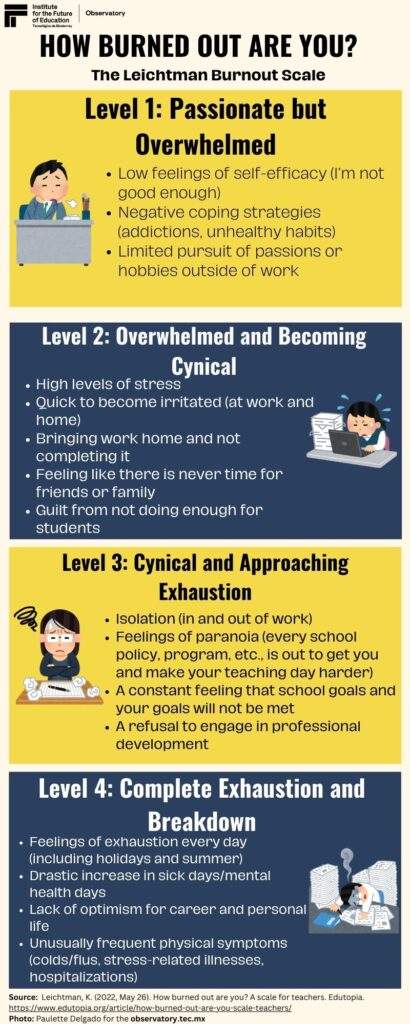
Kevin Leichtman, author of “The Perfect Ten: Ten Students, Ten Mindsets, One New Definition of Perfection,” wrote an article for EduTopia, explaining that he invented “Leichtman’s Burnout Scale” to provide “a clear understanding of the burnout process specifically for educators.” Leichtman mentions that although each case is different, certain tendencies between symptoms and variable thresholds can help decipher the burnout level each educator experiences.
There are four levels: The first is to be passionate but feel overwhelmed. The teacher loves what he does, feels engaged, and takes on more tasks, and the burnout begins. The second is feeling overwhelmed and cynical when that passion of the first level does not yield results such as a better salary, better evaluation, or other benefits; there is only more workload, which is when the teacher begins to feel cynicism towards the profession. Level three is complete cynicism, and the feeling of exhaustion begins. The teacher may feel that it is impossible to be a good educator, that everything and everyone is to blame for the state of education, and that no matter what he does, things will not change. Those feelings do not stay in the classroom; they accompany the teacher home, impacting other areas of life. Finally, there is the collapse due to total exhaustion. Burnout has invaded every part of your life, affecting your well-being and putting you in survival mode. Leichtman mentions that at this point, there are two options: “leave or recommit:” either leave the profession or recover the passion.
Another effect of the burnout syndrome that few talk about is the feeling of guilt that accompanies it. For many educators, this emotion is part of their daily lives: guilt for taking vacations, missing work because they are sick, leaving work on time, not finishing grading, among others.
This feeling arises from wanting to do everything they can for their students while at the same time feeling overwhelmed and exhausted by their workload, lack of support, and anything going on around them. They feel bad that they cannot complete everything they would like. Crystal Foxx of the NEA publication mentions that “the responsibility does not lie with educators, but with the political leaders who perpetuate a system that creates this cycle of guilt, since a person cannot manage to do everything without sacrificing something, like family or personal time.”
Supporting teachers to cope with burnout syndrome
Because everyone’s tolerance for stress and emotional management is different, it is impossible to give a one-size-fits-all answer to avoiding burnout. Still, one place to start is to watch for early signs. According to the Leichtman scale, the educator at level one should seek support and help and take measures to avoid reaching the last level. The organization “Education Support” provides in their portal “Several Tips to Avoid Burnout Syndrome.” Start with being aware of your emotions, stress level, and health. Use strategies such as mindfulness, meditation, journaling, or talking to others to track how you are doing and feeling so you can ask for help or take a step back if necessary. The organization writes that “being aware of and understanding stress, burnout, and mental health is invaluable to understanding oneself.”
Take control of your well-being; learn to balance work and personal life, and find moments to rest and relax. “Education Support” mentions that it’s normal for teachers to put their students first, but it’s okay to put themselves first and not feel guilty about it. If you want to take care of your students and offer the best education, you must also spend time recharging and taking care of your health and well-being.” Question whether you can cope with an immense workload. Taking on more work to be better at what you do and help your students is not a bad thing; however, before doing this, the organization recommends questioning the purpose of the new tasks you will assume if it goes beyond everyday responsibilities if it is something you have time to do without impacting the other areas of your life and without exhausting you. Stop and think whether it is really necessary.
With this last point in mind, Education Support advises educators to remember that sometimes one must say no; it’s okay not to be able to do everything, whether due to lack of time, too much work, or because it would have little impact on students. Another essential consideration is taking needed mental health days. Whether you feel exhausted or are already suffering from burnout syndrome, it is good to take time to recover. Whether it’s a workday, weekend, or holiday, you need to relax and give yourself time to heal emotionally and physically.
Finally, the organization advises learning how to ask for help and get support when needed. Talking to peers, friends, family, or experts can help you avoid burnout. Remember that Tec has programs for emotional support, such as TQueremos.
Have you experienced burnout? If so, what steps have you taken? What advice would you give to other teachers?
Translation by: Daniel Wetta