

In this era, when information is just a click away, the various skills and abilities that students and workers must have change and increase in lock-step with technology. That is why digital literacy has become fundamental, encompassing a wide range of competencies that allow people to navigate, understand, and participate critically in the digital environment.
What is digital literacy?
Traditionally, “literacy” referred to the skills linked to reading and writing, which were necessary to function effectively in society. However, this concept falls short due to the modern world’s drastic changes. Learning to read and write is no longer enough.
The term “digital literacy” is not new. Cheryl Brown points out that, as early as 1997, Gilster defined it as “the ability to understand and use information in multiple formats and from different sources when presented by computer.” However, he clarified that the meaning transcends a group of technological skills, saying, “It is more about mastering ideas, not pressing the keys of the computer”.
As technology advances, the concept of digital literacy evolves. While Gilster laid the groundwork, today, UNESCO describes it as “the ability to access, manage, understand, integrate, communicate, evaluate and create information through the secure and relevant use of digital technologies.” This includes using technological devices such as cell phones, computers, tablets, and others.
In an article for the BBC, Alex Christian explained that digital literacy was previously a limited reference linked to sending emails or using a word processor. However, today, it is a mindset more than a functional necessity. Employees, students, and recent graduates must adapt quickly to the technologies in their work and the ever-changing tools and approaches. They must go beyond mastering digital platforms and mobile devices to comprehensively understand the tools that facilitate tasks in academia and work, function in hybrid and remote environments, participate in collaborative programs, and use real-time messaging applications.
Digital literacy practices
In the article Digital Literacy for the 21st Century, in the fourth edition of the Encyclopedia of Information Science and Technology, Spires, Medlock Paul, and Kerkhoff assert that digital literacy practices involve three primary skills: 1) finding and consuming digital content, 2) creating digital content, and 3) communicating and sharing digital content, all while critically assessing it.
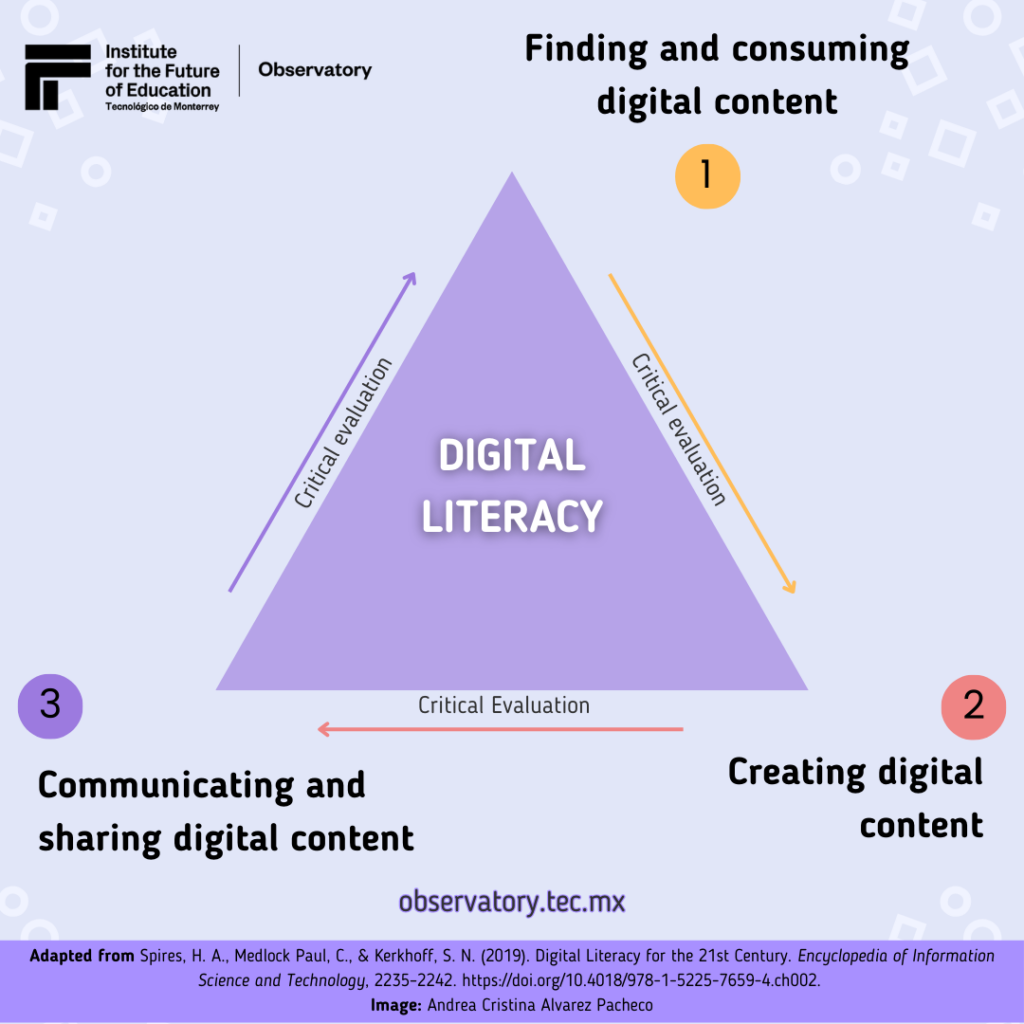
Although point number one, finding and consuming digital content, would seem to be the easiest to fulfill, it has been shown that nowadays, young people have stopped using traditional search engines such as Google, preferring to go to social media, where there is more possibility of being a victim of misinformation. Finding what is being searched for is not enough; it becomes necessary to discern the information’s veracity and relevance to achieve educational and work success.
On the other hand, practice number two, creating digital content, includes generating publications in different written formats, such as blogs and emails, and other media, like videos and podcasts. Finally, practice number three, communicating and sharing digital content, refers to the ability to curate information, which involves reading the material critically to select, order, synthesize, and publish the content in the digital space.
Digital literacy transcends the basic use of devices to develop cognitive-critical skills for searching, selecting, organizing, and analyzing information on the Internet. Communication skills are also required to create and share messages using digital tools. Digital literacy comprises a comprehensive approach combining the technical, analytical, and communicative competencies essential for practical digital environment exploration.
Digital literacy in a technological age
Something as simple as reading an article requires additional skills because, unlike traditional media, online sites can have videos, advertising, links, images, comment sections, or share buttons. More than reading from beginning to end, the user must decide what to read or click on first.
In addition, developing critical skills for internet resource consultation can prevent the spreading of false alarms on social networks, email fraud, and phishing – risks that endanger users’ security, privacy, and integrity. Competent digital literacy enables us to identify threats, discern truthful information from false information, and adopt safe online practices.
Thus, digital literacy involves five key domains in effective virtual functioning:

- Information and data literacy: Refers to the ability to search, evaluate, interpret, and use information and data effectively. It includes distinguishing between reliable and unreliable sources and managing large volumes of information.
- Communication and collaboration: This domain includes the necessary skills to communicate appropriately in digital environments, whether through emails, social networks, videoconferences, and others, as well as collaborating with other users digitally, such as on shared work platforms.
- Digital Content Creation: Implies the ability to create and produce digital content, whether texts, images, videos, or other online resources. It also includes understanding and using various tools and platforms for content creation and editing.
- Security: Focuses on protecting privacy and online security, including using passwords, protecting against viruses and fraud, and acquiring knowledge of best practices to maintain personal and professional security in the digital environment.
- Problem-solving: This domain encompasses identifying and solving technical and digital problems, including managing software and hardware and solving issues related to technology access or use.
Essential tool for personal and professional development
We use technology in almost every aspect of our daily lives, whether working, studying, or even socializing; it all depends on our digital capabilities. Previously, knowing how to use a computer was an added value. Today, it is an indispensable requirement, an essential skill for active participation in modern society and leveraging work and educational opportunities.
However, digital literacy transcends knowing how to use computers. To be digitally literate, one must develop search skills, create content, solve problems, innovate, communicate effectively online, and collaborate. In addition, it is essential to recognize the risks, stay safe online, protect personal well-being, and practice positive behaviors in the digital environment, the latter being commonly forgotten.
The future of digital literacy will encompass the aspects already mentioned and also include emerging technology skills for artificial intelligence, automation, and data analysis, as well as understanding how these technologies work and how to use them ethically and responsibly—all of which will change how we work, learn, and communicate.
Even without a view to the future, for some years now, digital literacy has been required to adapt to today’s world, allowing access to information, active participation in society, and developing essential skills for everyday life. Fostering it is key to a more equitable and connected future.
Translation by: Daniel Wetta