
Many things have changed in the last 15 years: we went from relying almost exclusively on Word to working in the cloud with Google Drive and real-time collaborative tools. Platforms like Coursera or Duolingo were in their infancy, so the idea of taking an online college course was still unimaginable. Virtual assistants did not yet exist, so you could not turn to Siri, which was announced in 2011, or Alexa, which was released in 2014. It was unthinkable to imagine what is now very common: accessing multiple generative artificial intelligence platforms like ChatGPT.
Mobile connectivity advanced from 3G to 5G; there were no influencers as we know them today. The changes in social media have been radical: in 2010, you saw your “friends'” Facebook posts in chronological order. Over time, the algorithm became more complex; the priority shifted from the closeness of your connections or chronological publication time to the number of interactions.
Today, the feed is a product of artificial intelligence and machine learning, analyzing thousands of signals simultaneously. This means that what appears in your feed is no longer necessarily what your connections upload, but what the machine predicts will hook you the most: viral posts, reels, groups, ads, etc. The goal is no longer for you to follow your friends’ lives but to keep you in the app longer.
And what about the educational world? This area has also undergone impactful transformations. In 2010, most universities offered a traditional, teacher-centric model, with face-to-face classes, rigid curricula, and platforms like Blackboard for organizing assignments and materials. Online learning was still limited and little known.
Now, in contrast, we experience a much more flexible, digital, and interdisciplinary educational model. Classes are no longer limited to listening to the professor; they involve real challenges, project collaborations, and international experiences. Hybrid and online learning took hold during and after the pandemic, and LMS or Learning Management Systems (LMS) such as Canvas replaced Blackboard, integrating digital resources, real-time collaboration, and access from any device.
At Tecnológico de Monterrey, for example, this change is reflected in the move from the pre-2019 educational model to a new one where challenge-based learning, educational innovation, and the use of artificial intelligence tools such as TECgpt guide the new learning experience.
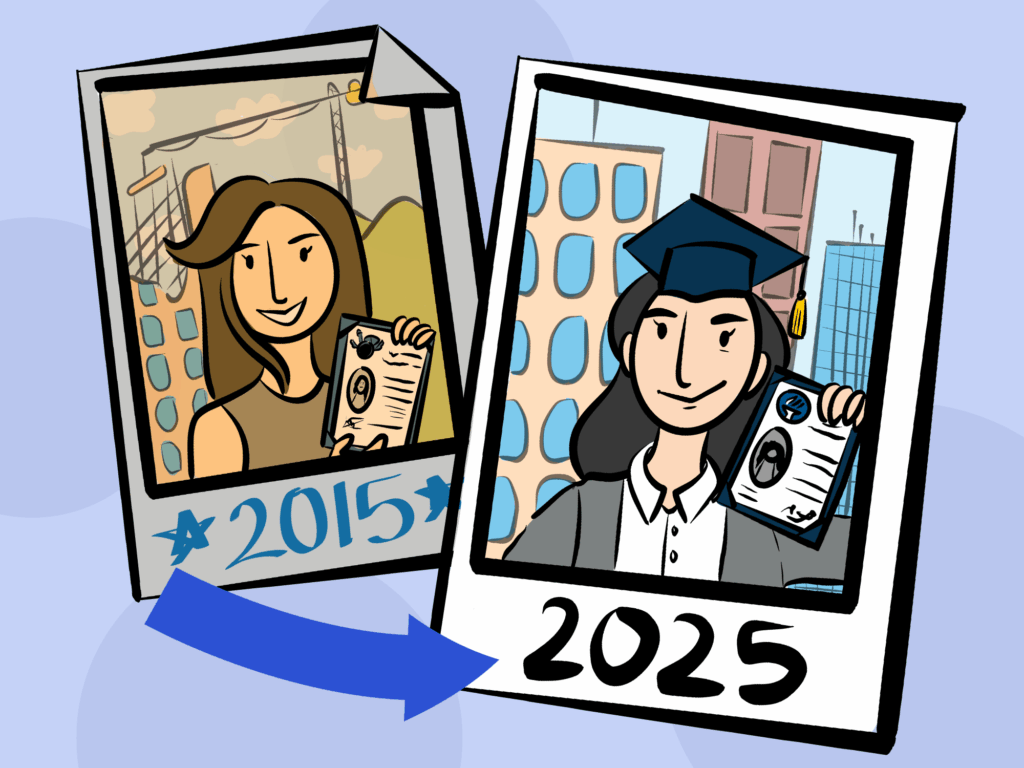
I entered university in August 2010; I pursued a Bachelor’s Degree in Journalism and Information Media at Tecnológico de Monterrey and graduated in May 2015. In recent years, I have had to read and write about the changes in the educational environment. Still, I did not experience them until I began my master’s degree program in Education in August 2023. If all goes well, I will graduate in December of this year. This is why I’ve decided to tell my story.
The type of journalism I am writing in this article is known as Gonzo, where the journalist is not objective; this work is about my perspective. I, the author, am the protagonist and experience what is being reported. I learned this style in the “Genres of Journalism” class in my fourth semester of college, and I loved it. The teacher, Aurelio Collado, put forth some very unique ideas.
For my story about Gonzo journalism, I went to a protest outside Tec organized to demand justice for Javier and Jorge’s deaths. The teacher asked us to interview someone and write their story as if it were our own. I chose to interview an acquaintance who is a lesbian and tell how she came to accept her sexuality, her first relationships, and what it was like to come out of the closet. As a heterosexual person, it was challenging for me to immerse myself in her stories to the point of making them my own.
For the “History of Journalism” class, with the same professor (and I think one of my most challenging and favorite assignments), I watched the documentary Deliver Us from Evil in the classroom. It was about the case of convicted pedophile Oliver O’Grady, who, as a priest, abused the children of his parishioners, allegedly with the knowledge of his ecclesiastical superiors. The documentary shows how Amy Berg, the director, locates O’Grady in Ireland, where he lives freely under the protection of the Church, which gives him space to expose his own version of events.
Once we cried, it gave us courage and feelings of impotence. We read Journalism in Mexico: 500 Years of History. I learned about corruption in the country, sensationalism, and the struggle to tell the truth. Like me, you have to ask yourself what a strange combination: first a documentary about a pedophile and then the history of Mexico: what does one have to do with the other? Well, as a final project, we had to write an essay comparing the evolution of our profession with the documentary. At the time, I thought the professor was crazy. What do a documentary about a pedophile priest and the history of journalism in Mexico have in common? Ultimately, I decided to talk about corruption, how many people are involved in silencing voices, and how difficult it is to tell a story. Many knew that Oliver O’Grady sexually abused children, and no one did anything; there was no punishment, as in the case of the coup against the newspaper Excélsior that sought to dismiss Julio Scherer García, its Director.
I remember that class perfectly because it was so challenging and enjoyable. It forced me to see everything from a different, more journalistic perspective, to learn how to look for patterns, find things in common, and be creative. It also spoke to the professor’s originality in pushing us out of our comfort zones.
Returning to study in the age of artificial intelligence
Almost ten years later, I decided to return to classes in a radically different context. The academic world and society no longer resembled the ones I knew as an undergraduate student. Now I use Canvas instead of Blackboard, taking fully online classes, and am exposed daily to artificial intelligence through platforms such as ChatGPT.
Although I had been reading and writing about educational trends in the Observatory for five years and was aware of artificial intelligence’s impact, I never imagined that so much would change, even my way of studying.
All the books I used for my classes were printed while studying for my undergraduate degree. I haven’t used a single paper book during my two years of master’s degree. All my classes and group work have been exclusively online. Of course, this is to be expected since most classes are asynchronous, except for the few synchronous ones via Zoom.
There are several similarities, including extensive reading, classmates who do nothing, and the evaluation process; however, other aspects I found incredulous, such as the inclusion of ChatGPT responses. Honestly, I didn’t expect AI’s significant impact on my student experience.
At first, I saw this technology as an enemy. I constantly heard how it would replace my profession (a discussion for another day), so I refused to utilize it. Little by little, I had to succumb to using it, first by asking it for definitions I had received as a task, then for synonyms or to simplify texts. Since I have dyslexia, I often struggle to understand texts with very complicated words, so the ability to seek support was a great help. Before I knew it, I increasingly turned to AI instead of Google for answers.
AI has been the most helpful tool in preparing my thesis. Starting with the theoretical framework, I use the Logically application, a reference manager that allows you to work on a document actively. It is also a writing assistant and academic search engine with artificial intelligence, integrating GPT-4 and Claude models. Here, I can easily see if my sources are indexed, organize them, and even ask the chatbot to summarize the readings if necessary.
I also have utilized NotebookLM extensively, a research assistant powered by Google AI that enables uploading documents, organizing them, interacting with the content, and generating summaries, guides, timelines, and even podcasts based on the material you provide. In my case, with 50 sources in my theoretical framework, I constantly forget who said what, so I could ask ChatGPT, for example, about the utilization of screens by children from four to six years old. It provided a summary with references, allowing me to access the reading and locate the textual quote.
I also relied heavily on ChatGPT to explain the results of my research. I took methodology classes in college, but it has been over 10 years, so I have found it difficult to recall many details. A friend who works in research helped me understand how to process data. Even so, I heavily relied on AI to simplify the figures, change the color of the graphs, and provide more straightforward explanations of specific data.
Although I had hoped that AI would change things for me as a student, I didn’t expect it would make everything so simple, to the point that there wouldn’t be much creativity or challenge. This doesn’t mean I find mastery simple or don’t do anything; the complicated part is trying to do things myself instead of relying on the tool.
A fundamental part of my university student life has been learning how to summarize. A good journalist must be able to select the essential and communicate it in a way that preserves all relevant information and conveys it clearly in an article or essay without diluting its impact. That’s what I always do: I sit down to read articles and research, absorb what is most important, and then transmit it in an article so that you, the readers, receive it in your mail every Tuesday.
It is essential to know how to synthesize information. In my discipline’s “Asia Scenario class” of my discipline, ” Professor Renato Balderrama assigned us a final activity: reading a 20-chapter book, handwriting a one-page summary of each chapter, and writing a two-page essay that included the book and two other chapters from another book. Its purpose was precisely to synthesize the most important things.
Nowadays, it’s easy to skip reading the texts and ask the AI for a summary. Sadly, I have used this method when I did not have enough time to read something. It becomes optional to do the reading when there is a much simpler alternative that gives you the answer in seconds. What has changed the most is my determination as a student to do things right. Before, it was either you read or you didn’t read; now it is: either you read it, or you read ChatGPT.
Research has proven that students who rely more heavily on these tools tend to delegate cognitive processes such as deep analysis and critical evaluation. Additionally, research conducted at MIT shows that AI-assisted students have lower neural activation, especially in alpha and beta networks related to attention, memory, and planning. They struggle to recall written material or accurately quote their own essays.
Moreover, MIT, Cornell, and Santa Clara researchers observed that AI-generated work tends to be standardized, less creative, and with less individual voice. This can weaken cultural diversity, creativity, and intellectual confidence, suggesting that the excessive use of AI might reconfigure cognitive norms at the societal level.
Before, when I saw this type of research, I used to think, “How lazy these students are, using these tools!” But after becoming a student again, I realize it goes beyond that. It’s not just that they are lazy; the issue is accessibility and convenience. For example, I had to read five texts in the second week of classes, which took me six to eight hours because I underlined and took notes. ChatGPT could do this for me in minutes, and I could have more time for my knitting hobby.
Perhaps the most significant change from 2015 to 2025 is not the platforms or algorithms, but the decisions that students make. Learning is no longer about accumulating information, but about discerning when to rely on AI and when to dare to think for ourselves.
Ten years ago, the challenge was to turn in an essay on time, survive Blackboard, and pray that the printer wouldn’t run out of ink. Today, the challenge is very different: resisting the urge for AI to do it all. Between laziness and convenience is a very thin line; crossing it does not mean learning less, but learning differently. Ultimately, the question remains the same as a decade ago, but with new words: What kind of students do we want to be in 2025 and the years to come?
Translation by Daniel Wetta