

When talking about Artificial Intelligence (AI) in education, the conversation seems to focus almost exclusively on tools, new platforms, or generative models—generally, the discussion centers on which technologies to adopt and which to offer to students and teachers.
However, given the speed at which these capabilities have developed, it is worth asking whether an educational institution can prepare for a world traversed by algorithms, language models, and automation by simply incorporating new tools into the classroom.
Tecnológico de Monterrey has opted for a different vision: to treat AI as a structural axis of institutional transformation rather than merely an additional technology within the educational ecosystem.
Part of this institutional strategy was embodied in a series of cases that Tecnológico de Monterrey presented to the Digital Education Council. This international organization documents outstanding innovation practices in higher education. Through these cases, the institution shared some of the main mechanisms by which it has sought to integrate artificial intelligence into its educational model, including its institutional technological ecosystem, its training initiatives in AI fundamentals, and its structures to scale teaching innovation.
For his part, Irving Hidrogo, Director of Educational Artificial Intelligence at Tecnológico de Monterrey, explains to The Observatory that “for us, artificial intelligence is not an isolated tool; it is a structural axis of our educational model. That’s why, on the one hand, we train students for a world with intelligence, but we also use artificial intelligence to transform how we teach and how students learn.”
While many institutions continue to explore how to adapt specific tools, Tec seeks a different logic for building an institutional strategy that integrates artificial intelligence across different levels of its educational model, from curriculum and teacher training to technological infrastructure and organizational decision-making.
This strategy is part of its 2030 Strategic Plan. It is based on three pillars: integrating AI into teaching and learning, incorporating it into curricula, and developing AI fundamentals for the entire academic community. With this, Tecnológico de Monterrey takes the stance that the integration of AI is not a problem of adoption; it is a problem of institutional capacity.
Governance before tools
What distinguishes Tecnológico de Monterrey’s strategy is its decision to build a governance structure for educational artificial intelligence. Instead of treating this technology as an isolated set of initiatives, the institution has chosen to develop a coordination model that enables it to monitor trends, prioritize projects, and align decisions across different academic and administrative areas.
Currently, the plan is implemented through a strategic committee that includes the Rector and Vice-Presidencies, as well as an operational committee comprising Deans, Vice-Rectors, and representatives from key areas. Both bodies meet regularly to review progress, prioritize initiatives, and adjust decisions as the technological landscape evolves.
For Hidrogo, this model addresses a specific need: the pace of technological change requires institutions capable of making quick decisions without sacrificing strategic coherence. “We try to do as much as possible through this governance model, in which we have a strategic Artificial Intelligence Committee and an Operational Committee that allow us to monitor what is happening in the world, see how we are progressing in the institution’s projects, and give direction and prioritization to the projects,” he says.
What further differentiates Tecnológico de Monterrey from other institutions is its commitment to fostering innovation without falling into dispersion, especially in an environment where hundreds of professors and multiple institutional areas seek to experiment with artificial intelligence simultaneously. The challenge is not only to promote adoption, but also to coordinate it. So, the function of governance is not to limit innovation, but to give it direction.
“We are an institution with a paradox,” explains Hidrogo. “While it is very important that we motivate, enable, and encourage experimentation and innovation to be at the forefront, we also have a great faculty and a very strong culture of innovation, which means that many people continuously come up with new ways to leverage these technologies. That is very positive, but it also generates dispersion.”
Designing tools and criteria
One of the most visible decisions within this strategy has been the development of TECgpt, an institutional generative artificial intelligence platform designed specifically for the institution’s educational context. Although at first glance it may seem like a gamble to compete with commercial tools, the objective is not to replace them but to provide an infrastructure aligned with Tec’s pedagogical, ethical, security, and operational requirements for a large-scale educational institution.
As Hidrogo explains, many tools on the market “were created for commercial purposes so that anyone could use them, but they are not necessarily designed for a university.” Added to this are concerns related to data privacy, institutional governance, and pedagogical scalability.
This tool serves as an institutional ecosystem that integrates various generative AI functions in a controlled environment, including a chatbot conversational interface, enabling the academic community to interact with language models within a protected infrastructure aligned with institutional privacy and governance guidelines.
Another tool is Skill Studio, which allows teachers to create small educational applications using natural language without programming. Using this tool, teachers can design personalized resources to automate repetitive tasks, generate learning activities, or structure specific experiences for their courses. Instead of relying solely on individual prompts, they can build reusable tools tailored to specific pedagogical needs.
There is also Agent Studio, an environment designed to develop specialized conversational agents with personalities, functions, and objectives defined by the teacher or by a member of the academic staff. Its purpose is to produce academic assistants, virtual tutors, or disciplinary companions who assist in the context of a specific subject or learning experience.
Beyond its technical capabilities, this strategy is particularly distinctive in the change in logic it represents. By offering a platform designed specifically for its educational context, Tecnológico de Monterrey facilitates safer, more structured use of these tools in academic activities and also redefines how teachers relate to them.
For example, instead of positioning the teacher solely as a user of artificial intelligence, the model enables them to design educational experiences powered by this technology. Thus, Tec’s commitment is not only to expand access to tools but also to strengthen teachers’ pedagogical capacity to create with them.
In fact, the university reported to the Digital Education Council that the use of its institutional AI ecosystem has reduced the time faculty spend on repetitive academic tasks by up to 70%, an indicator the institution uses to assess the operational and pedagogical impact of its technology integration strategy.
Beyond this, the most significant change has been the way this tool has redefined the role of the teacher. In the words of the Director of Educational Artificial Intelligence at Tecnológico de Monterrey, Irving Hidrogo, the platform “allows the teacher to focus on what really gives value, which is ultimately the student’s training.”
However, access to and development of technology are only one part of Tecnológico de Monterrey’s institutional strategy. The university also presented a case on AI Foundations to the Digital Education Council. This initiative seeks to incorporate AI fundamentals across all educational levels by training human and transversal skills.
The institution starts from a clear premise: in an environment where tools evolve rapidly, the most durable and transferable skills are not technical, but human. It is crucial to prepare students for the future. It means not only teaching them how to use tools with artificial intelligence, but also helping them develop criteria for interacting with them. For this reason, one of the pillars of the strategy is AI Foundations, an initiative aimed at integrating AI bases at all educational levels through the development of human and transversal skills.
“When we talk about technology and something as powerful as AI, the most important thing of all ends up being human skill,” explains Hidrogo. “These human-centered skills are all those that allow a person to use technology, create projects, implement solutions, and even critique its use.”
Thus, with this vision, Tec has structured its foundational approach around five transversal competencies: critical thinking, communication, ethics, thinking about the future, and entrepreneurial innovation. These skills are integrated into its high school, professional undergraduate disciplines, and graduate school, employing different curricular formats and learning experiences. The objective is not to train expert students in a specific tool, but rather professionals capable of adapting to a technologically evolving environment.
As Hidrogo points out, “When students graduate, surely many of the tools they learned to use in their education today might no longer exist in the future. So, the important thing is all the crucial skills that accompany the development of the students.”
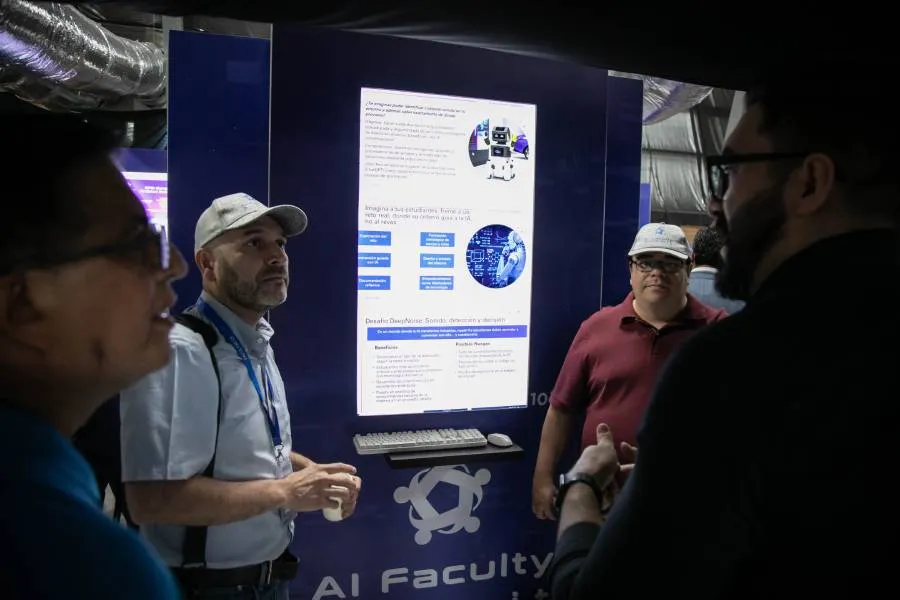
Moreover, one of the biggest challenges of any innovation strategy is moving from isolated pilots to transformation. To this end, Tecnológico de Monterrey has implemented mechanisms to convert teaching experimentation into organizational learning. The clearest example is the AI Faculty Summit, where hundreds of professors from various institutions work intensively on the design, implementation, and evaluation of AI integration projects within specific disciplinary contexts.
More than just another AI event, the Summit serves as an annual framework for guided experimentation in which, for several days, teachers design projects focused on priority institutional challenges, then explain how they will implement these proposals in their courses, document results, and share their learning with the academic community. The Summit has grown from 190 participants to more than 370, and is projected to reach 600 in 2026.
However, its main value lies not in the number of attendees but in the institutional use of the results. As Hidrogo describes, “We are not talking about an experimentation that stays in the classroom and that a teacher carried out simply to mobilize. It all speaks about the possibility of having information and data to make future decisions in the school.”
At a time when many universities are still considering which AI tools to implement, Tecnológico de Monterrey raises a different question: What type of institution needs to be built to integrate this technology meaningfully?
The institution answers that artificial intelligence alone does not transform education. It is not enough to offer access to platforms, allow isolated experimentation, or incorporate courses on new technologies. Transformation requires governance structures, a shared institutional vision, coordination mechanisms, and the ability to translate local innovation into systemic change.
In the words of Hidrogo, “The great differentiator is that we do not think about testing technological tools, but about how artificial intelligence is transforming the world and how we can approach it with a broad institutional vision.”
Perhaps one of the most relevant lessons is that artificial intelligence is not integrated by buying tools; its integration requires building the institutional capacity to decide, coordinate, and transform with these, because a university’s true competitive advantage is not in the first tool it adopts, but in its ability to adapt, learn, and evolve with intention.
In the end, Tecnológico de Monterrey’s commitment suggests that the challenge of AI in education is not technological, but organizational. The main question is not which app to integrate, but what structures, processes, and capabilities the institution needs to develop to respond strategically to an ever-changing environment.
Especially because the platforms and ways of applying AI today may not look the same in four or ten years, universities must create the conditions to learn, adapt, and continuously redesign themselves in the face of this scenario.
In this sense, perhaps the most relevant strategic lesson does not lie in TECgpt, AI Foundations, or the AI Faculty Summit separately, but in the decision to address AI as a matter of institutional transformation rather than merely technological innovation. Because when a technology has the potential to change what is taught, how it is taught, and why it is taught, the real question ceases to be how to integrate it into the classroom; it becomes how to redesign the entire institution to coexist with it.
As Irving Hidrogo summarizes, “The great differentiator is that we stop thinking about testing technological tools, but instead consider how artificial intelligence is transforming the world and how we can address it with a broad institutional vision.”
Translated by Daniel Wetta