

For many years, I asked myself a question that, over time, I came to understand was insufficient: how to innovate in education? I listened in forums about this, discussed it in academic spaces, and worked on innovations across various institutional projects. However, the more I advanced in this field, the more evident it became that the problem was not the lack of answers but the way we posed the question. In this article, I propose considering educational innovation through four interconnected dimensions that help us understand what constitutes a truly transformational learning model: the what, the how, the with what, and the why of teaching. Beyond a conceptual reflection, this text describes how these four dimensions can materialize in a primary-level educational model that intentionally articulates them, showing that integral education is not an aspiration but a possible practice.
When we talk about educational innovation, it is common to focus on “how to innovate” without realizing that reducing it to methodologies, tools, or technologies can be superficial. In my experience, one reason for the myopic focus is that solving the “how” is usually the most visible, the most immediate, and, in many cases, the easiest to identify as an innovation. New tools, platforms, artificial intelligence, active methodologies, or emerging pedagogical trends quickly capture our attention because they represent tangible changes. It is much easier to incorporate a technological tool or modify a class activity than to rethink the entire educational purpose. However, when innovation is considered only from the perspective of “how,” it results in a fragmented experience.
On the other hand, it is also true that integral educational innovation poses a greater challenge, since it requires time, articulation, curriculum design, teacher training, and an institutional vision capable of coherently connecting multiple dimensions of learning. The four dimensions I propose in this article allow us to broaden our vision, reflect on, and respond to questions that lead us to generate deeper change. For example, is what we teach still relevant to today’s world and to the lives our students will lead? Do learning experiences really connect with learners’ interests, emotions, and contexts? Do the environments, resources, and educational spaces favor exploration, experimentation, and creation? Or does learning have a purpose that transcends the classroom and generates an impact on others? These questions remind us that educational innovation is not about incorporating something new but about rethinking everything that gives learning its meaning. For this reason, the real transformation occurs when we decide to question the entire system: what we teach, how we teach it, with what we do it, and, above all, for what (purpose) we educate.
Four dimensions that transform education and learning
More than fifteen years of promoting educational innovation projects have shown me that when these four dimensions are not aligned, any attempt at change ends up being partial. We could end up incorporating active but meaningless methodologies, using new technologies in the classroom without a clear purpose, or teaching content that is disconnected from the environment and students’ lives. In fact, various international organizations warn that many educational innovations fail because they focus on isolated interventions rather than systemic transformations (OECD, 2023; UNESCO, 2021). However, when these four decisions are articulated coherently, learning gains additional depth and relevance.
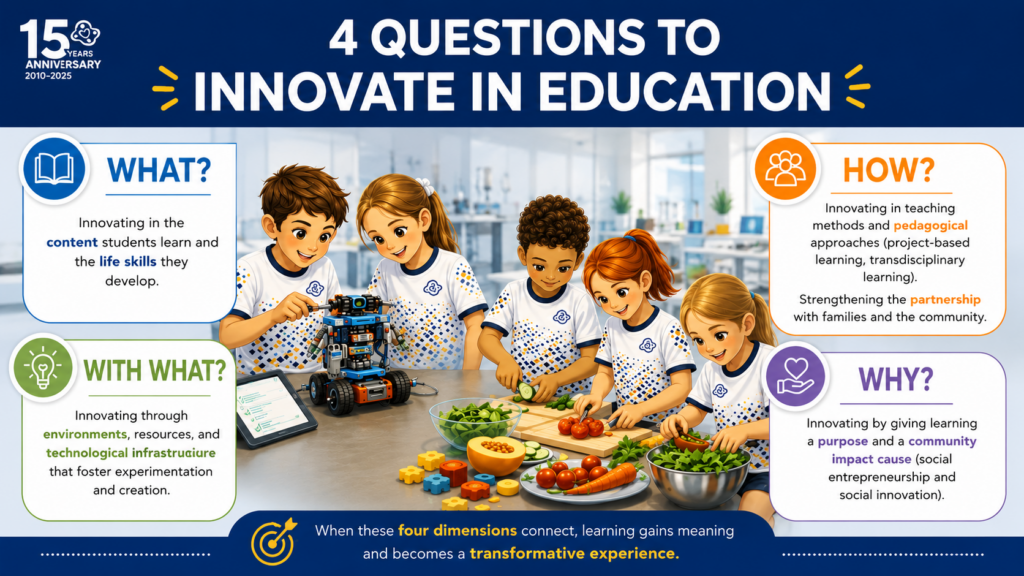
What to teach?
For a long time, school curricula have focused on transmitting disciplinary content, based on the logic that mastering information is equivalent to being prepared for the future. However, today we know that this is insufficient in a context where knowledge is continually evolving, and human skills are becoming increasingly valuable (World Economic Forum, 2025). The question is no longer how much content we cover, but what skills we are developing in our learners.
The development of life skills is not treated as a complementary component in a truly integral educational model, but rather as a structural part of the curriculum. It manifests in the formal incorporation of enriched environments and specialized spaces that accompany students from the early years through high school: nutrition, art, music, physical activity, science, robotics, finance, digital citizenship, and socio-emotional education. Each of these is taught by professionals in their fields, allowing students to engage in deep, authentic learning.
Thus, in practice, the student not only acquires knowledge but also develops habits, criteria, and ways of relating to the world. They learn to care for their bodies and health, to express themselves, to solve problems and understand the world, to interact critically with technology, and to recognize and manage their emotions. This approach addresses the need to train people capable of navigating complex and uncertain environments, as raised in recent discussions on the future of education (Quintero, 2019). Educational innovation also involves deciding what learning should be prioritized for the lives students will face.
How to teach?
The “how” is the dimension where many innovative proposals focus, though not always with sufficient depth. It is not enough to adopt project-based learning as a label; it is necessary to understand its logic and design it with pedagogical intentionality.
In this model, the process begins with the class’s genuine interest. Their interest does not replace the curriculum but serves as the axis that articulates the expected learning. For example, when a class of students shows a particular interest in the World Cup, both teachers and specialists build a transdisciplinary experience that connects content from different areas: statistical analysis of results, geographical and cultural understanding of the participating countries, the study of physical principles of movement, reflection on social phenomena linked to the sport, and development of communication skills, to mention a few.
This process is not an improvisation. It requires a teaching mediation that ensures the expected learning is developed while students remain connected to a topic that is meaningful to them. Transdisciplinarity ceases to be abstract and becomes a concrete experience where knowledge is articulated for a shared purpose.
The project intentionally evolves into an application that transcends the classroom. The students, accompanied by their teachers, design a product or service for their project, considering real-world variables such as costs, production, communication, and utility. This process culminates in a social entrepreneurship experience (a community event managed by the institution) that is not simulated but has a positive impact on the surrounding environment.
Simultaneously, the school establishes formal dialogue with families through the Academy for the Family, an initiative organized to address issues of learning, development, and upbringing. This space is not just informative; it also provides training and accompaniment to align parents and guardians in the educational process, laying the foundations for genuine co-responsibility in the integral formation of each student. Thus, transforming how we teach means going far beyond a methodology: it means building real-world experiences that genuinely interest students and fostering co-responsibility between school and family.
Teaching with what?
The third dimension, teaching “with what,” introduces an element that has historically been undervalued: the environment. Learning environments are not neutral; they directly influence how students interact, explore, experiment, and construct knowledge. Research on enriched environments has highlighted its impact on students’ cognitive and emotional development, reinforcing the importance of contextual designs that favor experimentation and curiosity.
In this sense, the classroom ceases to be a rigid space and becomes a flexible environment that adapts to the class’s dynamics. The infrastructure is complemented by specialized laboratories – such as maker spaces – where students prototype the ideas behind the projects they participate in, test solutions, make mistakes, and try again as a natural part of the learning process. In these spaces, ideas cease to be abstract and become tangible, continuously improving. Thus, they experiment in areas such as nutrition, art, music, physical activity, science, robotics, finance, socio-emotional education, and digital citizenship, guided by active, iterative, and deeply formative logic.
Likewise, enriched and specialized spaces are essential components of integral development, acknowledging that learning entails the care of the body, mind, and environment, as well as the expression and construction of identity. In this sense, environmental spaces cease to be just infrastructure and become an active part of the educational experience.
Why teach?
This whole system finally comes together and makes sense in the fourth dimension: the “what for” (the reason). Here, education ceases to be a process of accumulating knowledge and becomes an experience with purpose.
Each project developed throughout the school year culminates in a structured social entrepreneurship exercise in which students from all school grades, from primary to secondary levels, participate in projects and experiences aligned with their stage of development. To do this, the educational institution allocates seed capital to each class, enabling students to develop their product or service in line with real production needs. During the entrepreneurship fair attended by families and community members, students present their proposals, recoup their initial investment, and generate profits. These profits then flow to a previously defined social, environmental, cultural, or inclusivity cause.
This process allows students to understand the connection between knowledge, action, and impact through experience. It is not a pedagogical simulation but a real experience in which they make decisions, face challenges, and observe the consequences of their actions. At that moment, learning ceases to be an academic requirement and becomes a tool for positively transforming the environment around them.
These four dimensions remind us that educational innovation is not about incorporating something new but about rethinking everything that gives learning its meaning. Probably, some educational institutions have advanced more in some dimensions than in others, according to their vision, priorities, possibilities, or educational philosophy, which is also part of the transformation process. However, truly integral innovation does not occur by strengthening one of these elements in isolation; we must connect what we teach, how it is learned, the environments and resources that accompany the educational experience, and the human and social purpose that gives meaning to the entire process.
A real educational experience that integrates the four dimensions
At the Docet Institute, these four dimensions are intentionally articulated within the educational model. For example, during September-June 2026, students in the 3rd year of primary school developed a project based on their interest in a sport and their understanding of how physical well-being influences people’s lives. This concern led the teachers to connect the class’s interests with the expected learning in social and natural sciences, food, emotions, and healthy lifestyle habits. The project integrated science, nutrition, and human development into a transdisciplinary approach, providing students with a contextualized and meaningful experience.
Their learning is formed through a project-based approach. During the process, the students met the team “Blindados,” comprised of visually impaired people who play soccer competitively. This meeting prompted the class to reflect on inclusion, effort, resilience, and the importance of sports as opportunities for personal and community development. From this, they developed “Granola 3000,” a food product intended to support healthy habits among high-performance athletes. In the Nutrition Lab, they experimented with ingredients, analyzed options, conducted tests, and adjusted recipes. They made decisions about costs, production, and product presentation, thereby developing life skills such as collaboration, creativity, resource management, and problem-solving.
Finally, the project culminated in a real exercise in social entrepreneurship, hand in hand with the Somos el Cambio (We Are Change) Foundation. During the entrepreneurship fair, the students marketed their products to raise funds for the “Blindados” team’s out-of-state sports competitions. At that time, learning ceased to feel like an isolated school activity. It became an experience with a purpose, in which science, nutrition, entrepreneurship, inclusion, and social transformation were no longer treated as separate subjects but were integrated into a single educational process.
Reflection
After years of participating in various educational innovation efforts, I have come to understand that transforming education must go beyond incorporating new methodologies or technologies and achieve coherence among pedagogical decisions, learning environments, the experiences of the student community, and the formative purpose that guides the entire process. When these dimensions are articulated, learning ceases to feel fragmented and begins to take on meaning for those who experience it.
True educational innovation does not lie in doing different things in isolation; rather, it ensures that all the decisions that shape it align. This direction, today more than ever, requires training people capable not only of adapting to the world, but of transforming it.
About the Author
Eliud Quintero Rodríguez (eliud.quintero@gmail.com) holds a PhD in Educational Innovation. He was National Director of the Educational Innovation Program at Tecnológico de Monterrey and is currently CEO of the Docet Institute. He has more than 15 years of experience promoting educational transformation projects at different educational levels.
References
OECD (2023). Future of Education and Skills 2030/2040: OECD Learning Compass. OECD Publishing.
Quintero, E. (2019). How to prepare professionals for uncertainty? Observatory of Educational Innovation.
UNESCO (2021). Reimagining our futures together: A new social contract for education.
World Economic Forum. (2025). The Future of Jobs Report 2025.
Editing
Edited by Rubí Román (rubi.roman@tec.mx) – Editor of the Edu bits articles and producer of The Observatory webinars – «Learning that inspires» – Observatory of the Institute for the Future of Education at Tec de Monterrey.
Translation
Daniel Wetta