

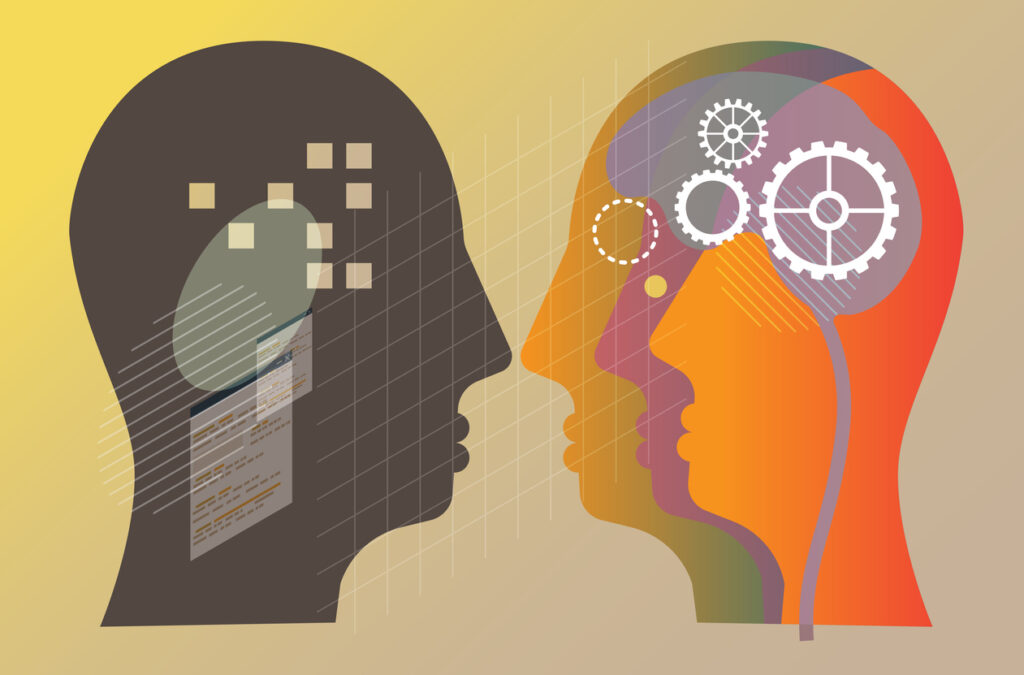
Two university graduates begin their first day of work in a company. Both use similar digital tools. They know how to search for information fast, automate tasks, use artificial intelligence, and deliver technically suitable products in a professional environment. During the second week of work, a project involving several people pops up; the information available is incomplete, and decisions must be made under pressure and quickly.
The first graduate opens software, uses templates, analyzes the data, and generates results in a short time. However, when asked why he chose that path and how it would affect the people involved, he cannot explain with certainty.
The second graduate reflects before acting, talks with the people involved, understands that the data does not come only from an information system but also from people, analyzes the information available in different sources, reviews alternatives, and tries to understand the implications of choosing one path over the other for those involved. When he finally explains his reasoning and decides, he does so knowing that the choice has consequences and that he will have to take responsibility because it will impact the lives of others.
Balance between technological development and human training
The use of digital tools helps students to advance quickly and access large volumes of information efficiently. However, how appropriate is it to focus university education on technologies that continuously change or become obsolete in a short time? This question is increasingly addressed in academic literature in response to a broader need for a balance between technical development and human training.
This idea has been discussed in highly specialized forums such as the International Conference on Advances in Artificial Intelligence and Machine Learning (AAIML 2026) in Tokyo, Japan. The general vision of that congress looked not only at issues of technological development, but rather at how we should guide reflection towards ethical, social, and people-centered issues. A shared concern is beginning to consolidate: technological progress should be accompanied by social responsibility and human training.
Using technology is not the same as having professional judgment
Students now pursuing a university degree grew up in decades in which technology was already part of their daily life in communication, entertainment, and access to information. Thus, they are comfortable in digital environments, learn to use various platforms, and solve tasks using technological tools with relative ease. However, this familiarity with technology does not automatically come with the necessary judgment to use it responsibly within professional contexts or to understand the implications of the actions taken with its use. In other words, knowing how to use technology is not the same as knowing how to make decisions with it.
This difference becomes visible when people are faced with situations in which technology alone does not offer clear answers, as is often the case in the complex environments that constitute professional reality. Thus, students face the challenges described below, which require attention.
Situations where technology alone does not provide clear answers
- When it is unknown if the information is reliable
The first difficulty has to do with the students’ ability to evaluate the quality of the knowledge they use. Today, digital tools can generate compelling reports, complex visualizations, or well-structured texts in a matter of seconds. However, the appearance of accuracy does not necessarily mean that the information is correct or that it can be easily verified.
In different educational contexts, it is increasingly common to find academic works that, although well presented from a technical point of view, include citations of studies that do not exist, mix sources without clarity about their origin, or interpret statistical correlations as if they were causal relationships. When asked to review where the information comes from or explain how a certain result was obtained, the student often fails to reconstruct the process that led to the conclusions clearly.
This situation highlights that the problem is not only technological, but also the ability to question the available evidence, verify sources, and understand the assumptions behind the models or systems that generate the information (Oxford University Press, 2023).
- When a decision must be explained and defended
This difficulty arises when the results produced by technological tools must be explained to other people.
In many professional environments, it is not enough to present a correct analysis or show that a tool works properly. Decisions made based on that information need to be communicated, justified, and, in some cases, defended for people who don’t necessarily share the same technical language or the same way of interpreting data.
This requires skills that go beyond the use of digital tools. It involves being able to clearly explain the criteria used, show what alternatives were considered before making a decision, recognize the limits of the available information, and take responsibility for the consequences of a proposal.
When these capacities are not strengthened during university education, students may be able to produce technically correct results, but face difficulties when asked to explain why they chose a certain solution and what effects it could have in the context where it is applied.
Are students able to build a complete narrative thread about their decision-making process from an analysis carried out with digital tools?
- When a technology decision affects other people
A third difficulty arises when technology-based decisions are applied in real contexts without sufficiently careful consideration of their human consequences.
Losing sight of the fact that data comes from people and that the decisions derived from them also impact people is a serious mistake that can arise when professional practice is disconnected from its fundamental purpose. In the university environment, it is essential to remember that professionals are trained to address real problems; therefore, their actions must always be based on the understanding of the complex environments in which they will have to intervene.
Thus, training should not only concern technical performance or the efficient use of a system, but also who assumes responsibility for the decisions made based on it and what criteria are used to evaluate their effects on people.
According to UNESCO (2021), one of the most important challenges for artificial intelligence education is precisely to train professionals capable of analyzing the social impact of the technologies they use or develop and, above all, taking responsibility for the consequences of the decisions that derive from their use.
The need for human skills training
In this scenario, a question arises that the university cannot avoid. If many technical tasks can be automated or carried out by digital systems, but with the risk of failing to produce the expected educational outcomes, what competencies should be at the heart of professional education to address possible biases or limited uses of technology?
Answering this question implies recognizing that the value of higher education should not be limited to teaching the use of technological tools. Its main contribution is to train professionals capable of understanding complex problems, engaging in dialogue with others before making decisions, and acting based on clear reasons, while also considering the possible consequences of their decisions (UNESCO, 2023).
It is important to emphasize that more than competing with technology, the educational challenge consists of training professionals capable of guiding its use with criteria, responsibility, and social awareness. Thus, there are at least five competencies that are particularly important and that have been highlighted in various studies on the impact of artificial intelligence on education and professional development (Holmes et al., 2019; Luckin et al., 2016).
- Ethical judgment and social responsibility. In any profession, technical decisions have consequences for individuals and communities. Therefore, the educational challenge is not only to teach how to solve problems, but also to help recognize dilemmas, evaluate alternatives, and take responsibility for the decisions made.
- Understand complex problems. Many of the contemporary challenges, from climate change to digital transformation, cannot be understood from a single discipline or solved with simple answers. Forming a multi-disciplinary view implies helping students to recognize interdependencies, anticipate indirect effects, and understand that technical solutions also have social and cultural implications.
- Creativity when there are real limits. Artificial intelligence tools can generate multiple ideas in a few seconds, but professional creativity involves something more demanding. It involves assessing the feasibility of proposals, adapting them to specific contexts, and developing solutions under time limits, with limited resources, and under regulatory obligations.
- Professional collaboration and communication. Contemporary projects are rarely developed individually. They require teams with different profiles, capable of dialogue, who can translate technical languages and forge agreements between people with different perspectives.
- Ability to learn continuously. In an environment where knowledge changes rapidly, one of the most valuable skills is setting information memorization aside, reviewing what is known, recognizing what remains to be learned, and adjusting strategies when conditions change (UNESCO, 2023).
These competencies are not a substitute for technical training. On the contrary, they complement and guide it. Technology can expand what a person is capable of doing, but professional criteria determine how, when, and what to use it for.
Learning based on real problems
How can the competencies discussed above be developed within the daily university experience? In various courses and training projects, we have explored a pedagogical strategy to integrate technical learning and ethical and social reflection in the posing of authentic challenges.
An authentic challenge is a learning experience based on real problems, with real actors and restrictions that force students to make justified decisions. Unlike simulated tasks, which are usually solved in the classroom, an authentic experience puts students in situations in which technical knowledge must be applied, considering its impact on specific social contexts.
One of the initiatives applying this approach is the SEL4C (Social Entrepreneurship Learning for Complexity) methodology, developed at Tecnológico de Monterrey. The purpose of this initiative is to promote the development of complex thinking and social entrepreneurship skills through educational experiences that connect academic training with real-world challenges.
In these experiences, students begin by identifying a specific problem in their community or in their life context. From there, they conduct field research, talk to people involved in the situation, and analyze information that allows them to delve into the problem they want to address. Then, having made a diagnosis, they develop alternative solutions, evaluating their technical feasibility, yes, but also their possible social and ethical consequences.
During this process, technology plays a supporting role within learning. In the initial phase, for example, teams might use collaborative mapping tools such as Miro to visually organize information, identify stakeholders, and map associations between different problem elements. Later, in the validation stage, they use artificial intelligence tools to compare proposals, simulate an external expert’s judgment, or test the strength of an argument. In these cases, technology does not replace human analysis; rather, it broadens reflection and strengthens the justification of decisions.
In this way, learning focuses not only on technological use but on the ability to argue for the decisions made throughout the project. The teams must explain the alternatives they considered, the assessment criteria used to evaluate them, and why they moved forward with one proposal over others (even though sometimes the most rational proposal is not the one chosen).
Subsequently, they develop prototypes and present them to people who are part of the problem context, which allows them to test the initial ideas within reality and adjust the proposed solutions based on the feedback they receive.
One of the most frequent lessons in this type of project is that technology does not solve complex problems. Digital tools facilitate the analysis of information and support the generation of different alternatives. Still, human judgment allows us to interpret the results, consider their implications, and make responsible decisions coming from people for people.
Thus, the authentic challenges function as a pedagogical space where the use of technology is combined with the development of professional judgment, the understanding of complex problems, and social responsibility, allowing university education to come closer to the real conditions under which future professionals will make decisions with competencies beyond the digital tools they know how to use.
Reflection
Integrating humanistic approaches into university education does not mean abandoning technical training or downplaying its importance. It means, rather, orienting it towards its original purpose: to solve real problems to improve people’s lives.
When the university achieves that its students learn to do things and understand why they do them and whom their decisions may affect, then education fulfills one of its most important functions: to train professionals capable of acting with humaneness in increasingly complex contexts.
To achieve this purpose, no major structural reforms or the creation of new curricula are required. The adoption of training based on real challenges can be integrated gradually, with small changes in teaching practice.
A first step may be to pose some academic activities as challenges linked to real problems with actors in the social or professional environment. When learning is connected to situations that exist outside the classroom, students begin to understand that technical decisions do not occur in the abstract and have concrete consequences for people.
Another possible change has to do with how learning is assessed. Rather than focusing solely on the result of a task or project, it is important to pay attention to the decision-making process. Asking students to explain the criteria they used, describe the alternatives they considered, or reflect on what they learned during the process spotlights their development of critical thinking and professional judgment.
It is also valuable to facilitate opportunities for cross-discipline dialogue, where technical and humanistic perspectives can come together to analyze complex problems from different angles. When these conversations are incorporated into the educational experience, students begin to comprehend that contemporary challenges can rarely be understood from a single field of knowledge.
In the end, the current educational challenge is not to choose between technology and humanity, but to integrate them intentionally and responsibly into training processes. Only in this way can we prepare new generations to use technology with critical judgment and a human touch to build more just and more sustainable societies.
About the Author
Dr. José Carlos Vázquez Parra (jcvazquezp@tec.mx) is a PhD in Humanistic Studies and a PhD candidate in Psychology. Currently, he is a professor at the School of Humanities and Education at the Tecnológico de Monterrey, Guadalajara Campus. He has participated in multiple congresses and colloquia and has been invited to give lectures and workshops at several national and international universities in Europe, Asia, and Latin America. He is a Level 2 member of the National System of Researchers of Mexico.
References
Holmes, W., Bialik, M., & Fadel, C. (2019). Artificial intelligence in education: Promises and implications for teaching and learning. Center for Curriculum Redesign.
Luckin, R., Holmes, W., Griffiths, M., & Forcier, L. B. (2016). Intelligence Unleashed: An argument for AI in education. Pearson Education.
Oxford University Press. (2023, October 18). AI in education: Where we are and what happens next. https://corp.oup.com/feature/ai-in-education-where-we-are-and-what-happens-next/
UNESCO. (2021). AI and education: Guidance for policy-makers. UNESCO Publishing. https://unesdoc.unesco.org/ark:/48223/pf0000376709
UNESCO. (2023). Guidance for generative AI in education and research. UNESCO Publishing. https://unesdoc.unesco.org/ark:/48223/pf0000386693
Edition
Edited by Rubí Román (rubi.roman@tec.mx) – Editor of the Edu bits articles and producer of the Observatory’s Webinars – “Learning that inspires” – Observatory of the Institute for the Future of Education of Tec de Monterrey