

Throughout history, technological advances have enabled us to enjoy the benefits of modern life, including transportation, digital technologies, and food engineering. However, this flourishing also led to an obesity pandemic that has changed the state of our physical health, and, to date, efforts are still underway to contain it. Counter effects are the flip side of progress. Over time, we have learned that attention to our diet, exercising, sleeping well, and leading a healthy life are essential for our physical well-being.
Similarly, the advancing development of generative artificial intelligence (AI Gen) introduces a new form of cognitive delegation that can displace intellectual processes that were previously part of learning. Thus, this analogy emerges: If the brain can be nourished like the body, why not create a “cognitive diet” that translates the intellectual discharge involved in the use of AI and transfers that energy to processes that require us to enhance our human intelligence? In this article, I share a proposal for a cognitive label, like the nutritional labels of foods, that would indicate the cognitive expenditure of a school subject’s activity at any educational level.
A Cognitive Nutrition Label for the Mind
This cognitive label is a pedagogical tool inspired by food nutrition labels. Just as those inscriptions allow us to understand a product’s nutrients and whether it contributes to a balanced diet, the cognitive nutrition label lets us know the thinking an educational activity requires and the intellectual value it brings to the student. The cognitive label indicates the mental effort applied using AI in a classroom activity. It helps us to 1) make evident the value of what students will learn, 2) raise awareness about how we “feed” our brains when using AI, and 3) better decide on pedagogical aspects in class using new artificial intelligence technologies.
My proposal seeks to promote the healthy use of new AI technologies in education, preserving our agency and the development of human capacities such as critical analysis, interpretation, creativity, and foresight. This will help us achieve higher purposes as human beings.
The cognitive label I designed, called StoryQ-AI, lets us analyze the role technology plays in the learning process by evaluating four fundamental aspects:
- Level of artificial intelligence intervention
Indicates which part of the process was carried out by AI and which by the student. This makes it possible to distinguish between mechanical delegation and intellectual participation. - Type of cognitive offloading
Every technology produces a certain amount of cognitive offload; that is, it frees the brain from repetitive or mechanical tasks. The label allows us to identify whether this offload impoverishes learning or, on the contrary, frees up mental resources for more complex operations. - Cognitive value of the activity
This value indicates whether the activity promotes analysis, synthesis, interpretation, creativity, or prospective thinking. In this way, the focus shifts from the result to the intellectual process that the student develops. - The student’s AI strategy
The label component allows us to recognize the type of relationship the student establishes with the technology. For example, they might apply it only as an efficiency tool, as support to deepen an analysis, or as a critical interlocutor that challenges their ideas.
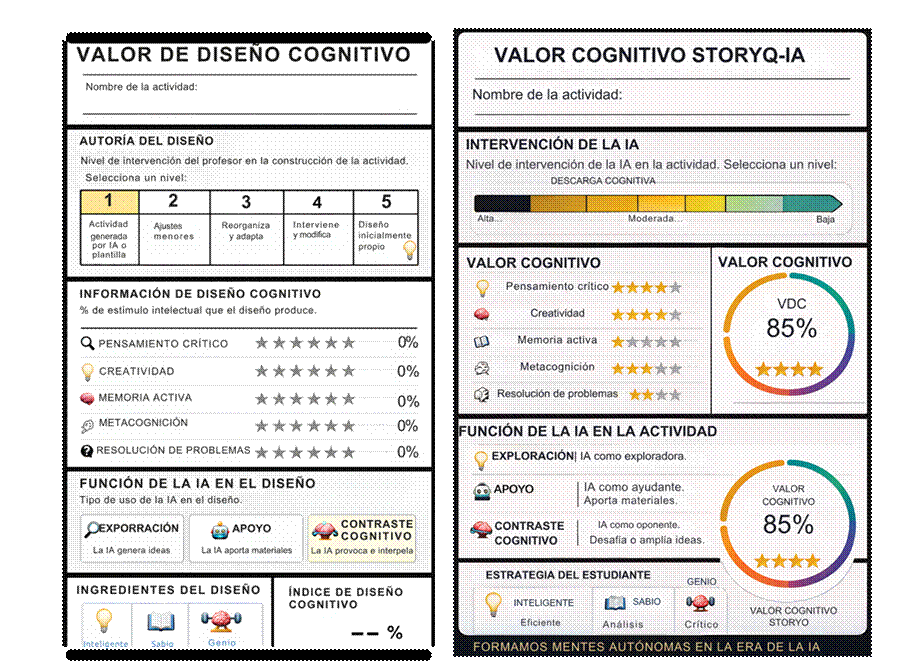
Figure 1 presents the structure of the teacher’s cognitive label (left) for the development of educational materials, and the students’ cognitive label (right) for the activities they carry out. The label’s design highlights the distribution of mental load in activities mediated by artificial intelligence. The instrument articulates five dimensions: 1) tool intervention, 2) cognitive download, 3) cognitive value, 4) AI function, and 5) student strategy. Its purpose is not to measure performance in traditional terms, but to identify the type of relationship established between the subject and the system, as well as the cognitive operations activated during the process.
Student’s AI strategy
One of the StoryQ-AI cognitive label’s contributionsis that it operates as an instrument of pedagogical persuasion rather than control. It seeks to spotlight the path chosen by the student and the resulting cognitive value. Three strategy categories are proposed, understood as heuristic typologies of use and not as a psychometric hierarchy:
- Intelligent (efficient use). The student uses artificial intelligence to optimize tasks and speed up processes without losing comprehension or the preservation of meaning.
- Wise (analytical use). This describes a reflexive use in which the tool serves to contrast ideas, broaden perspectives, and sustain a critical dialogue with the information generated.
- Genius (creative use). AI becomes a source of friction or a conversational partner to produce original ideas, unexpected re-interpretations, or prospective projections.
These categories function as elective modes of execution. The premise of the proposal is that the student’s thought process should be more complex than the delegated task; that is, it operates as a guiding criterion for cognitive sovereignty.
StoryQ-AI pedagogical proposal
StoryQ-AI is a pedagogical proposal to strengthen the student’s cognitive sovereignty. Here, cognitive sovereignty is the ability to sustain one’s judgment, understand the thinking that a tool promotes or replaces, and consciously choose forms of interaction with artificial intelligence that favor the elaboration of meaning.
From this perspective, AI emerges as a testing ground that forces pedagogical decisions into the open: for example, which tasks are best delegated, which require substantive human intervention, and what kind of teaching mediation can transform technical efficiency into a training opportunity.
The central shift of this proposal is to move attention from the product to the process. It becomes necessary to examine the cognitive journey: what the student analyzed, what they understood, what they verified, what they imagined, and how they used the tool in relation to their thinking. This shift requires rethinking the unit of analysis of writing as a dialogic journey: a sequence of iterations that articulates intention, formulation, system response, critical reading, friction, reformulation, and synthesis.
StoryQ-AI Taxonomy of Human Thought
The starting point for this proposal is the SQ = IQ + EQ equation proposed by Richard Stone and Scott Livengoode in the book Story Intelligence: Master Story, Master Life. Here, storytelling is understoodas an articulation between cognitive intelligence and emotional intelligence, conferring the ability to narrate human experience as the solid foundation for a life of well-being. If we think about it carefully, how we tell ourselves about our life and make it either a meaningful journey or an inescapable abyss depends on the reason and emotion we invest in telling ourselves our story and those of others.
This formulation recognizes that the ability to tell, understand, and connect stories depends not only on logical reasoning, but also on emotion, empathy, and the construction of meaning. In this framework, narrating implies ordering experience, linking memory and affect, and transforming dispersed information into a meaningful sequence. My proposal expands the original equation in the following terms:
StoryQ = N (IQ + EQ + II + PA)
The expanded equation translates into the following functional taxonomy for examining cognitive operations in practice:
- StoryQ – This is the ability to tell one’s life in resilient ways to survive adversity. It means recomposing and adapting personal, work, professional, or social history so that we are susceptible to adapting to changing reality.
- N – Represents narrative intelligence, that is, the ability to organize human experience into stories that offer meaning, connect scattered information, and project futures. Four dimensions of human intelligence operate in this narrative architecture:
- IQ – Analytical intelligence. It allows understanding information, establishing logical relationships, and solving problems.
- EQ – Emotional and relational intelligence. It makes it possible to understand others, cooperate, and build shared meaning.
- II – Intellectual immunity. This is the ability to detect biases, question automatic responses, and maintain critical thinking in the face of algorithmic systems.
- PA – Prospective anticipation. This is the ability to imagine future scenarios, evaluate consequences, and integrate critical thinking with action-oriented imagination.
The expanded equation does not replace the previous formulation, but critically extends it. Its contribution consists of incorporating two dimensions that are indispensable today. The first is intellectual immunity, understood as the ability to question automatic responses, compare perspectives, verify information, and resist narrative frameworks imposed by algorithmic systems. The second is prospective anticipation, which is the ability to imagine future scenarios, evaluate consequences, and combine critical thinking and action-oriented imagination.
Reflection
With the emergence of tools capable of simulating human production in texts, images, or music, the temptation to avoid the “friction” of thought and delegate our cognition is immense. However, responding with a punitive academic audit only erodes trust.
The true path lies in awareness: a cognitive label that makes effort transparent and returns to the student the responsibility for their intellectual process.
StoryQ-AI is the evolution of storytelling as a pedagogical device. By integrating intellectual immunity and prospective anticipation, this model offers a grammar to sustain independent judgment and authorship in the face of generative systems.
The central contribution of this proposal is to displace the educational question: it is no longer a question of what the machine can do, but of what human thought must continue doing to build a future in which our intelligence and well-being are not replaceable. In this new scenario, narrative recovers its most sacred function: to organize experience, preserve meaning, and project possible futures with full sovereignty.
About the Author
Regina Freyman (regina.freyman@tec.mx) is a teacher who navigates between books and algorithms, convinced that the future of education lies at the intersection of the humanities and technology. Her hybrid training – a degree in Hispanic Language and Literature from the UNAM, a degree in Advertising from the CECC, and a Master’s degree in Literary Criticism from the Ibero – reflects her long-standing interest in shaping a new way of thinking.
Edition
Edited by Rubí Román (rubi.roman@tec.mx) – Editor of the Edu bits articles and Producer of the Observatory’s Webinars – “Learning that inspires” – Observatory of the Institute for the Future of Education of Tec de Monterrey.
Translation by Daniel Wetta