

“With the use of 360° immersive narrative videos, students present a real problem to raise awareness in their community, motivate action and improve their environment.”
Immersed in their problems and concerns, students can often be oblivious to their community and country’s problems without realizing that they play a crucial role in becoming positive change and influence agents. Therefore, we implemented challenge-based learning combined with virtual reality tools in class. We proposed that the students become creators of immersive 360-degree narrative videos to raise awareness in their community about a real problem, motivate them to action and improve their environment.
The students participated in the My World 360° Call, a global United Nations initiative on the Sustainable Development Goals (SDGs) through Digital Promise. The invitation is for all young people around the world to develop their digital skills, share their perspectives, and promote positive actions related to the 17 Sustainable Development Goals to end poverty, protect the planet, and ensure that all people enjoy peace and prosperity (Digital Promise Global, 2018).
This interdisciplinary project was carried out in the August-December 2019 semester in the Matter and the Environment, Citizen Ethical Commitment, and Computational Logical Thinking classes in the multicultural program of PrepaTec on the Morelia campus in Mexico. Students shot a narrative, 360-degree immersive video using immersive technologies. For this, they used Oculus VR and a Samsung Gear 360° camera. These are the most featured videos of 2019. The next call might be for the 2021 year due to the pandemic.
“In this project, students develop digital skills, share their perspectives and promote positive actions related to the 17 Sustainable Development Goals”.
To develop their project, the students focused on the water problem in Morelia, Michoacán, Mexico. They aligned it with the Sustainable Development Goals number 6, Clean Water and Sanitation, and number 12, Responsible Production and Consumption. As a first step, the students decided to use the design thinking methodology, which solves problems creatively and in innovative ways; its core characteristic is empathy. They subsequently generated their proposal using a research matrix called the CANVAS Digital Promise Matrix (Image 1). They brainstormed, selected the best, and defined the project’s objectives.
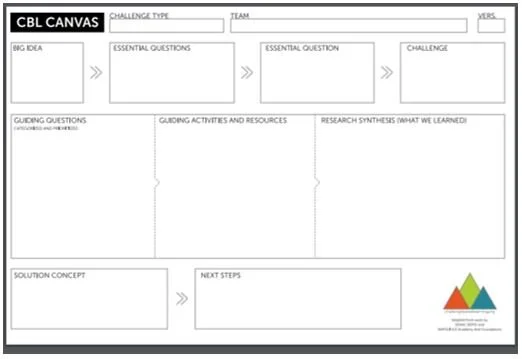
Image 1. CANVAS Digital Promise Matrix.
To ensure that the final product met the participation specifications, the students created a video production guide following the My World 360° Digital Promise call guidelines. To become familiar with the Gear 360° equipment, students worked on a Mini-Film, using it on an excursion to the ecotourism center of Yunuen Island on Lake Pátzcuaro in Michoacán, Mexico (Image 2). The island’s community organization operates the ecotourism center with absorption wells for water treatment, a reforestation project, and a facility for compost production for vegetable growth (Ortiz-Gómez 2012).

Image 2. Students on the Ucazanaztacua jetty off Yunuen Island (2019).
The students took various photos and videos of the place during the visit to Yunuen. They also practiced with the camera tripod, taking short, 20-second videos from different perspectives. Once back in the classroom, each team made sure to view their videos on the computer and extract them from the camera’s memory to begin using the Gear 360° software (previously downloaded to a laptop or tablet). After the editing was complete, the students uploaded the video to YouTube and made sure it could be seen correctly in the Virtual Reality viewers (Image 3). This process repeats several times.
Throughout the process, the teacher’s guidance in using the equipment and software was of paramount importance. One does not need to be a technology expert because both the computer and the software are incredibly intuitive and easy to use. The equipment used was the Gear 360° camera with the Gear 360° software from Samsung (downloaded for free). The Samsung VR viewers were bought thanks to the 2019 NOVUS Educational Innovation Fund of Tecnológico de Monterrey.
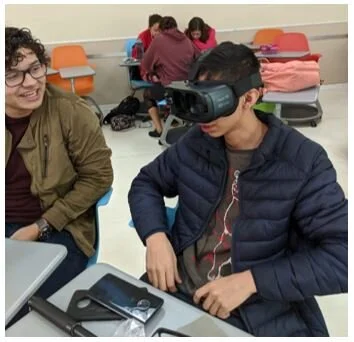
Image 3: Students in class reviewing their mini-video.
Results assessment
I applied a survey to the students before and after the project completion. Comparing the pre- and post-surveys results, we found that after having done this project, the students felt that they knew more about the problems of their community regarding the issues of water, and they stated that they were more interested and committed to this problem.
Through this project, we were able to boost citizen participation and improve the students’ comprehension of the global problems affecting their community. Also, they developed video production skills through the use of new 360-degree immersive video technologies. Although this project was carried out in a face-to-face class, I believe it can be achieved in the online modality that we have to use due to the COVID-19 pandemic. Students can record and edit audio or video, using 3D images obtained through Google Street View and Google Maps very easily, supported by the Google Tour Creator software and sharing their videos on YouTube or Vimeo. Sophisticated equipment such as the Gear 360° is not required; only a computer and an internet connection are necessary. The videos might not have the same quality. However, in the end, the goal is met because the students can create their narrative 360° narrative videos, exposing a real problem in their community and having the opportunity to share it with students from other organizations.
About the author
Arlette Audiffred Hinojosa (arlette.audiffred@itesm.mx) is a professor in the multicultural program of Prepa Tec, Morelia Campus. She teaches Chemistry and Social Entrepreneurship classes and also collaborates on educational innovation projects at TecnolÓgico de Monterrey.
Editing by Rubí Román (rubi.roman@tec.mx) – Observatory of Educational Innovation.
Translation by Daniel Wetta.