
“With the gradual return to the classroom, we now have the challenge of implementing practical activities in virtual and face-to-face classes.”
After twenty months of the pandemic, the gradual return to face-to-face attendance in the classroom is excellent news because we have missed very much the close and energetic contact that students give us. However, this transition also involves significant challenges. What strategies work in both modalities that we can use to achieve the best learning outcomes? In this article, we share our experiences.
Especially, a language class demands students’ dynamic, active, and continuous interactions to develop communicative competency, allowing them to express themselves spontaneously and accurately. During the pandemic, teachers had to learn technologies and educational strategies that better adapted to online classes. With the gradual return to the classroom, we now have the challenge of implementing practical activities in virtual and face-to-face classes. Below, we share five easily adaptable actions in both modalities.
“One child, one teacher, one book, one pen can change the world.”
– Malala Yousafzai
1. Create a cultural environment for the study of language.
A cultural environment nourishing the study of language helps students identify with the countries they are learning, generating a sense of community and group identity that motivates them to work together. For example, in a German class, in a playful, fun way, students can imagine that they are in “Little Germany”(Klein Deutschland). The teacher could be considered Chancellor Angela Merkel. Because they are in that tiny “territory” or environment, the rule is to use the German language in their interactions with the teacher and classmates.
The students and the teacher must review and establish group rules at the beginning of the course, including not using the native language in class. This condition gives students the possibility to improvise and be creative. We can invite them to propose their ideas if they comply with the rubric established.
A crucial element of an effective learning environment in the primary levels is to agree with the students to use only the structures seen in class and not resort to electronic translators. The use of electronic translators, although valuable, is not helpful in the basic levels because it prevents students from fully understanding the structures generated in their lessons. Thus, the students stop striving to generate sentences with their cognitive efforts.
2. Capitalize on previous knowledge
Drawing upon previous knowledge allows the student to build their learning. The teacher must use the study language and help with signs and cognates that are “transparent” both in the study language and the student’s native language. For example, suppose in the English class I am going to teach the concept of disease. In that case, I can say: “Coronavirus is an illness,” “Cancer is an illness,” or “Appendicitis is an illness.” I use words that the student knows in his language to explain what he does not know, i.e., the word for disease: illness. It is essential to start from what the student knows, activating previous knowledge to achieve a deep understanding of the concepts, as recommended by John Biggs, known for his contributions to innovative university teaching.
In the primary levels, students must understand in the class exercises that it is necessary to provide answers differently than they would in their native language. For example, let’s look at questions about age. In the everyday context, we know that if we are asked our age, “How old are you?” the answer is usually “15” or “30.” However, students should respond with complete sentences in the primary levels in class: “Wie alt bist du? (“How old are you?”) “Ich bin fünfzehn” (“I am 15 years old”). It is essential to reinforce grammatical structures but always based on their communicative function. It allows students to generate oral or written production in increasingly longer phrases and sentences, which subsequently help them to express themselves with greater confidence.
It is also important to encourage collaboration and attention. When a student contributes in class, we must make sure that others are listening:
Teacher: Frau Sánchez, wie alt sind Sie? (Srita. Sánchez, how old are you?)
Student 1: Ich bin 15 Jahre alt. (I am 15 years old.)
Teacher: Frau López, wie alt ist Sarah? (Srita. López, how old is Sarah?)
Student 2: Sie ist 15 Jahre alt. (She is 15 years old.)
In this example, we see three teaching opportunities in action: 1) active listening, 2) providing answers in different conjugations, and 3) culture. For the latter, in the case of learning German, it is helpful for students to know that in an everyday classroom situation in Germany or Austria, teachers will refer to them by their surname, given the formal context of the academic experience. It’s a cultural element that we can practice in class daily.
Using Zoom chat is especially useful for this activity. The teacher can question one student, and while he responds, another can write what the first said in the chatbox, either transcribing what he understood or reporting and changing the conjugation. It offers the opportunity to appeal to different learning styles, in this case, auditory and visual.
The roll call is an excellent time to review vocabulary, structures, and concepts covered in the previous class or ask students for synonyms or antonyms of terms studied. It is important to always refer to previous knowledge so that the student can gradually build their learning.
We must also make sure that we do not let a single class pass without everyone saying something. Keeping track in a notebook helps notice who has not participated; the student who failed to contribute something can be called upon in the next class. It is a strategy that consumes a lot of time. However, time is well invested because this practice reinforces knowledge and makes the student appreciate their class participation.
For this strategy to work at its best, it is essential to make a rule not to repeat what someone else has already said during this dynamic to ensure that they are paying attention. With this, we discourage “mental absenteeism” and prevent students from checking their WhatsApp or Facebook, instead of paying attention to what others are commentin
g on, emphasizing the value of active listening, essential for developing multicultural competency.
3. “Turn on your cameras!”
In classes conducted through Zoom or Skype, teachers must insist that the students keep the cameras on. According to a survey conducted by the European Center for Modern Languages, a sizable percentage of teachers said that students can “hide more easily in an online session, and, therefore, the weakest cannot progress.” It is clear the importance of asking students to have their cameras open, as this encourages attention. However, having the camera on is not enough. Teachers must be attentive to what the students are doing to realize we are aware of them and are interested in their presence in class. If a little brother passes behind them or a pet cross in front of the screen, you can make a friendly comment to the student so that he knows it is understandable that these things happen in online education. It even allows us to use spontaneous expressions like, “Is that your cat? It must want to learn English too!” These small interventions contribute to a relaxed and friendly atmosphere in the class. It lets the students see that we are paying attention to everything that happens. We must also ask questions at various times to know that they might be asked to participate at any moment.
4. Avoid the silent virtual classroom syndrome
One of the most frequent complaints of teachers during online classes is that when they ask a question, students do not participate. Several strategies work to counter this.
Ask students to put their names on the screen upon entering the session to identify them. It is essential to direct questions to each student using their name. Establish as a rule that they should always try to provide an answer, and it is irrelevant if they make mistakes. We can even teach them to say, “I’m not sure of the answer, but I can tell you that…” and they have the freedom to say whatever they wish. Let them know that responding “I don’t know” is never acceptable because there is always something to share, no matter how basic.
When correcting students, it is essential to do so tactfully to avoid making them feel unable to improve. For example, if a student makes many fundamental mistakes when speaking, praise his strengths first and recognize what he did well. It also works to ask another student to express what he understood the previous one said. Then, ask the student who initially made a mistake if that is what he meant so that he can have feedback and, if necessary, correct himself, seeing the impact or response of his peers to what he said. The feedback from peers fosters a sense of collaboration, improves the class environment, and provides opportunities to develop autonomy.
5. Reclaim the value of handwriting
Sometimes, for the cause of mastering technology, we rule out asking students to handwrite. However, writing on paper can improve performance in learning a new language. According to a study conducted by researchers at the University of California and Princeton, taking notes by hand activates the cerebral hippocampus, promotes better long-term learning, and increases response speed, essential for learning foreign languages.
On the Canvas platform, you can give feedback to students on their writings on paper, as shown below:
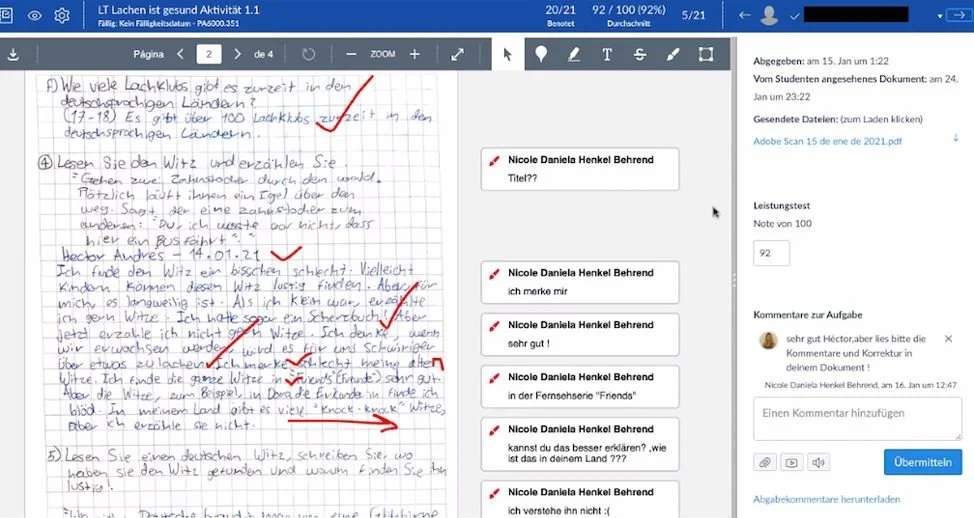
Image 1. Corrections to handwritten work using Canvas.
Online classes involve spending many hours in front of the computer; handwriting is a highly welcome change of stimulus for students.
Reflection
The pandemic has taught us many lessons, and we have acquired new skills. The challenges have motivated us to find more effective ways to reach students despite the distance. However, there are always effective strategies in any modality. As teachers, we must be open to renewing and enriching our practice, improving them contextually, and continuing to do what we are most passionate about, namely, training hundreds of young people every semester, preparing them for an increasingly multicultural environment.
About the Authors
Nicole Henkel is a teacher of German in the International Baccalaureate program of Prepa Tec CEGL (high school). She graduated with honors with a bachelor’s in computer systems from Tecnologico de Monterrey. Nicole is an examiner at the Vienna-based ÖSD for all levels of the Common European Framework of Reference for Languages, and she has been a curriculum designer of German courses for Prepa Tec at the system level of Tecnologico de Monterrey.
Carmen Benítez (benitez@tec.mx) is director of the Inter-Prepa Languages Department at Prepa Tec Monterrey. She obtained her master’s degree in Educational Technology at Tecnologico de Monterrey, jointly with the University of British Columbia (UBC). She graduated with honors in English Language and Literature from the Autonomous University of Chihuahua and is an International Baccalaureate examiner. Carmen has trained teachers and designed educational material for Prepa Tec and international organizations.
Edited by Rubí Román (rubi.roman@tec.mx) – Observatory of Educational Innovation.
Translation by Daniel Wetta.