
More than two-thirds of respondents to More in Common believe that debates are becoming more aggressive.
Historically, a debate has been a fundamental resource to work with two opposing ideas and determine the reasoning behind them or which has greater validity or significance. Politicians debate to present themselves as the best candidate; academicians debate to deliver solid knowledge and attain consensus; students debate to acquire self-confidence and emotional management in situations of disagreement. The usefulness of debate as a cognitive, communicative human exercise is evident.
However, external factors can influence the form and substance of argumentative practice and negatively impact the activity of the debate. In previous articles, we discussed how echo chambers and cognitive biases play an essential role in communicating and arguing with others. But what is the difference between the primary definition of debate and the meaning of debate today?
What is debate?
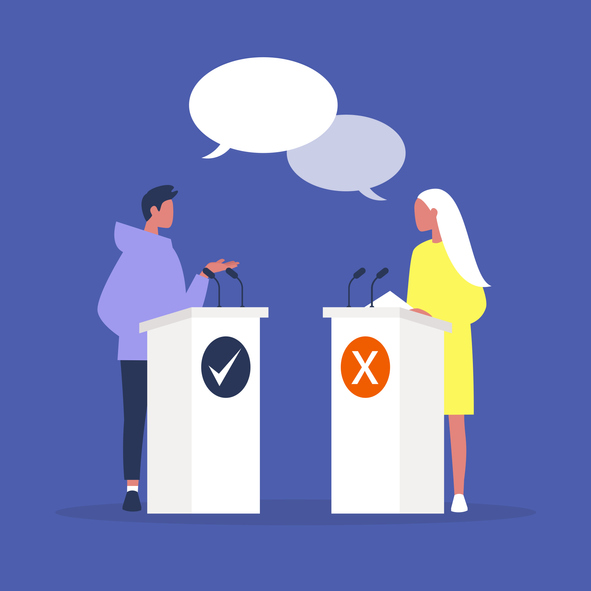
The practice of debate refers to a communication technique that pits confrontational ideas or opinions on a particular topic. The word comes from the Latin “debattuĕre,” which means “to argue” or “to fight.” We could say then that it is the act of fighting with words. However, the idea of the debate is not to be violent but to be articulate, solid, and knowledgeable about the subject. Rather than attacking an opposing viewpoint, debating means validating one’s position above reasonable doubt.
The flow of a consistent and helpful debate aligns with Hegelian ethics; there is a thesis, an antithesis, and, ideally, a synthesis at the end. This is not to say that the debate participants agree on a single point; each can retain their original argument. The main objective of a debate is not to convince but to enrich the initial point of view through listening and offering counterpoints during the exercise. The debate’s value does not lie in changing minds but rather in learning more about the topic and the people in the discussion. This particular set of aspects has been absent in debating since the explosion of social networks, content bubbles, and echo chambers. Today, it is more about fighting than learning.
Argumentation vs. Hate
A growing polarization among those with different ideological or political positions is putting the effectiveness of collective communication and the ability to humanize people with whom we disagree at risk. This is not to say that there are no ideas or causes worthy of an ironclad defense, such as reproductive rights or the validity of the existence of diverse peoples. Still, we should ask ourselves how effectively we defend crucial points if we are more interested in destroying an argument (and the person behind it) than proving our own.
More in Common’s survey found that more than two-thirds of the respondents felt that public debate was becoming increasingly aggressive. Forty-two percent said they did not feel safe expressing their opinions freely. This regression may be due to the intense focus on emotional content over neutrality or logic. A post that emotes more than discussing facts or appealing to reason goes more viral.
The expression of emotions is not a negative thing in itself, but there are public spaces where we can be anonymous and express emotions without human contact, consequences, or accountability. This sets up the perfect storm for an opinion, conversation, or debate to cease being an exercise in communication to become something less practical and more violent. Given how these factors have affected the practice of the debate, is it a good idea to continue teaching and practicing it in schools?
How to leverage the debate?
The debate as an educational tool can remain in force. Moreover, it should be taught to show the difference between an exchange of ideas and discussion versus an attack. What is necessary is to reevaluate the values or criteria we include in the curriculum. What aspects do we need to highlight or rethink about the debate?
To begin with, as teachers or moderators, we must stop thinking of debate as the solution to a problem or a competition in which one participant wins, and the other loses. The winner in any debate must be reasoning, listening, and expanding the knowledge about a particular topic or perspective.
Our life experiences, emotions, and political or ideological stances are more than valid and can be part of our argument. However, they cannot fully define our position or completely guide our discussion. Our point of view must be grounded in research, verifiable data, efficient and relatable discourse, and a civil attitude towards those who defend the other perspective.
The ability to discern which spaces and conversations generate good debate and which don’t is valuable for students, even if they’re not up for the debate team. The skill makes them aware of when to withdraw from useless online discussions before anyone begins attacking others. This is also vital to maintaining effective communication and healthy interactions in social networks.
Learning to think when our ideas are challenged, disagreeing, reaching a middle ground, and perhaps convincing (even if that is not the goal) without compromising our humanity or debate opponent makes the debate an essential didactic resource that should remain in the classrooms. However, teachers must be vigilant that these aspects leave their mark on the students.
Do you organize debates in your classes? On what topics? What do students learn when you assign them this exercise? Do you think the debate has been affected by the current polarization? How do you maintain the debate as a valuable tool in your classes? Let us know in the comments.