

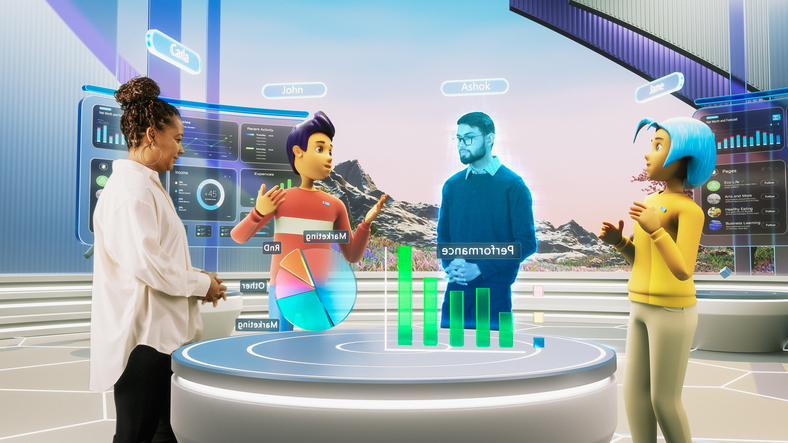
Online education has become a widely used educational modality, especially after the COVID-19 pandemic, which forced students to study from home or anywhere, avoiding unnecessary physical relocations through educational programs that are generally less costly than traditional training. According to a report by the market intelligence platform Statista (2024), there will be a significant growth in the number of users choosing an online university education, increasing from 31.4 million in 2024 to 50.2 million worldwide by 2029. However, online education also has challenges, primarily students’ emotional and cognitive disconnection. How can we design online education to be more immersive, interactive, and engaging for university students? The metaverse has emerged as a possible solution to this problem, especially for synchronous activities. In this article, I share my experience.
Challenges of online education
Pre-pandemic (Bettinger et al., 2017) and post-pandemic (Cellini y Grueso 2021) studies have shown that students taking online courses tend toward lower academic performance than their peers in face-to-face classes and higher dropout rates. This difference is attributed mainly to difficulties keeping up in an online environment due to a lack of direct interaction with teachers and peers and a feeling of disconnection. The lack of meaningful interaction between students and teachers directly affects student engagement with the class and knowledge retention.
Despite improvements in videoconferencing platforms and learning management systems, 2D environments fail to replicate the interaction and dynamism of physical classrooms, thus limiting the learning experience. As such, one of the most pressing issues in online education is the emotional and cognitive disconnection that many students experience in virtual environments.
Over the years, universities have tried to improve the online learning experience using platforms such as Moodle, Canvas, and Blackboard and video conferencing tools like Zoom and Microsoft Teams, allowing for some degree of interactivity. However, these interactions have yet to replicate the dynamism of face-to-face classes.
In June 2021, Stanford University launched a course called “Virtual People,” a complete virtual reality environment where students represented by avatars interacted in simulated environments. Despite such efforts, the mass adoption of Virtual Reality (VR) and the metaverse in college education still needs to be improved. Economic and technical barriers and lack of training in these technologies have made integrating them on a large scale problematic.
The metaverse provides better immersive online sessions
The metaverse can be a solution to enhance the online learning experience, mainly through synchronous activities. The metaverse is a three-dimensional virtual world where students interact immersively in virtual learning environments like physical reality. In the immersive metaverse, they collaborate and interact using learning objects to facilitate their understanding and strengthen their motivation.
Synchronous activities are class sessions where students interact with their classmates and the teacher in real-time in a virtual classroom. Students anticipate these activities highly, so it is essential to implement technologies that improve live interaction and intrigue them. Recent studies have shown that synchronous online teaching in virtual classrooms yields better student learning outcomes than asynchronous classes (Cellini & Grueso, 2021). This method of instruction is made possible by new technologies that make online instruction more akin to in-person instruction (Shankar et al., 2023).
Also, market research (Gupta, 2024) forecasts an increase in technologies that will enable and support synchronous instruction in online education in the coming years, allowing the creation of online educational experiences closer to physical reality.
A success story: the metaverse in higher education
As a teacher in virtual environments, I have had the opportunity to use immersive technologies, such as virtual reality and simulation environments, in a project focusing on developing soft skills in university students. The objective was to create a learning environment where students could simulate situations calling for teamwork, conflict resolution, and decision-making within an immersive space, promoting multiliteracy. “Multiliteracy” refers to developing various competencies, including languages and communication formats (e.g., digital, media, cultural and linguistic, visual and critical).
Platforms like Engage VR and Spatial facilitate the creation of immersive learning spaces where students and teachers interact in simulated environments replicating laboratories, auditoriums, and classrooms in 3D. Although still in an early phase, these innovations improve the path toward a hybrid education model where physical and virtual reality merge to create more in-depth educational experiences.
In May 2023, I participated with my team in a contest by Anahuac Online University in the project “Immersive Onlive Sessions: The Future of Postmodern Classrooms.” We used Spatial.io to increase attendance at synchronous sessions by promoting personalized learning and multiliteracy. To do this, we conducted a pilot test with the participation of teachers, administrative staff, and students from Mexico. They created their avatars on the platform and participated in group sessions in a three-dimensional virtual environment. During the live sessions, they interacted using virtual objects such as whiteboards, non-fungible tokens (NFT), and digital sticky notes, encouraging active and participatory learning.
The results were highly positive. Participants in the pilot expressed more substantial commitment and motivation than those in traditional online classes, and their ability to apply theoretical concepts to practical situations improved significantly. The student’s performance was reflected through project-based assessments, simulations, role-plays, and case studies. Likewise, the benefits for learning included better concept retention, improvement in interpersonal skills, and a more interactive and engaging learning experience. Finally, the project was chosen as one of the three winners due to its implementation in Anahuac University’s proposed online training.
Feedback from students who participated in this pilot
“The metaverse experience let me feel comfortable with the class and the interactions with the teacher and my classmates. Interacting with virtual objects and creating my avatar fascinated me: the personalization of learning in its best expression.”
“The session -onlive- inside the metaverse helped me discover a new world full of interactivity, ubiquity, socialization, and personalization. I loved the experience, as it taught me how to use unfamiliar new technological tools.”
The teachers and instructional design team who participated in the pilot believe that future iterations should address the number of students per module and the needs of each class. Given that some students have no experience with virtual spaces, a training day before their encounter is necessary.
From this experience, we must consider the following aspects for the metaverse to be integrated into online courses: 1) maintaining a pedagogical approach that prioritizes the student experience and the quality of learning, 2) teacher training on these platforms, 3) accessibility for all students, and 4) investment in technological infrastructure. The metaverse can resolve many online education problems with these advances and a proper approach.
Reflection
Many universities seek to transform their educational models due to the growing demand for online education. The metaverse is a tool with the potential to transform online education profoundly. It creates new opportunities to improve interaction, collaboration, emotional connection, and active learning in virtual environments.
As this article shows, the future of learning in the metaverse is full of possibilities. With companies like Meta, Microsoft, and Google investing heavily in creating educational metaverses, universities are expected to adopt these platforms increasingly. Developing more research to address this innovation’s pedagogical, technical, and economic challenges is also crucial.
I invite all educators to explore this powerful and motivating tool to optimize their teaching praxis. Please contact me for advice regarding these matters. Awareness of digital transformations lets us position ourselves at the forefront of knowledge. I believe virtuality must become a bridge, not a wall, to achieve significant learning.
About the author
Cecilia Frontera (cecilitafrontera@gmail.com) is an outstanding international expert in education and technology. She has trained more than 10 thousand professionals in Latin America and Europe. She has received several mentions and awards for her innovative work in education. To learn more about her trajectory, click on the following link: www.ceciliafrontera.com
References
Bettinger, E. P., Lindsay Fox, Susanna L., & Eric S. Taylor (2017). “Virtual Classrooms: How Online College Courses Affect Student Success.” American Economic Review, 107 (9): 2855–75. DOI: 10.1257/aer.20151193
Calvo, J. [Jorge Calvo]. (2022, 28 de julio). Espacios virtuales en el metaverso: Spatial [Video]. YouTube. https://www.youtube.com/watch?v=FBRqRSmGhac
Cellini, S. R., & Grueso, H. (2021). Student Learning in Online College Programs. AERA Open, 7. https://doi.org/10.1177/23328584211008105
Engage VR. (2023). Plataformas de realidad virtual para la educación. https://www.engagevr.io
Instituto Internacional de Educación (IIE). (2020). Informe sobre la experiencia estudiantil en la educación a distancia durante la pandemia. IIE Publications. https://www.iie.org
Shankar, K., Arora, P., & Binz-Scharf, M. C. (2023). Evidence on Online Higher Education: The Promise of COVID-19 Pandemic Data. Management and Labour Studies, 48(2), 242-249. https://doi.org/10.1177/0258042X211064783
Spatial.io (2024). Plataformas de realidad virtual para la educación. https://www.spatial.io/
Stanford University. (2022). Virtual People: El futuro de la educación inmersiva. Stanford News. https://news.stanford.edu
UNESCO. (2021). La educación en línea y a distancia: oportunidades y desafíos para la educación superior. https://unesdoc.unesco.org
Universidad de Tokio. (2022). El metaverso llega al campus universitario: La experiencia educativa virtual de Tokio. University of Tokyo Press. https://www.u-tokyo.ac.jp
Editing
Edited by Rubí Román (rubi.roman@tec.mx) – Editor of the Edu bits articles and producer of The Observatory webinars- “Learning that inspires” – Observatory of the Institute for the Future of Education at Tec de Monterrey.
Translation
Daniel Wetta