


It had taken me fifty class minutes to explain the mechanism of opening epoxy rings, which was fascinating for me as a researcher in sustainable materials. I was envisioning curved arrows connecting atoms, electrons jumping back and forth, and molecular structures magically transformed. Suddenly, a student asked me, “Professor, how does this help me?” I realized I was not clearly conveying the relevance of what I was explaining. Then the question arose that changed the way I teach my course: How can I bring the experience of real research to the classroom without specialized laboratories, a million-dollar budget, or compromising the safety of the student body? This is how the concept of mini-research was born: these cases are not simulations or invented exercises; instead, they are authentic fragments of real research pedagogically adapted so that undergraduate students can benefit from the support of intelligent assistants that provide personalized attention. In this article, I share my experience.
Organic chemistry is the engine that drives some of the world’s most critical innovations: biomedical materials, sustainable polymers, and advanced functional coatings, to name a few. Every day, we use products that exist thanks to organic chemistry, such as cell phone plastic, lens coatings, and even the medications we take. We also live exposed to CO₂ pollutants that can be captured and transformed to mitigate climate change. All of these examples result from chemical transformations. Often, students master the exercises in class through memorization without comprehending the scope of what they are learning. For example, they memorize that “CO₂ reacts with epoxides” but do not understand why the reaction occurs or its relevance.
The idea that changed my course: turning real research into mini-learning cases
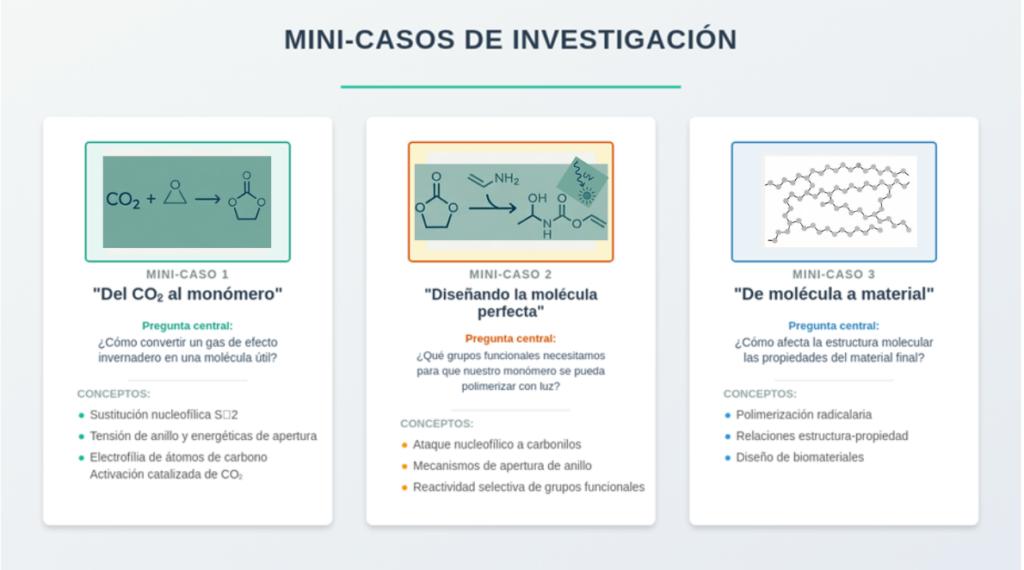
The solution came when I paused to analyze my own research process. In my lab, we develop light-curing materials from CO₂ as a renewable carbon source. This process employs several steps based on fundamental concepts of organic chemistry: carbon hybridization, nucleophilicity and electrophilicity, resonance, functional groups, reaction mechanisms, etc. (Cooper et al., 2010) I wondered, what if we broke this real-world project down into small cases that students can solve as a team? This led to transforming my research project into three mini-cases that students could tackle during the school term.
How does mini-research work in class?
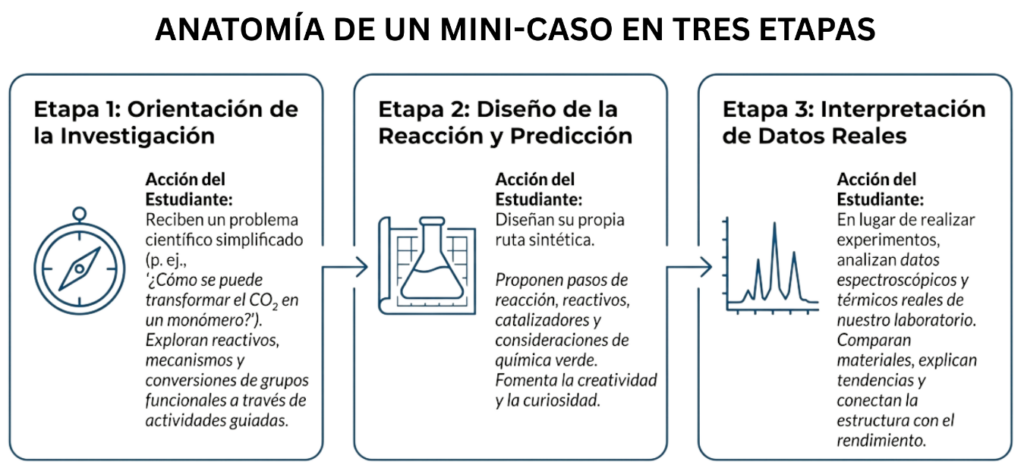
Each mini-research has a goal and three stages that replicate the scientific method.
Stage 1: Orientation – Understanding the problem as a scientist
Students are posed a simplified but real scientific challenge. For example, in Mini-case 1:
“CO₂ is a greenhouse gas that contributes to global warming. However, it can also be a renewable source of carbon to make materials. Your challenge: design a chemical route to convert CO₂ into a monomer that can be used to make sustainable polymers.”
Students work in teams to research, discuss, draw structures, and ask questions. They explore reactants, mechanisms, hybridization states, and functional group conversions through guided activities.
Stage 2: Design – Propose the reaction route
This is the most creative stage. Students design their own sequence of reactions using real transformations such as ring opening, carbonation (Du et al., 2018; North et al., 2010), urethane formation (Maisonneuve et al., 2015), and esterification. They must propose reagents and catalysts, outline purification strategies, and discuss green chemistry considerations (Anastas & Warner, 2000).
Stage 3: Analysis – Interpret real laboratory data
The class is theoretical, but we seek authentic learning, so instead of analyzing made-up data, students analyze real data from the research lab, including spectroscopic results, to demonstrate how functional groups react with one another to synthesize a new functional group. In addition, thermal analysis reveals the strength of intermolecular interactions, such as hydrogen bonds between newly formed functional groups. Photopolymerization data also helps them evaluate their hypotheses about polymerizable functional groups. They compare materials, identify functional groups, explain trends, and relate structure to performance, exactly as a real researcher would. This approach makes organic chemistry active, meaningful, and scientifically authentic, without requiring students to perform physically complex or dangerous experiments.
The educational impact observed in the classroom
The implementation of mini-research led to observable changes in student engagement, conceptual understanding, and scientific reasoning skills. Students felt engaged in real research, not just a chemistry class. They showed genuine curiosity about the real data they analyzed and asked follow-up questions beyond course expectations. By working with real CO₂-based reactions, students developed a deeper understanding of hybridization, resonance, nucleophilic/electrophilic behavior, spectroscopy, and polymerization mechanisms. Their explanations were more mechanistic and detailed, showing that they not only memorized but actually understood chemical processes.
Scaling personalized care using intelligent assistants
The mini-research worked well in the first implementation. Still, we identified a significant challenge: the scalability of personalized attention, or, in other words, how to make the long-standing teaching dream come true: the personalization of learning.
Large groups of students, divided into multiple teams each designing different routes and interpreting data, and needing specific feedback, make it impossible for teachers to give students the individualized attention that this pedagogical approach requires. It is even more complicated if they want to bring this implementation to the individual space.
“The classic problem of education: the best pedagogical strategies require individualized attention, but we have classes with multiple types of students and limited time.”
Agent Studio is an institutional solution of the TECgpt ecosystem
To address this scalability challenge, we are exploring Agent Studio, a platform in Tecnológico de Monterrey’s TECgpt ecosystem that enables teachers to create personalized intelligent assistants without requiring advanced programming knowledge.
Agent Studio is part of the TECgpt Portal, together with Skill Studio, and is specifically designed to develop specialized chatbots that securely and at scale support academic processes aligned with the institutional strategy of educational innovation. The platform has been recognized in Las Más Innovadoras 2025de Netmedia–IT Masters Mag (The Most Innovative 2025 in Netmedia-IT Masters Mag) with a special mention in the category “Democratization of Artificial Intelligence,” highlighting its impact on higher education.
The interesting thing about Agent Studio is that it functions as an orchestration layer atop generative models, integrated directly into Tec’s educational workflows. The assistants are trained with specific information (documents, internal course resources, web pages, etc.) so that they can answer contextualized questions, address specific organic chemistry questions, and guide students’ reasoning in a personalized way.
Three specialized mini-research assistants
We are designing three specialized assistants to be implemented in future iterations of the course:
Assistant 1: Reaction Design Tutor
This assistant would serve as a personal chemistry tutor, trained specifically in organic chemistry course content, relevant reaction mechanisms, and green chemistry strategies. The assistant would not give a direct answer: it would guide the student’s thinking with Socratic-pedagogical questions, just as a good instructor would.
Assistant 2: Data Interpretation Assistant
Spectra scare many students. This assistant would help students identify peaks in FTIR and NMR spectra, compare samples, relate structural changes to polymer performance, and reason through photopolymerization data. This type of dialogue will increase student confidence in interpretation tasks, especially outside of class time when the professor is unavailable.
Assistant 3: Scientific Reflection Guide
This assistant would strengthen metacognition and scientific thinking by helping students write pre-activity plans, reflect on misconceptions, identify reasoning errors, propose new experiments, and connect learning to CO₂ valorization. The following graphic illustrates these three assistants.
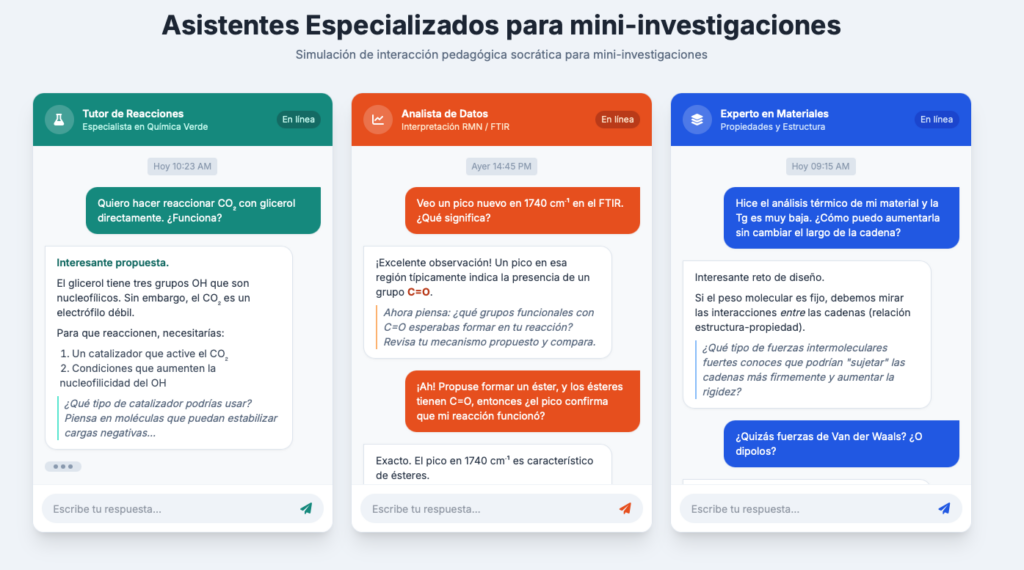
The creation of these assistants is not intended to replace the teacher, but rather to amplify the teacher’s ability to provide personalized attention to each student at their own pace, with support available when needed. The assistants provide on-demand support, interactive visualization, guided reasoning, personalized feedback, and structured reflection.
The combination of authentic mini-research with the support of specialized intelligent assistants can transform how we teach organic chemistry in massive-scale courses, while maintaining scientific rigor and addressing the challenge of personalized attention.
Do you want to implement mini-research in your course?
If you teach organic chemistry, general chemistry, biochemistry, or any science subject and want to try this approach, here are my practical tips based on our experience:
1. Start small
You don’t need to transform your entire course overnight. Choose a topic that is particularly abstract or difficult (in our case, reaction mechanisms and structure-property relationship). Design a single mini-research case, test it, adjust it, and expand later.
2. Search local research
You don’t need to have your own research lab. Find out which projects are being carried out at your institution. Look at nearby universities. Many researchers are willing to share real data and collaborate in education. Alternatively, look for recent scientific publications with supplemental data.
3. Real data is key
Don’t use made-up or “over-cleaned” data. Students can distinguish real from simulated data. Authenticity generates their engagement. Simplify when you think it’s necessary to make it pedagogically accessible.
4. Clearly structure the three stages
Students need to know what is expected of them at any given time:
- Orientation: Understand the problem (explore the scientific context).
- Design: Propose solutions (create your reaction path).
- Analysis: Interpret evidence (connect data with predictions).
Each stage has clear learning objectives and specific deliverables.
Reflection
Traditional organic chemistry education turns students into spectators of science: they copy the reactions that the teacher writes on the blackboard, memorize rules, and solve pre-designed exercises. Mini-research makes them active participants in the scientific process.
Is it more work for the teacher? Yes, especially in the initial design phase. Does it require rethinking how we evaluate and what we value? Absolutely. We need to evaluate the scientific thought process, not just the right answer.
“In the time of AI, the important thing is not the final product but the thought process, the cognitive process.”
Science is not learned by memorizing facts; it requires asking questions, designing experiments, making mistakes, interpreting evidence, and constructing knowledge. If we want to train the next generation of scientists, engineers, and scientifically literate citizens, we need to teach science as it is actually practiced.
With mini-research based on real data and potentially supported by specialized intelligent assistants, we can train students in a scalable, secure, and pedagogically sound way, even in courses with limited resources.
“Mini-investigations transform students from passive learners to active researchers. Inspiration in education comes when we believe in what our students can achieve.”
The future of science teaching lies not in transmitting more information but in creating experiences where students conduct real science. This classroom implementation shows that it is possible to start down that path today; tools such as Agent Studio will allow us to scale this vision in the near future.
About the Authors
Dr. Saeed Beigiboroujeni (saeed.beigi@tec.mx) is a professor-researcher at Tecnológico de Monterrey, specializing in CO₂-derived monomers, green polymers, and photopolymerization. His research focuses on the development of sustainable functional materials.
Dr. Jorge Cruz-Angeles (jecruzangeles@tec.mx) is a professor and researcher at Tecnológico de Monterrey, specializing in the use of artificial intelligence in science. He leads educational innovation projects in artificial intelligence, particularly in designing intelligent tutoring systems (ITS) for science learning.
References
Anastas, P. T., & Warner, J. C. (2000). Green chemistry: Theory and practice. Oxford University Press.
Aresta, M., Dibenedetto, A., & Angelini, A. (2014). Catalysis for the valorization of exhaust carbon: From CO₂ to chemicals, materials, and fuels. Chemical Reviews, 114(3), 1709–1742. https://doi.org/10.1021/cr4002758
Cooper, M. M., Grove, N., Underwood, S. M., & Klymkowsky, M. W. (2010). Lost in Lewis structures: An investigation of student difficulties in developing representational competence. Journal of Chemical Education, 87(8), 869–874.
Corrigan, N., Yeow, J., Judzewitsch, P., Xu, J., & Boyer, C. (2019). Photocatalysis in organic and polymer synthesis. Chemical Society Reviews, 48(18), 7029–7053.
Du, Y., Wu, W., Xie, D., & Tang, S. (2018). Synthesis of cyclic carbonates from CO₂ and epoxides. Journal of CO₂ Utilization, 25, 196–208.
Freeman, S., Eddy, S. L., McDonough, M., Smith, M. K., Okoroafor, N., Jordt, H., & Wenderoth, M. P. (2014). Active learning increases student performance in science. PNAS, 111(23), 8410–8415.
Maisonneuve, L., Lamarzelle, O., Rix, E., Grau, E., & Cramail, H. (2015). Isocyanate-free routes to polyurethanes. Chemical Reviews, 115(22), 12407–12439.
North, M., Pasquale, R., & Young, C. (2010). Sustainable chemistry: Using CO₂ as a renewable C1 source. Green Chemistry, 12(9), 1514–1539.
Tecnológico de Monterrey. (2025). This is how Tec de Monterrey’s AI ecosystem is advancing. Conecta, March 31.
Tecnológico de Monterrey. (2025). Agent Studio, Tec’s AI platform awarded for educational impact. Conecta, October 24.
Editing
Edited by Rubí Román (rubi.roman@tec.mx) – Editor of the Edu bits articles and producer of The Observatory webinars- “Learning that inspires” – Observatory of the Institute for the Future of Education at Tec de Monterrey.
Translation
Daniel Wetta