

“Faced with unexpected situations such as the COVID-19 pandemic, a culture of adaptation to change in an institution is essential to respond assertively to changes and avoid being paralyzed.”
When a pandemic like the one we are experiencing now, COVID-19, paralyzes the entire world, it is time to act, not put the brakes on our development and plans. More than a year has passed, and today, in the current situation, we know this reality will continue but not for how long. A situation of this nature leaves its mark and lessons learned in all settings worldwide, including health, public, business, and educational sectors.
Many schools at the primary and secondary levels and universities closed due to the lack of capacity to respond to the new educational demands; others continued as usual. However, they could not avoid the desertion and disenchantment of the students, parents, and families about the virtual formats. A survey applied by the National Institute of Statistics and Geography of Mexico (INEGI) reported school dropout rates when the confinements began: “2.2% of the population aged 3 to 29 years (738.4 thousand people) declared not finishing the school grade in which they were enrolled, being slightly higher for men (2.4%) than for women (2.0%)” (INEGI 2021).
“Most of our teachers ventured into the digital world for the first time.”
In March 2020, Tecnológico de Monterrey decided to suspend face-to-face activities to protect its academic community, students, and collaborators from the imminent arrival of the SARS-CoV-2 virus in Mexico. At that moment, little was known about the scope and magnitude of the pandemic. It was seen as something that would be short-lived.
Different teams started a contingency plan for a strategy to change from face-to-face teaching to a digital modality. We had to innovate to migrate all the high school, undergraduate and postgraduate courses effectively to the virtual format in one week. Likewise, we were challenged to guide or train the teachers to deliver their courses in remote synchronous sessions; most of them were learning the digital world for the first time. Tecnológico de Monterrey is an institution with 92,645 students enrolled in various educational levels on 26 campuses. On March 26, 2020, the students and teachers continued their classes in virtual format.
Tec de Monterrey created a digital delivery model known as the Flexible Digital Model (FDM) to ensure academic continuity. The teachers designed their courses on a platform for learning (Learning Management System (LMS)), following this model’s methodology. Simultaneously, they had to consider a possible return to the classroom; thus, the HyFlex+Tec model was designed, deploying new components that allowed the flexible return according to the permitted classroom capacities.
“The moment of truth is when teachers teach their virtual classes. With this in mind, we train teachers and carry out centralized actions at the national level to support them in class in front of their groups.”
To support almost 10,000 teachers, the Centers for Teacher Development and Educational Innovation (CEDDIE) team offered training in conjunction with several departments such as Educational Innovation, Education Technologies, the different academic departments, and expert teachers. The courses covered the pedagogical and technological needs of the teachers.
Although the training was an immediate action for academic continuity, the moment of truth arrived when the professors began teaching their virtual classes. The training was complemented by actions from the university’s central administration to support teachers with their classes nationally. This article shares the accompaniment model designed at Tecnológico de Monterrey to support the teachers with delivering their online courses during the COVID-19 pandemic.
The support model was comprised of three main areas designed to attend to the specific needs of the teachers at all the institution’s educational levels and obtain timely assessments of the Tec virtual courses. A group of approximately 1,700 people from various institutional departments and schools worked together to make this effort successful. Processes were specified to clarify the responsibilities and scope of each person participating in this effort. The function of each area and how they relate to each other is explained below.
-
Accompaniment to the teachers. The guidance was supported by two roles focused on different needs:
-
Teaching advisor with a profile of an expert in virtual education played a critical supporting role for the correct implementation of the courses. Even though the teachers received extensive training to perform successfully in the digital environment, live virtual teaching requires an advisor to support its logistics and pedagogical aspects. Their support comes from advice during the course design and session observations with a recording instrument to provide feedback to the teacher and realistic guidance about applicable course adjustments to ensure a compelling student experience.
-
The academic Buddy is skilled in managing technology. Two specialist roles were created for technology management: The remote Buddy attends 100% of the virtual courses, knows the Zoom video-conferencing tool, and feeds the reporting system that must be completed for each assigned course. Subsequently, the face-to-face Buddy specialist role was created. They prepare for the arrival of hybrid courses, which must be available on campus, and attend to the teacher’s support technology needs in the classroom. Both roles had to meet the needs of the teachers in their respective courses on a day-to-day basis.
-
-
Monitoring of synchronous sessions. The monitoring table fulfills a double function. On the one hand, it supports and guides each Buddy calling the central number on the table to report an incident and request help. On the other hand, the number contacts a Regional Coordinator who has access to the Zoom administration modules and can visualize the behavior of all the courses from a technical perspective and identify things that Buddy does not access in the course he is supporting. With this, one can quickly tell if the course is being taught in another link and see many other incidents. The Regional Coordinator guides the Buddy when advice is required so that he can, in turn, support the teacher for the effective use of Zoom. They also generate a report of all incidents called in and their statuses.
To create the support group for the monitoring table, we needed to create a profile of people with the skills to resolve incidents derived from their experiences in virtual courses. In addition, it should be clarified that another critical element for the success of this group was the communication among the coordinators because while they attended to each Buddy, they could receive help from thei
r colleagues; thus, there would be no unanswered questions. -
Data analytics for decision making. The Data Analytics area receives the information on the course incidents. They then generate integrated reports that shed light on how the courses are being taught and help decision-making at the institutional level. This work at the end of the chain has been valuable in registering all incidents and improving educational practices.
The relationship of these areas can be seen in image 1:
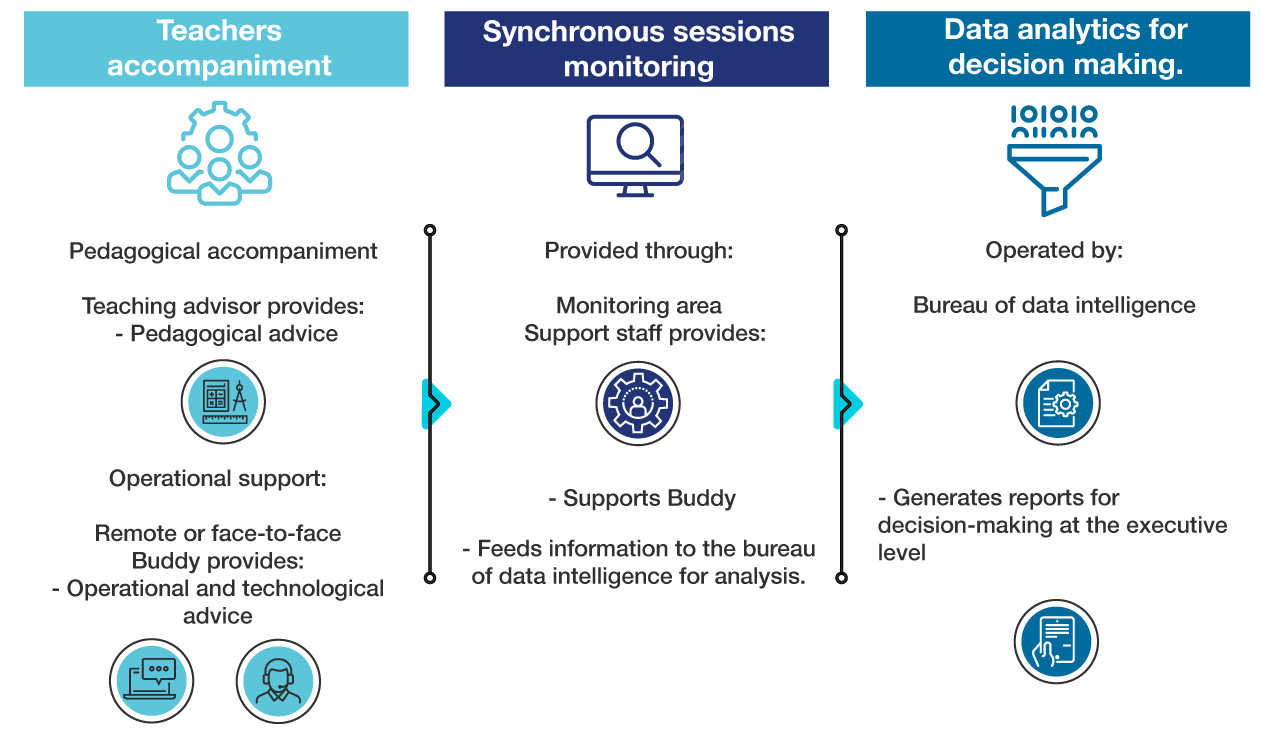
Image 1: Support model designed at Tecnológico de Monterrey to aid its teachers in delivering their online courses during the COVID-19 pandemic.
If you want to know more details about the support process for academic teaching during contingencies in the digital modality, we invite you to download the following document.
To support teachers in contingency situations, we must prepare through adequate planning and communication among all involved areas. It is crucial to create a culture of adaptation to change in the institution and not let unexpected situations paralyze our educational functions.
About the authors
Laura Patricia Aldape Valdés patricia.aldape@tec.mx has a Bachelor of Communication Sciences and a master’s in administration. She is currently the Director of the Innovative Learning Experiences area in the Educational Innovation Directorate at Tecnológico de Monterrey. She has more than 25 years of experience in business development, professional updating, development of hybrid and distance educational models, and management of educational innovation projects. In recent years she has dedicated herself to promoting Educational Innovation, which she is passionate about, and has allowed her to participate in strategic initiatives that are transforming education.
Olga Lya López Zepeda olopez@tec.mx has a bachelor’s degree in Information Sciences and a master’s degree in Higher Education. She is currently part of the Educational Innovation team at Tecnológico de Monterrey as Leader of Innovation Models. At the start of her career in this institution, she was in charge of producing graduate courses; thanks to this, she has extensive experience developing online innovative educational projects and hybrid presential models enriched by technology.
References
Instituto Nacional de Estadística y Geografía (INEGI). (March 2021). Encuesta para la medición del impacto COVID en la Educación. Website: https://www.inegi.org.mx/investigacion/ecovided/2020/
Edited by Rubí Román (rubi.roman@tec.mx) – Observatory of Educational Innovation.
Translation by Daniel Wetta.