
How do we teach complex topics to students with limited attention spans and who are already accustomed to using AI as a work tool? In this article, I propose a teaching method that combines the flipped classroom and gamification to promote the intentional use of newly acquired information in class, diversify the stimulus, and create a dynamic, engaging learning environment. My goal is to share a practical guide on implementing flipped learning in the classroom, considering the two main stages that comprise this pedagogical approach: 1) the pre-class preparation phase by the students, and 2) the application of the class activities. I also share the results of this dynamic process, feedback from students who experienced this method, my findings from implementing the activity, and considerations for improving the execution of this practice in future editions.
Flipped learning has gained renown and increased use thanks to numerous articles highlighting its merits and limitations (Baig & Yadegaridehkordi, 2023; Ma et al., 2025; Mizza et al., 2025). Initially known as flipped classroom, this teaching technique is defined as a “pedagogical approach in which direct instruction occurs outside the classroom and face-to-face time is used to develop meaningful and personalized learning activities” (Observatory of Educational Innovation, 2014, p. 3). However, I note that several sources often describe face-to-face activities in flipped learning only superficially. An example of such a limitation can be found in idDOCENTE (2025). Moreover, the University of Waterloo (n.d.) link provides another, less common example of flipped learning, with a genuine effort to develop the technique’s practical application. I assume this relative discretion about the “how” is intended to allow the teacher to adapt flipped learning to the needs of their class or group of students.
Using flipped learning to promote the intentional use of new information
During the August-December 2025 semester, I taught the subject Regional Scenario of Europe to students in the final part of their bachelor’s degree in international relations at Tecnológico de Monterrey. One-third of the course required students to present five European states across six dimensions: history, geography, demography, economy, domestic politics, and foreign policy. Given the density of information about each country and the exploration of five different national contexts, it was risky to rely on traditional, essentially expository methods to cover these topics, about which students had limited prior knowledge. If students’ level of attention in the classroom is a classic cause for concern (Bunce et al., 2010), the omnipresence of mobile devices and social networks in our daily lives has further reinforced this concern (Haliti-Sylaj & Sadiku, 2024). Therefore, I designed a series of activities for both before and during the class to teach these topics employing flipped learning.
First flipped learning stage: students’ activities before class
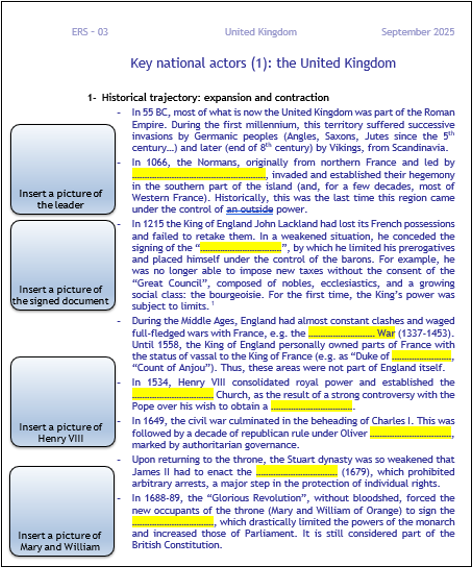
As part of the preparation phase before the class, the students had to read a document I had prepared from my notes on the subject. Between six and eight pages long, this document contained key information about one of the European states covered in the subject. The file shared with the students was Read-only, so they had to download a copy to make edits.
The document contained missing words in the yellow-marked spaces. In addition, empty boxes in the left margin included explanatory instructions on the content to include, such as a map, a graph, or a photograph of a person or monument. Figure 1 illustrates the first page of the United Kingdom document.
The incomplete text was intended to encourage students to actively explore the subject, rather than simply review the file contents. Of course, word filling can be done easily with AI; even so, it still requires the student to interact with the document’s content. However, it would be much more difficult for students to automate the insertion of the requested information into the tables.
Second flipped-learning stage: in-class activities
At the beginning of the face-to-face class, I presented a set of gamified activities (the first two were individual, and the next three were team-based) that would be organized throughout that session and the next, all based on the previously assigned reading. The five activities were:
1. Online Starter Quiz. The first activity involved an online quiz, in this case using Kahoot, with 12 questions based on information from the text. Each question prompted a plenary discussion about the correct answer and the incorrect options. In addition to helping check whether the students had completed the assigned reading, this initial quiz allowed us to recall and, where appropriate, clarify several key points about the country studied. Participation in this individual exercise allowed me to assign points based on the number of correct answers rather than on the score calculated by Kahoot, which accounts for response speed. To maintain a playful and stimulating environment, I awarded additional points to those who finished on the podium at the final classification.
2. Making connections. The second dynamic was based on the game Connections (New York Times, 2025). Each student had to identify, within a set of 16 words (or groups of words), four sets of four words related to one another by thematic coherence. For example, for a given state, it might be four treaty names, four current politicians, four cities, and four historical figures. To put together their own connections puzzle, the teacher can use sites like this “Create a Puzzle” site. In class, I assigned a time limit for the individual to complete this activity. I allowed students to consult notes, but I made sure they did not use artificial intelligence. I calculated the points for each one, taking into account the number of attempts to arrive at the correct combination of terms.
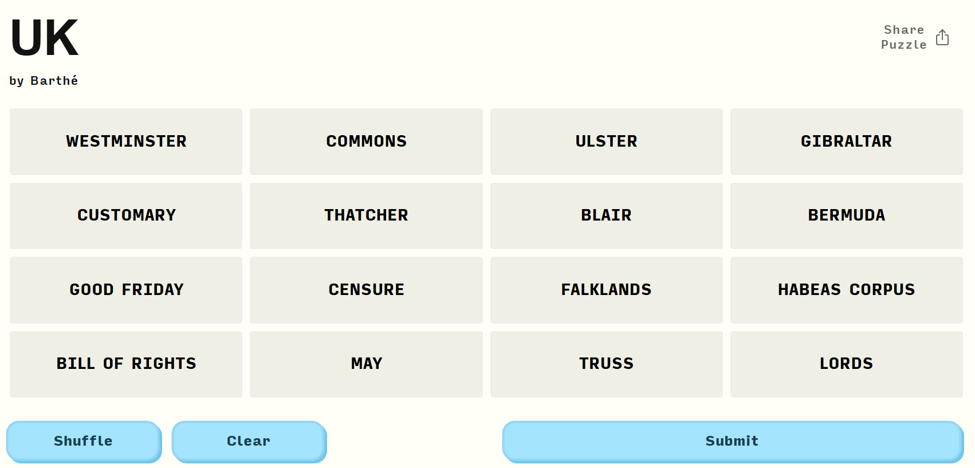
The moment the correct “connections” were revealed sparked the class’s active participation in clarifying the meanings of the different terms.
After these two individual stages, I announced the teams (a maximum of 4 members) that would participate in the next three phases.
3. Cross-question challenge. For the third “game,” students worked in teams to craft questions based on the assigned reading that could be answered in a few words. Depending on the size of their group, the teacher determined how many questions each team needed, usually between three and six. Each team then posed these questions to the rest of the group, and points were awarded to the teams that were quickest to provide the correct answers. Of course, this dynamic also presented an opportunity for plenary conversations on the points addressed.
4. The broken phone. Prior to the class, I selected a topic that was only mentioned briefly and allusively in the reading. In class, I shared additional explanations orally with a representative from each team, who repeated them to a teammate, and so on. The last student on each team wrote down what she understood on a sheet of paper, and I used the content to determine each team’s grade. Finally, a collective discussion enabled the reconstruction of the original message.
About an hour and a half was needed to complete the four activities described. Before the end of this session, I assigned each team a topic to investigate and present in the next session as a podcast, as part of the fifth and final stage.
5. The podcast. The objective of the podcast was to delve into a specific aspect of the reading. The podcast had the following guidelines for the students’ compliance:
- Respect the indicated time range (between 4 and 6 minutes).
- Present it live (i.e., not through recordings).
- Adopt a conversational format between different people, each assuming a certain role (driver, journalist, expert, interviewee, etc.).
- All team members had to participate meaningfully in the podcast.
- Participants could not have electronic devices or printed materials on hand. Only handwritten notes on paper not exceeding a quarter of a letter-size sheet were allowed.
This last requirement sought to ensure that, although students could use artificial intelligence to define the content of their presentation, they had to internalize the information to present it clearly and in an organized manner.
Within this framework, they were encouraged to be creative to attract the audience’s attention, as would be expected in any podcast.
After each podcast, a Q&A session began, with classmates’ questions addressed to the teams. I also participated in this process to clarify, provide additional information, and, where appropriate, make corrections. Subsequently, I shared qualitative feedback on the podcast and the corresponding grade.
Results
The activities conducted at various times during the semester yielded very favorable results for class dynamics. Students entered the classroom knowing they would be actively involved in a series of recreational activities, and reflected attitudes of expectation, motivation, and enthusiastic participation.
However, in a feedback session after the first two implementations under real conditions, several students shared with me that although they enjoyed this novel learning experience, they found it demanding in terms of prior preparation and in-class activation, so they recommended alternating this approach with more traditional methods.
To assess the impact of this pedagogical experiment on academic results, I compared the quality of answers on the focused test across the five states studied, bearing in mind that I applied this method in three of these countries and used traditional methods in the other two. The numbers collected on that occasion did not allow me to draw inferences about the impact of flipped and gamified learning on academic performance, since the dispersion of grades seemed to depend more on the State under consideration than on the didactic technique used.
Therefore, at this point, I consider that the added value of this proposal, based on flipped learning and gamification, lies mainly in improving and diversifying the classroom experience, which current generations usually deem essential.
Additionally, I think it is important to highlight some difficulties and offer tips to keep in mind when “flipping learning” in a way inspired by the procedure described above.
First, I noticed that students were concerned about how they would score in each session, which negatively affected their experience. This observation led me to reconfigure the number of points available at each stage so that, in total, they exceeded 100. As a result, high grades became more achievable while still maintaining the incentive to score as many points as possible.
Second, to keep their spirits up, it is valuable for students to be aware of the points they add at each successive stage of the process. This can be achieved through an Excel-like document available online and projected at various points in the activity – typically, after each stage. To update the table, the teacher can leverage the times when the class is working, for example, while they solve the “connections” puzzle in stage 2 or design questions in stage 3. For large classes, the support of an intern can be very useful in resolving practice issues and expediting the implementation of activities.
Third, I observed that the first implementation was a little more laborious, especially when explaining certain dynamics, but the process naturally became more fluid in subsequent editions once the learning curve had been overcome.
Reflection
In short, this experience was very stimulating, not only for my students but also for me as a teacher. I created a class environment very different from the “normal” one, with more interaction, some physical movement in the classroom, and agile knowledge circulation, especially among students.
In particular, the students’ podcast quality pleasantly surprised me. Finding themselves in conditions different from those of traditional class presentations, the students proved able to present their topics with confidence and aplomb. Although the content most likely included a significant dose of artificial intelligence, the objective of this exercise is not the research effort itself, but their appropriation of the information and their ability to share it in an organized, clear, and coordinated way with their own team.
With the confidence that this pedagogical practice works, I invite you to adapt this model by taking up the activities that inspire you, discarding the others, and adding new ones. I will gladly answer any questions you may have about this experience, and I would love to receive feedback on your experiments based on this idea, so I can, in turn, be inspired by your findings.
About the Author
Dr. Barthélémy Michalon (bmichalon@tec.mx) is a full professor in the Department of Political Science and International Relations at the Puebla Campus of the Tecnológico de Monterrey. He specializes in geopolitics, regional scenarios in Europe and Asia, and in the socio-political effects of digital technologies.
References
Baig, M. I., & Yadegaridehkordi, E. (2023). Flipped classroom in higher education: A systematic literature review and research challenges. International Journal of Educational Technology in Higher Education, 20(1), 61. https://doi.org/10.1186/s41239-023-00430-5
Bunce, D. M., Flens, E. A., & Neiles, K. Y. (2010). How Long Can Students Pay Attention in Class? A Study of Student Attention Decline Using Clickers. Journal of Chemical Education, 87(12), 1438–1443. https://doi.org/10.1021/ed100409p
Haliti-Sylaj, T., & Sadiku, A. (2024). Impact of Short Reels on Attention Span and Academic Performance of Undergraduate Students. Eurasian Journal of Applied Linguistics, 10(3), 60–68.
idDOCENTE. (2025, February 18). Flipped Classroom: Examples and tips. Innovation and Teacher Development.
Ma, Y., Fan, H., & Ning, B. (2025). The effectiveness of the flipped classroom: A second-order meta-analysis. International Journal of Educational Research, 134, 102855. https://doi.org/10.1016/j.ijer.2025.102855
Mizza, D., Reese, M., & Malouche, D. (2025). Flipped classroom evaluation and blended learning potential: A case study of engagement and inclusion in quantitative education. Smart Learning Environments, 12(1), 56. https://doi.org/10.1186/s40561-025-00412-2
Morán, L. (2022). Blended learning through the flipped classroom model: Experiences of Internships at the higher level. Virtuality, Education and Science, 13(25), 9–31. https://doi.org/10.60020/1853-6530.v13.n25.37678
New York Times. (2025). Connections—Group words that share a common thread. https://www.nytimes.com/games/connections
Observatory of Educational Innovation. (2014). Flipped Learning (EduTrends). Technologico de Monterrey. https://eduteka.icesi.edu.co/pdfdir/edutrends-aprendizaje-invertido.pdf
University of Waterloo. (n.d.). In-Class Activities and Assessment for the Flipped Classroom. Centre for Teaching Excellence. Retrieved December 16, 2025, from https://uwaterloo.ca/centre-for-teaching-excellence/catalogs/tip-sheets/class-activities-and-asse ssment-flipped-classroom
Editing
Edited by Rubí Román (rubi.roman@tec.mx) – Editor of the Edu bits articles and producer of The Observatory webinars – «Learning that inspires» – Observatory of the Institute for the Future of Education at Tec de Monterrey.