
When we are presented with the problem of illiteracy, we are usually shown graphs of the alarming number of illiterate people, which UNESCO estimates to be 765 million adults worldwide. Even though the numbers decrease yearly, the gap persists, and many people are deprived of this fundamental human right.
Moreover, much needs to be said about the true impact of illiteracy, which is devastating to these people’s lives. It was during my reading of the second chapter of Pablo Freire’s Teacher’s as Cultural Workers: Letters to Those Who Dare Teach, which we are reading in the next Reading Circle of the Observatory, that I could not help but reflect on and investigate further this intriguing and, at the same time, sad topic.
Many of us take reading and writing for granted, something we were taught from a young age and now do automatically. When I read Freire’s chapter recounting the writing process, I realized that I had never stopped to think about the intricate mechanics involved in these marvelous actions that we undervalue; they involve a familiar but complex process in our minds. Reading and writing connect language, thought, and reality, allowing us to express our ideas and understand our environment and beyond.
It’s not just sliding a pen on paper or typing in a Word file; words magically appear. If that were the case, the product would be meaningless words or scribbles. Writing involves formulating an idea in our mind, examining it, thinking about it, understanding it, relating it to past knowledge and experiences, detailing it, and rethinking it to capture it digitally or on paper. However, this process continues; the idea must also be translated into our language, with the lexicon we know, in the best possible way. Finally, when the idea is transferred, it must be plastered through letters that form words so that literate people can understand what you are communicating. Sounds complicated, doesn’t it? We realize this complexity when we step back from our actions and scrutinize them, thus comprehending the power we receive from knowing how to read and write.
However, this process is not possible for illiterate people. A reduced lexicon and the inability to convey precise thoughts or understand communication make the world smaller for these persons. One segment in George Orwell’s book 1984 is highly memorable for me, and from time to time, I think about it and how it relates to this topic. In this segment, the dystopian government described in the book reduces people’s vocabulary and constantly represses them. In this way, people do not have the words to describe their feelings and cannot rebel against the terrible government in this novel.
Isn’t it the same with illiteracy? Not being able to read and write denies people their freedom of thought, of naming their emotions or experiences, preventing them from communicating what they think because of the lack of writing and writing abilities, nor do they have the opportunity to understand other perspectives, proposals, or knowledge in general. Of course, in Orwell’s book, the elimination of these words applies to all people without discrimination. Illiteracy has almost the same effect, hindering people from achieving their full potential.
It is worth mentioning that their potential is one of many things affected. Imagine being unable to perform simple tasks such as writing a grocery list, reading a prescription, writing an instant message, and more. These tasks seem easy, but not knowing how to read and write makes them almost impossible. Illiteracy, defined as a person’s lack of ability to read and write, is more complicated than I thought, as there are two main types:
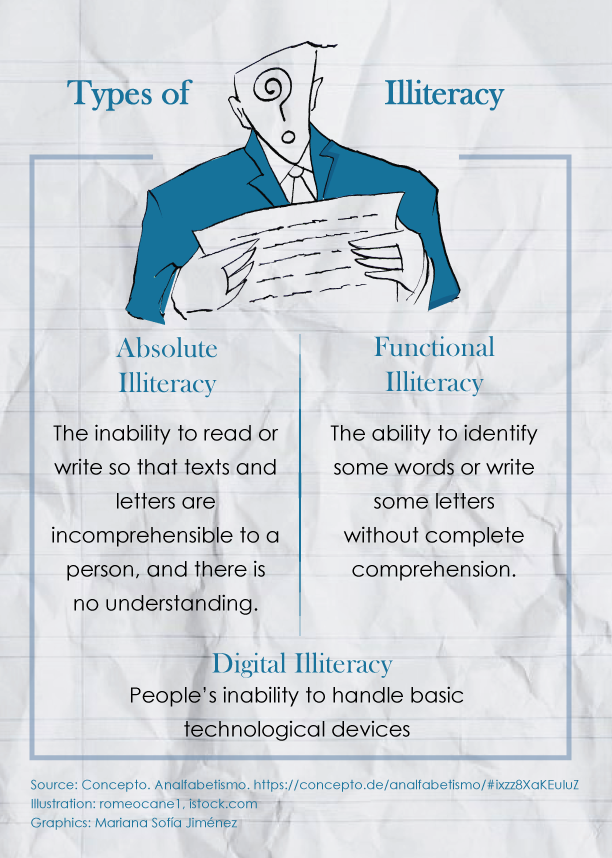
- Absolute illiteracy: The inability to read or write so that texts and letters are incomprehensible to a person, and there is no understanding.
- Functional illiteracy: The ability to identify some words or write some letters without complete comprehension.
It should be noted that digital illiteracy, which consists of the inability of people to handle essential technological devices, was also recently defined (but for now, we will leave it aside, although it is just as important; however, in this article, we will focus on reading and writing).
Recalling the number of illiterate people in the world, a study carried out by Óscar Chapital points out that institutions worldwide that conduct censuses to calculate illiteracy have different definitions of this concept, so there is no way to standardize both types of illiterate people; therefore, there is no absolute certainty of the exact figure. For example, an institution’s survey suggests that an illiterate person knows or does not know how to write. Hence, the person considers this when answering yes or no. However, such a person may be functionally illiterate, and because they cannot read or write 100%, they may be already considered illiterate.
Illiteracy results from various situations, primarily the lack of personal and educational opportunities linked to poverty. People who do not have the time to pursue minimum education because they have to work to survive may not be able to go to a school because of how far away it is from their locality or because of their culture (for example, Afghan women who are prevented from studying just for being women) are some examples of why some face the impossibility of learning to read and write.
These people face solid obstacles that create a disability that narrows their opportunities and seriously impacts their quality of life. Two types of barriers are:
- Social: Illiterate people are often marginalized and discriminated against due to a lack of literacy. Their citizen participation is limited due to the absence of knowledge on related topics and complete trust in authority figures.
- Economic: Not knowing how to read and write is a solid barrier to obtaining numerous jobs and professional development. Notably, many illiterate people are vulnerable when they cannot read the employment contracts provided at the time of hiring or they have to accept risky jobs.
Reading and writing are directly linked to education. If people cannot learn, it is difficult to continue their studies beyond the first school years; thus, dropping out is quite common among illiterates. The linkage of literacy with education helps students obtain, transmit, and reflect on varied knowledge that makes them better people who can improve their understanding of the current context.
Considering all the negatives of illiteracy, I thought there would be long-term consequences for the cognitive process of illiterate people. However, while there are some, it is essential to note that being illiterate is not equivalent to being intellectually inferior to a literate person. Let’s remember that centuries ago, the majority could not read and write but could carry out their everyday lives; today, that situation can no longer be the norm due to the demands of the modern world.
Some cognitive disadvantages of illiterate people are:

- Differentiated cognitive architecture: The neural networks of literate and illiterate people are different because the cognitive connections formed throughout people’s academic lives, including logical reasoning, prolonged attention span, decision-making, visual-motor skills, and memorization strategies, do not naturally develop among illiterate people. Additionally, illiterate people are more likely to develop dementia.
- Language and vocabulary: Reading and writing increase vocabulary, and therefore, people can better express their emotions, thoughts, etc. However, illiterate people often cannot understand abstract concepts, and even if they receive messages in their language or context, they may not fully understand them.
- Limited short-term memory: Imagine not being able to write down the address of a location instantly. Now imagine that anything we need to remember can only be in our heads because we do not have support from notes or lists. Sounds difficult? Many illiterate people have very good long-term memory; however, literate people can rely on words or letters to remember things, and schools are the institutions that instill the importance of memorization.
- Reduced ability to perform mathematical operations: We all have innate abilities for calculation. Although people who cannot read or write can perform simple operations to carry out their work or solve arithmetic problems related to daily life, they are surpassed by literate people. Additionally, it is more difficult for them to understand abstract operations, such as 15+23.
Writing and reading give us a deep understanding of the world and open doors to infinite opportunities and knowledge that promote a person’s integral human development. Beyond statistics, we must consider that there are people like us who navigate the same world but are deprived of indispensable skills. Therefore, awareness of their lack of these skills is essential to gradually reducing the number of illiterate people.
“Because we handle language, we know, feel, interact, familiarize, and communicate. One speaks to be heard; one writes to be read. In words lies the secret of our species; it is an authentic code of culture” (Narro, J. et al. 2012).
Translation by Daniel Wetta