
Innovation often involves solving real problems and, in education, it extends beyond the classroom to be applied across organizations. This is the case of the internship in the Licensure (bachelor’s degree program) in Educational Innovation (LEI) at Tecnológico de Monterrey. Graduates conclude their training by presenting solutions with the potential for implementation and scalability, born from real needs rather than hypothetical exercises.
LEI students do not complete this stage with a document that simply gets filed away; instead, they finish with projects focused on the educational field, designed to be implemented, validated, and scaled. They work with training partners and an industry client, a particular institution or organization, to address an identified challenge.
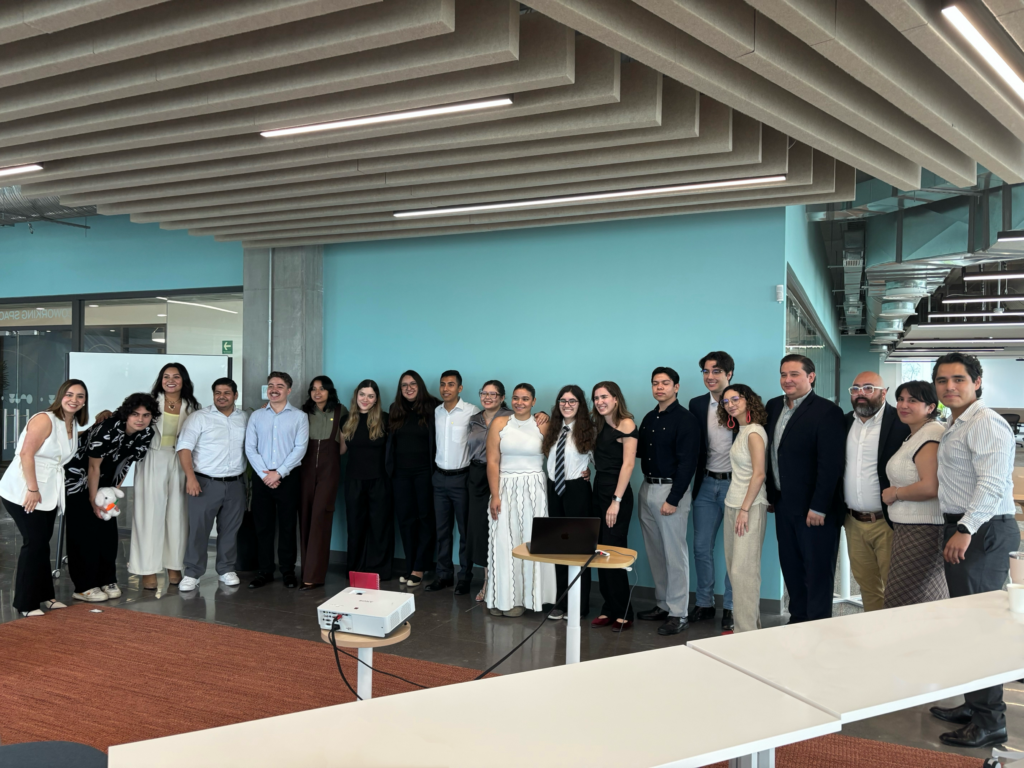
One purpose of Demo Day is to help students develop professional skills, such as presenting, arguing, and validating their ideas. Thus, their graduation marks the beginning of initiatives that position them as emerging leaders in the sector and a generation committed to transforming learning.
In this space, professionals formulate innovative proposals that meet the needs of companies, social organizations, communities, and learning processes, demonstrating their ability to turn educational challenges into concrete solutions. Each project reflects commitment, creativity, and an action-oriented vision, contributing to the strengthening of learning communities and promoting a more sustainable, inclusive education centered on people’s well-being.
Over the course of the ten-week integrative educational innovation learning block, this year’s cohort undertook an intensive process of designing and structuring ideas to address current challenges in education. Furthermore, these ideas focused on human beings and economic sustainability, with the purpose of contributing to access to, and the strengthening of, quality education for specific populations. During this journey, they also validated their project and oversaw its financial aspects.
Some of the professors who guided and supported the students during this stage were Priscila Rodríguez, Eder Estrada, Miguel Ángel Rodríguez, Titia Martínez, Marisol Flores, and Lesslie Rojas.
Martha Rendón, an LEI graduate, shares that this experience breaks with the usual dynamic in which a training partner defines the project’s needs; instead, the students identify for themselves what is required and what can be offered. In addition, she reflects from an educational innovation perspective that developing practical projects with immediate application is highly relevant today.
“Educational innovation is present in all learning processes, in how you relate to people, but above all in how you can generate this impact in any company or organization,” says Rubén Olvera, another LEI graduate.
In this most recent edition, the session featured the special participation of Leonardo Glaserman, Research Unit Leader at the Institute for the Future of Education (IFE); César Sánchez, Manager at the IFE Accelerator; Rodrigo Romo, Research Leader at Inverkids; María Paula González, Junior MOA Functional Analyst at Ternium; Sadie Guerrero, Director of Educational Technologies and Digital Transformation. These speakers provided valuable feedback, evaluating the feasibility, innovation, and sustainability of each project.
Below are the projects that were presented in the most recent session:
Astronautas Digitales (Digital Astronauts) | Sofía Rocha Castillo
The proposal involved presenting a gamified educational technology platform, designed to develop critical digital literacy, security, and digital citizenship skills in elementary education students.
Operación Recreo (Operation Recreation) | Emilia Toledo Canché
This socio-emotional program is based on game dynamics that prevent bullying and promote positive coexistence by empowering elementary school students.
Inglés a las Escuelas (English to the Schools) | Luisa Fernanda Castañeda Flores
This social impact initiative connects elementary schools with volunteers and provides structured lesson plans for effective language teaching.
Senti Kit | Camila Victoria Romero Chavez
This is a hybrid pedagogical solution (physical and digital) with agile dynamics and teaching guides for socio-emotional management and conflict resolution in the elementary school classroom.
Corpus Consultoría Educativa (Educational Consulting Corpus) | Iztac Rubén Olvera Cámara
This specialized advisory service focuses on professionalizing institutional management and pedagogical practice in accordance with national and international quality standards.
Ruta Educa | Jesús Ignacio Quiñones Poqui
Ruta Ecuca consists of a consulting and teacher-training program in elementary education that, based on an institutional diagnosis, provides training in the pedagogical and contextual integration of artificial intelligence.
INGENIUM | Jesús Raúl Treviño García
This training development ecosystem for student groups integrates competency diagnosis, personalized learning paths, and data analytics for continuous improvement.
Beesy Hive | Greta Elizondo Martínez Sotomayor
This initiative offers an experiential kit of brief daily activities for parents and children, designed to strengthen emotional bonds and support early socio-emotional development at home.
LODU | Dulce María López Cruz
This digital assistant, powered by artificial intelligence, guides users in developing autonomy and sustainable financial habits through personalized support.
Contexta | Andrés Ruiz Gudiño
This curated curricular resource platform supports elementary school teachers in contextualizing SEP content and is complemented by active didactic mediation guides.
Holos | Martha Cecilia Rendón Cruz
Holos comprises a digital ecosystem (web and in-app) that supports families in monitoring, stimulating, and understanding the key milestones of motor and cognitive development in early childhood.
Nutrikid | Ángeles Teresa Cisneros Aguilar
This visual, interactive recipe book is designed to encourage children’s participation in the kitchen and facilitate the practical learning of fundamental notions of nutrition and well-being.
Capital | Víctor Asís Galán Pacheco
“Capital” is a training board game focused on developing family financial education, designed to encourage conscious, collaborative economic decision-making between parents and children.
These efforts testify that the future of learning is being shaped today. By putting innovation at the service of people, these initiatives demonstrate that transforming education is not only possible, but urgent. Spaces like this provide the impetus to spark new ideas, connect talents, and highlight the relevance of rethinking how we learn and teach in today’s Mexico.