
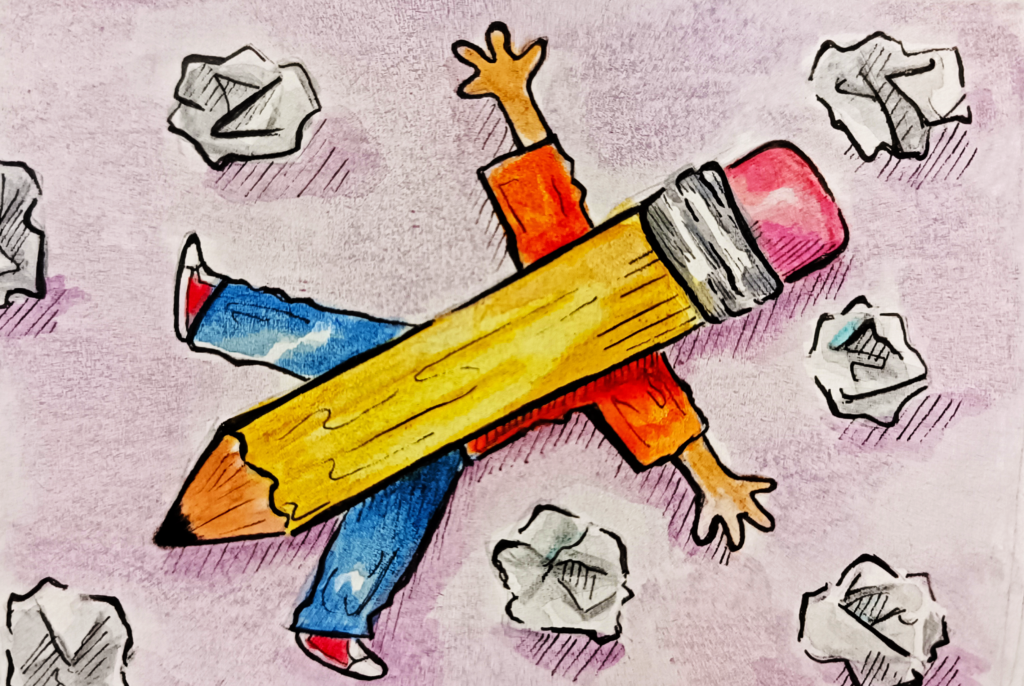
Every person who has been given the task of writing has encountered that irrational fear of sitting at their desk and confronting a blank sheet of paper that seems enormous and menacing. Or, in the same way, sitting in front of the computer and looking at that Word file (or similar software), instead of writing itself as we would like for it to do, it returns our gaze with the cursor blinking on the left edge of the document. With a blank mind and fingers flat on the computer keyboard, it is here that we usually self-diagnose ourselves with what we have read about on the Internet or heard from other colleagues: writer’s block.
What better way to face the enemy than by knowing him? Despite being a concept that has been referred to thousands of times (with that single term, we can understand its meaning), writer’s block goes beyond its definition and has a long history.
Background
Writer’s block is “the condition of being unable to create a piece of written work because something in your mind prevents you from doing it,” says The Cambridge Dictionary. It is not something new. Feeling blocked when writing goes way back to when people began to write years ago and can occur during different stages of the creative process. Having perfect ideas to write something is so precious and magical that the ancient Greeks attributed their inspiration to muses! Contrarily, finding yourself without ideas about what to write next is one of the biggest nightmares for authors of any era.
Some famous writers have also expressed their frustrations about feeling unable to write. Franz Kafka, best known for his acclaimed work The Metamorphosis, has a couple of entries in his diary where he talks about these feelings:
“March 11. “How time flies; another ten days and I have achieved nothing. It doesn’t come off. A page now and then is successful, but I can’t keep it up, the next day I am powerless.”
“23 March. Incapable of writing a line.”
Virginia Woolf had similar thoughts on the matter, which she also recorded in her diary:
“And I ought to be writing Jacob’s Room; and I can’t, and instead I shall write down the reason why I can’t—this diary being a kindly blankfaced old confidante. Well, you see, I’m a failure as a writer.”
Gustave Flaubert, author of Madame Bovary, expresses resembling sentiments in a letter sent to George Sand (actually a pseudonym used by the writer Amandine Aurore Lucile Dupin when publishing her books so that her works wouldn’t be overlooked for being a woman):
“[…] You don’t know what it’s like to spend a whole day with your head in your hands trying to squeeze your unfortunate brain to find a word. For you, ideas come easily and incessantly, like a stream. For me, it’s just a trickle of water.”
These literary legends, who lived many years ago, suffered from the same thing as many of us in modern times, so it can be said that the blessing of writing also carries the intermittent curse of writer’s block. However, the condition did not have a specific name during those times.
Only at the beginning of the twentieth century did several psychoanalysts, who were Sigmund Freud’s students, begin to investigate the subject. Psychiatrist Edmund Bergler coined the concept of writer’s block in 1947 by “studying writers who suffered from ‘neurotic inhibitions of productivity’ in an attempt to determine the reason why they were unable to create – and what, if anything, could be done about it” (Konnikova, 2016). Thus, Bergler named this condition, which many other people later studied.
However, many debates wage about whether writer‘s block exists, mainly because it is not a medical condition. Some authors do not believe in this concept since it’s just another form of anxiety. On the other hand, other authors argue that writer’s block does exist, as many writers have experienced it.
Causes
This blockage has no specific duration; it can last minutes, weeks, and even years for some. But what causes it? Sarah Ahmed, backed by various authors, affirms in her study that the reasons fall into four categories:
- Physiological: conditions such as depression, anxiety, fatigue, and stress can be the reason why someone could feel unable to write. Likewise, having a mind oversaturated with other matters will not leave space to deal with the creative process properly. Burnout is also a cause that falls into this category.
- Motivational: refers to indifference to writing due to the feeling of not being good enough and fear of criticism; what others think may decrease some people’s enthusiasm for writing. Similarly, apathy for writing may occur because it feels like an obligation; other motivational depletions also lead to these blocks.
- Cognitive: Extreme attention to detail or perfectionism can impede attaining the desired inspiration. Over-attention to structures, grammatical rules, and planning can slow down the creative process. It can lead to limited thinking, where creativity is restricted as well.
- Behavioral: These are causes related to lack of practice, organization, and procrastination, where a person decides to postpone writing because they do not have a specific schedule or they’d instead perform other activities before writing.
Whether or not you are an experienced writer, everyone is prone to writer’s block. A beginner may feel lost because they aren’t used to writing, or they may not like it. An experienced writer, on the other hand, may find themselves feeling pressured to release a masterpiece or become stressed about producing an upcoming installment. Writer’s block does not discriminate, and the reasons why people suffer from it are as diverse as each individual’s different personalities and experiences.
Yes, you can escape!
Even so, some tips can help you get past this blockage. However, it is essential to mention that not all these will work the same for everyone. The best option is to understand what is happening and choose the remedy that attacks the specific reason:
- Write: As we saw earlier, Virginia Woolf described her frustration at being unable to continue her work. Write about why you can’t write, describe your day, or narrate what you are thinking now; taking the first step by just writing anything can be beneficial. Sometimes, you may find ideas or encouragement that can help you start or continue your creative process.
- Unplug: Being in front of the computer (or a blank page) won’t magically make things write themselves. You probably need a change of scenery so you don’t get stuck in the same vicious cycle of focusing on being unable to write. Doing some of your favorite hobbies or exercising, even if it’s walking, can help you feel more energetic, and getting some fresh air may help you come up with more ideas.
- Get informed: Many times, when you start writing a text, you don’t know where to go next due to a lack of information. Researching more about your topic and sorting through the information helps you broaden your horizons and open the way to new subtopics and ideas.
- Question: You can turn to a colleague, friend, family member, etc., for different perspectives you may not have considered. Similarly, generative artificial intelligence can also help you brainstorm ideas.
- Focus: In this digital age, it’s hard to stay unplugged. While computers offer us everything we need and more, having a world of distractions like social media and other entertainment in the same place can be a double-edged sword. Minimize or eliminate these distractions by closing tabs unrelated to your work, muting your notifications, or using apps like Forest to focus. Similarly, writing in a peaceful environment can also help boost your productivity.
- Relax: Be patient. Writing is a process that takes time. Sometimes, we pressure ourselves because we want our next piece of writing to be successful; we are worried about not being good enough or scared of what others may think. Lower your expectations, don’t be too hard on yourself, and trust your abilities.
It should be noted that knowing the root of the problem will not be enough in difficult personal situations since many cannot be resolved quickly. It may be necessary to take a little break from writing and, when you are willing, return to it. On the other hand, writing could even work as a distraction from the situation, making a person clear their mind and feel a little better.
Legends such as Gabriel García Márquez expressed their terror when they began to write: “The blank page is the most distressing thing I know after claustrophobia.” If this famous writer (and many others) was afraid of not knowing what to write, why don’t we take pity on ourselves? Deep introspection about our feelings will be the best way to deal with this problem and become victorious.
Let’s not delay our work and hide behind the concept of writer’s block; instead, let’s address the problem. It is crucial not to be passive during this blockage but to give ourselves a space to reflect, analyze, and then develop a solution to escape our mental block.
Translated by Daniel Wetta