)
)
)
)

By the end of the IFE Conference 2025, an annual event at the Institute for the Future of Education (IFE) at Tecnologico de Monterrey, Monterrey campus, the attendees and speakers had acquired new knowledge and reflections from the more than 250 activities related to the future of education. The IFE Education Policy Summit was included in all the offerings of conferences, panels, awards, and networking, and it comprised a series of sessions dedicated to discussing educational policies.
Educational policies must not be left behind in this erratic and changing world. They must keep up with the demands of the academic and professional fields and support the training of professionals with the right skills to satisfy the needs of various industries. Therefore, generating an environment where these issues can be addressed is paramount to disseminating new trends and strategies that improve quality, access to education, evaluation, financing, and technologies that are changing education and the world. All these points came from the contributions of education experts from multiple fields.
The conference Lessons from the US to Transform Learning and Work in Latin America, by Sharon Leu, a resident executive for JFFLabs, highlighted the current state and common aspects shared by the United States and Latin America regarding today’s challenges in education and employability. During the talk, Leu discussed three of these challenges:
- Employers need talent, and they seek college graduates. However, approximately 37 million people did not finish university and, therefore, do not have a university degree.
- Most people working are aging; five million young people do not study or work.
- Artificial intelligence systems are eliminating jobs and positions for workers. Currently, 27 million people have been replaced by automated systems.
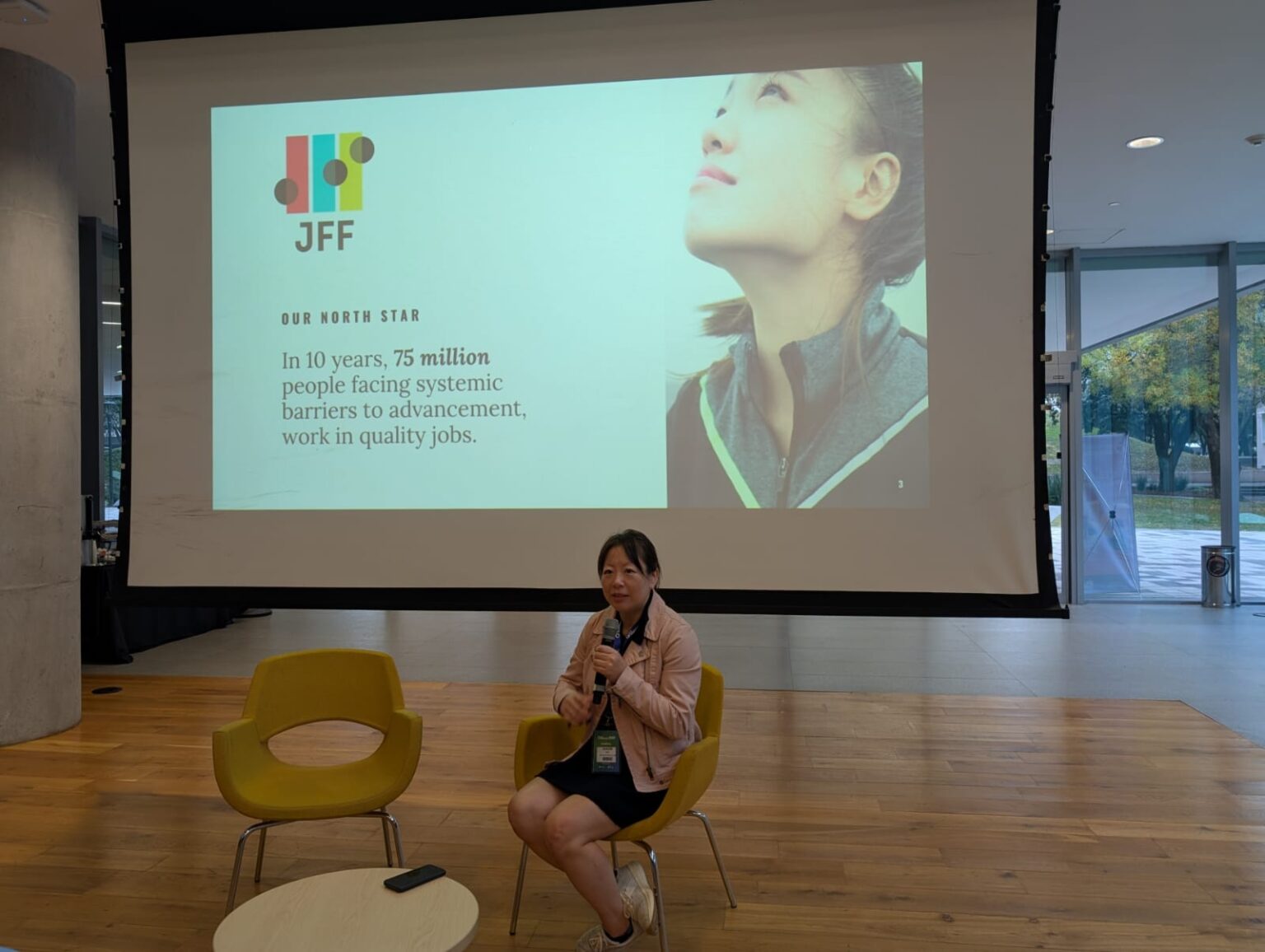
While these points are concerning, they also point to ways institutions can counteract these problems. During the conference, Leu highlighted the importance of data usage in identifying specific obstacles. First, knowing the environment to detect needs and seek solutions to overcome these and other challenges is essential.
Young people’s apathy makes it imperative that institutions focus on engaging newer generations to cushion the impact of aging personnel. Similarly, strengthening verifiable digital credentials and refining best practices for finding talent focused on specific skills will benefit both workers and companies.
On the other hand, the panel Transformation of Educational Policies: Challenges and Opportunities for the Future of Work gave attendees a glimpse of the work environment that graduates will face soon. This panel, moderated by Claudia Uribe, included the participation of Arturo Cherbowski, Executive Director of Santander Universities and General Director of Universia Mexico; María De Las Mercedes Miguel, Minister of Education of the City of Buenos Aires; and Sofialeticia Morales, Secretary of Education of Nuevo León. It stressed the importance of primary education as a space to consider future problems, contradicting the belief that only higher education should be responsible for them. The panel also highlighted the role of teachers in the teaching and learning process at all educational levels, clearly presenting that, in the search for quality, it is necessary to improve teaching staff’s conditions, including their salaries, and adopt a new perspective of their work. It was concluded that, although it is needed to prepare students for the labor market, this is not the primary purpose of education, and it must also consider people’s well-being.
Another interesting session for this Summit was AI and Strategic Data: Policies for Innovative and Responsible Learning, in which the conversation revolved around the ethics that should be involved when working with Artificial Intelligence in education. This panel was moderated by Paulo Blikstein, Director of the IFE’s Research Lab, with the participation of Francisco José García Peñalvo, Professor of the Department of Computer Science and Automation at the University of Salamanca; Melchor Sánchez Mendiola, Coordinator of Educational Development and Curricular Innovation at UNAM; and Luis Portales, IFE’s Leader of Experimentation and Impact Measurement at Tecnologico de Monterrey. The group discussed different ethical implications of user privacy, transparency in data, and how algorithmic biases could be avoided in AI tools.

They also covered aspects mentioned during the keynote speeches, such as the myths surrounding these new technologies and how misinformation should be countered. Ultimately, they pointed out that this new knowledge is here to stay, and people will use it in their daily lives. Given this, different policies and regulations are required to regulate AI and protect users.
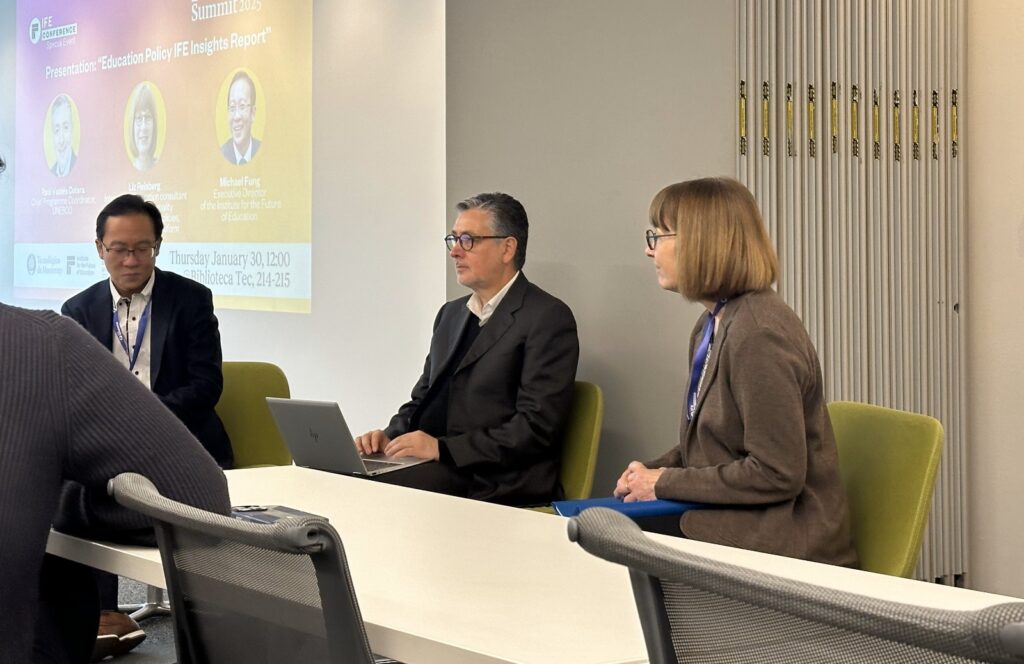
On the other hand, the IFE Conference hosted the report Educational Policies: Lessons from the IFE Conference 2024, presented by Raúl Valdés Cotera, team leader of the UNESCO Institute for Lifelong Learning, together with Liz Reisberg, consultant and member of the Advisory Board of the Center for International Higher Education at Boston College. The session was moderated by Michael J. L. Fung, Executive Director of the Institute for the Future of Education (IFE).
Throughout this conversation, which took place in one of the institution’s library rooms, experts reflected on the lessons learned from the IFE Conference 2024, which focused on adapting education systems to current trends and future challenges. The session sparked an in-depth discussion on reimagining policies to ensure quality, inclusivity, and innovative education. It spotlighted the importance of educational policies in creating resilient societies that are future-ready.
In this context, lifelong learning was emphasized as an indispensable tool for adapting to the continuous changes of the modern world. It fosters the development of skills, drives innovation, and allows people to remain competitive beyond the workplace, thus improving their well-being and ability to face professional and personal challenges.
This free report can be downloaded along with others in the IFE Insights series here.
The 2025 IFE Conference made it clear that the future of education depends on policies that adapt to a dynamic and changing environment. The IFE Education Policy Summit delved into the need to update and renew educational strategies to ensure that future professionals have the necessary skills to face emerging industry challenges. Discussions and presentations by experts highlighted the urgency of improving critical areas such as educational quality, equitable access, assessment and financing, and exploring how technologies transform the global education landscape.
IFE Conference 2025 offered a valuable space to exchange knowledge, experiences, and opinions. It became apparent that education in the future must align with the demands of a continuously evolving world without neglecting people’s well-being. The lessons learned should empower action to create more effective and relevant policies for upcoming generations.
Translation by: Daniel Wetta

)
)
This article from Observatory of the Institute for the Future of Education may be shared under the terms of the license CC BY-NC-SA 4.0