)
)
)
)

Education is a journey that provides us with the opportunity not only to learn, but also to apply the knowledge acquired and verify, through various means, that it is correctly applied to our daily lives. Due to feedback, people can focus on working on areas for improvement, thereby enhancing their overall performance exponentially.
Although feedback is a valuable component of the learning cycle, it is often overlooked, incomplete, or omitted. Feedback is sometimes not offered because some teachers underestimate this practice and deem it unnecessary or lack time within the educational process.
Moreover, teachers and students may face the dilemma of wanting to contribute to the development of another person through feedback. Still, they fear hurting their feelings or worry about the effects it could have on them (such as demotivation, frustration, or even quitting), so many keep restraining from voicing their opinions instead.
However, this can be counterproductive. Of course, empathy toward others is a virtue, and the last thing we want is to insult the recipient or inadvertently hurt their susceptibilities. However, failing to provide feedback on the other person’s work can impede their growth and overlook areas for improvement. Without honest feedback, the person cannot know precisely what they need to improve, or they may have a misconception about their work that obscures their vision of a goal to improve or avoid making the same mistakes. Thus, even if it’s difficult, it is better to know areas of opportunity and correct them than not to understand and do nothing about them.
Notably, feedback does not mean only criticism or pointing out what is wrong, but also includes noticing, thanking, and congratulating the person for those skills or actions they applied correctly. It is essential to balance positive aspects with the “negative” or “what is lacking.”
The timing of feedback is also essential to consider. Immediate feedback is best for responding to classroom oral expressions, attitudes, or actions. In this way, the student receiving their teacher’s comments will remember more precisely how they carried out the activity. From this, they can reflect on their actions and make productive use of the feedback they were provided with.
However, feedback in the moment is not always convenient; sometimes, situations do not allow enough time to provide feedback to everyone promptly, or the activities do not necessarily require input (for example, corrections to a written piece or an exam).
It is essential to note that the person providing feedback should do so only in situations that warrant it, as continuous feedback can also overwhelm the recipient, unless they explicitly request it. For example, a good practice in the workplace is to have short sessions between a supervisor and their collaborator every week to recap the events of the last seven days. Similarly, general feedback on what happened during the work cycle can be valuable for summarizing the receiver’s overall performance.
Of course, asking, pointing out, or correcting may not be pleasant. Still, in the long run, it contributes to the development of others in various areas, and the benefits of consistently practicing this approach are numerous.
Benefits of feedback
- Encourages self-reflection: Feedback invites recipients to reflect on their feedback and make positive changes. This acts as motivation that promotes self-learning.
- Invites dialogue: Giving and receiving feedback opens a channel of dialogue that could otherwise be difficult to open. It can initiate a valuable conversation that benefits both parties at that time or in the future.
- Strengthens relationships: Feedback helps trust flow between friends, co-workers, schoolmates, and authority figures, thus opening an opportunity for suggestions and fraternal corrections without fear of damaging susceptibilities but, instead, encouraging improvements in all.
- Encourages personal growth: Taking criticism impersonally tears down a crucial barrier to personal development. With this ability, people can accept corrections and suggestions, strengthening their self-esteem.
But how can we provide good feedback? Thankfully, various institutions have developed strategies that guide how to promote people’s development in both academic fields and the workplace, as well as personally. Below are a couple of simple methodologies that can help structure your thoughts and comments to provide good feedback.
Feedback Sandwich
The Feedback Sandwich, coined by Marshall Goldsmith, is a methodology that gained popularity in the workplace in the 1980s due to its simplicity. It consists of praising the person with a positive comment, then proceeding with constructive criticism, areas for improvement, requests, and corrections, and concluding with positive comments and reinforcement. Thus, the positive feedback items are the slices of bread that “wrap” the ingredients, which are the areas of opportunity.
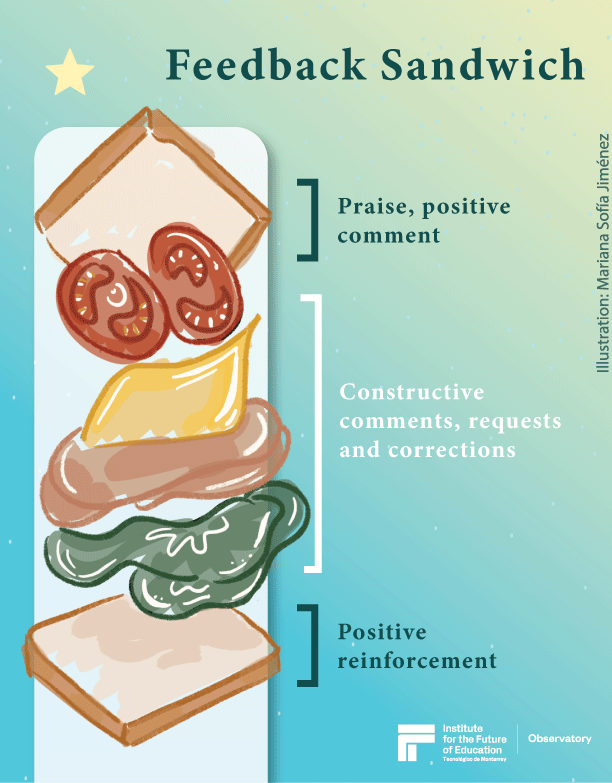
Example: “Thank you very much for your participation. I think you made comments that contribute positively to the class (praise). However, I consider that the way you did it, interrupting your colleagues, is not the best approach, and you should wait for your turn (criticism). Even so, I am happy to know that the topics we cover in class are to your liking (reinforcement).”
This is a straightforward method for people who find it challenging to give criticism or make requests, as the praise at the beginning and end cushions the “tough” part of the feedback. This approach is also practical for corrections that are not extensive or complex, and it serves as a good starting point for those unaccustomed to providing feedback.
However, we must be careful when using this technique. It might be that the slices of bread are so thick that the ingredients filling the sandwich pale in comparison. In other words, praising the receiver too much muddies the real message, and their misconception could lead them to focus only on what they did correctly and overlook improvement areas.
The Feedback Ladder
The Feedback Ladder is a tool created by the Harvard Project Zero initiative dedicated to understanding learning. This methodology aims to structure feedback so that the communication to the receiver is clear and concise. It consists of four stages:

- Clarify: Resolving any questions underlying the feedback before issuing any criticism is essential. Without doing this, a clear explanation of specific ideas could be omitted or not offered, so it is imperative to clarify them.
- Example: “Before we start, I would like to ask a few questions about the frozen jellies venture you just presented to the classroom. How long do they last in the refrigerator? Are there other flavors besides strawberry and apple?”
- Example: “Before we start, I would like to ask a few questions about the frozen jellies venture you just presented to the classroom. How long do they last in the refrigerator? Are there other flavors besides strawberry and apple?”
- Value: In this stage, the recipient’s performance is recognized and appreciated, accentuating the positive aspects of the work, performance, or action.
- Example: “Thank you for sharing your idea with the class. Your marketing campaign for this project is phenomenal; I think it’s aimed at the right people and could be implemented effectively.”
- Example: “Thank you for sharing your idea with the class. Your marketing campaign for this project is phenomenal; I think it’s aimed at the right people and could be implemented effectively.”
- State concerns: Do this directly and respectfully, pointing out the corrections, failures, and concerns that you want the person to understand so they can consider this criticism and improve.
- Example: “It seems to me that the cost of your product is very high, which I would think is due to production costs. Also, I think that the individual portion is tiny.”
- Example: “It seems to me that the cost of your product is very high, which I would think is due to production costs. Also, I think that the individual portion is tiny.”
- Suggest: Finally, this stage is when guidance and suggestions can be provided to highlight the areas of opportunity or correct what prevents the feedback recipient from improving.
- Example: “Maybe you can do this to lower the cost of production and make the product accessible to more people, and not only that, but you can also increase the individual portion size through this.”
When giving feedback, ensure that suggestions and criticisms are realistic and focus on what the person can change, rather than what they have no control over. For example, suppose the criticism is that the student’s presentation started ten minutes late because the projector did not work. In that case, the fact that the projector did not work or that the student could not fix it should not be held against them. Instead, suggest that they arrive minutes before their presentation starts to ensure everything works correctly and have alternatives in case technology fails.
Additionally, the comments and suggestions provided must emphasize that they just opinions, as this feedback is based entirely on a particular perspective.
How to receive feedback efficiently?
However, receiving feedback can also be tricky. It is crucial to understand that, beyond criticism, feedback is a strategy that benefits professional development. The feedback recipient should be aware that the criticism provided is constructive and directed at the work performed, not the person. Some tips for receiving feedback efficiently are the following:
- Wait for the person providing feedback to finish speaking: Be patient! It is essential to remain silent while the person makes their points, and avoid hasty conclusions by not interrupting until they have finished what they have to say. This way, suggestions, comments, and proposals can flow uninterrupted, ensuring complete feedback. Wait until the person finishes speaking to recognize and develop a plan to improve your performance.
- Recognize without excuses: Own your words and actions, don’t try to excuse them, and work on them next time to improve your performance.
- Be aware of your language: Beyond spoken language, remember that our posture and gestures can betray our dissatisfaction or displeasure, so it is essential to regulate our communication with both tone of voice and body language when receiving feedback.
- Always be grateful: The people who provide us with their opinions took on the task of identifying and analyzing our performance, so it is important to thank them for the time and effort they have dedicated to identifying our strengths and areas of opportunity.
Despite being very useful in the educational field, the workplace, and social settings, feedback is often omitted, misunderstood, or even frowned upon. However, it is a step in the learning process that holds high personal value, and we should treasure what another person, who seeks our integral formation, offers us. This practice must be implemented in the classroom, allowing students to engage in and normalize dialogues and healthy conversations that foster mutual growth.
Translation by: Daniel Wetta

)
)
This article from Observatory of the Institute for the Future of Education may be shared under the terms of the license CC BY-NC-SA 4.0