
Integral education encompasses cognitive, emotional, social, and physical development, as well as students’ curiosity and creativity, which are key components of human growth that are impelled through learning environments. These physical, environmental, and social spaces are essential for the educational process of children and young people, where they have the opportunity to interact and receive training from motor skills to autonomy. They also create a sense of belonging to the community and educational institutions.
An effective learning environment poses a challenge for the educational community because it must promote the integral development of children through safe, stimulating spaces tailored to their needs, explains Pedro Luis González Rivera, a specialist in Pedagogical Sciences. These environments encompass both the physical environment, with areas for play, art, and reading, as well as social, emotional, cognitive, and cultural aspects.
Each of these components promotes specific skills: the social environment strengthens interaction, empathy, and communication; the emotional climate fosters affective security and emotional expression; the cognitive environment promotes critical thinking and creativity; and the cultural environment cultivates respect for diversity. Under the guidance of committed adults, these spaces offer valuable opportunities for students to play, explore, and learn.
In these ecosystems, people with similar educational purposes converge, where a guide, the teacher, maintains a respectful and reciprocal dialogue. The classroom comprises two elements: the physical, architectural space and the sensory, emotional environment. Thus, beyond material conditions and the interpersonal relationships between teaching staff and students, the learning environment encompasses the processes and relationships in the educational environment.
Therefore, learning should occur under conditions that offer appealing and challenging materials in a specific physical space, facilitating collaboration and adequate, comfortable interactions.
A few years ago, Rosan Bosch, a renowned Dutch architect and designer, explained to the IFE Observatory that students need to be motivated and activated. This requires modifying their physical environment into places that seem comfortable to them, where they can concentrate and become motivated to learn and collaborate. He emphasizes that when a building, such as in a university, is well-designed, it generates in people a sense of respect for the individuals and the activities that take place inside.
Bosch is internationally acclaimed for differentiated learning environments, specifically interior designs at Vittra schools in Sweden. Instead of following a traditional classroom model, he implemented an open environment in these institutions, utilizing custom furniture that defines distinct areas with unique names for various types of activities. These designs aim to encourage children’s curiosity and creativity.
Her teams’ designs follow six principles that link learning with the physical environment to effectively develop twenty-first-century skills:
- Top of the mountain – a person addresses an audience in a teaching role and shares their vision and knowledge.
- Cave – a small, quiet place for one or two people, encouraging concentration and individual reflection.
- Campfire – Here, students are trained to work effectively in small groups, paying attention to dialogue and enhancing their capacity for collaboration.
- Watering hole – Facilitates informal, social, and circulatory spaces, where disruption can occur and lead to unexpected ideas, surprises, or inspirational information.
- Hands-on work – a laboratory that adds a non-verbal dimension to learning, connecting theory and practice, such as body and mind, perception and play.
- Up! – Incorporates movement in any scenario, crucial for energizing the learning process, regardless of the topic.
This flexible model, where students experience spaces contextual to the situation, helps to cultivate their creativity, critical thinking, collaboration, and self-learning. Integrating these principles into design triggers the senses through the use of colors, tactile materials, and strategic lighting that capture attention; the design provides ample spaces for extended dynamics.
These learning environments are designed to enable participants to acquire knowledge and develop skills in an optimized manner. They must be flexible and adapt to students’ needs, objectives, and preferences so they can learn actively, following the principles of constructivism. Meanwhile, the teacher has the responsibility to modify the classroom environment to meet the class’s needs and facilitate interactions.
Characteristics of learning environments
A learning environment comprises physical scenarios, contexts, and cultural factors. It consists of four dimensions:
- Physical– material/tangible elements constructed and organized in the environment, such as the classroom and furniture.
- Functional– refers to how spaces are used, i.e., the activities that take place in a specific place and the guidelines for the tasks and the means for performing them.
- Temporal– the organization of time and instances in which learners use a space, providing a rhythm for classes and dynamics, such as choosing between asynchronous and synchronous courses.
- Relational– the correlation of the connections established in the previous dimensions with the active participation of all actors. It encompasses the style of interpersonal relationships between teachers and students, or between classmates, and whether the teacher will lead or opt for a cooperative approach.
Categorization of environments in which learning occurs:
- Physical environments– tangible environments where learning processes take place, such as classrooms, but also the home.
- Virtual environments– digital environments that do not require the physical presence of any of the actors in the teaching-learning process; learning occurs through electronic devices such as cell phones, computers, or tablets.
- Formal environments– those in government-regulated education systems.
- Informal environments– A teacher or tutor does not accompany or set the tone for a specific curriculum. Examples of informal environments include the home, museums, and libraries.
Learning environments are primarily characterized as spaces planned by teachers, who develop strategies that favor content assimilation and put students in a central, active role throughout the process. Four elements comprise these environments:
- Information– includes all the content to be transmitted.
- Interaction– covers the methods and tools used by students and teachers to communicate in a relationship of respect and trust.
- Production– is a result or material product that the student provides as evidence of learning and new experiences.
- Exhibition– The student shares their product and discusses it with their classmates.
It is essential to recognize that not all environments will be similar; instead, they will be variable, adapting quickly to the required conditions while also considering social and cultural factors.
Physical ecosystems of learning
The school’s physical space can significantly impact the academic performance of students and the perception of a favorable educational climate. The institution’s facilities can be linked to students’ performance in subjects such as English and mathematics. Therefore, architecture, pedagogy, and technology are articulated as primary components of a stimulating educational environment.
EmotionLAB, a company that designs and transforms educational spaces, shares some strategies for school designs that promote critical thinking and active student participation. Primarily, it requires thorough planning and a deep understanding of the students’ needs and purposes. Establishing the educational objectives that the school aspires to achieve is essential to define the experience to provide and align it with the strategies to follow.
Effective school design requires not only adequate spaces but also innovative student-centered pedagogies. In the digital age, incorporating technological tools such as interactive devices, electronic whiteboards, and educational software allows students to experience new, interactive dynamics.
The entire academic community must participate in redesigning schools, as it enables the integration of diverse perspectives from students, teachers, families, and other stakeholders. Therefore, involving the entire institutional community in co-design promotes more inclusive spaces.
Similarly, school architecture is essential in creating functional and inspiring educational environments. A good spatial design must strike a balance between aesthetics and functionality, facilitating interaction, creativity, and collaboration in spaces such as classrooms, common areas, and recreation areas. It must also prioritize accessibility and safety through elements such as ramps, adapted toilets, or wide corridors, and seek integration with the local environment and its natural landscapes to reinforce the sense of belonging. The choice of materials and the incorporation of renewable energy sources promote environmental awareness as a guiding principle for students.
Moreover, educational architecture is a discipline that transcends building construction: it includes planning that considers pedagogical, psychological, and social factors to drive meaningful learning. Aspects such as lighting, ventilation, and acoustics are also key, as they contribute to the well-being, concentration, and comprehensive development of those in the educational community.
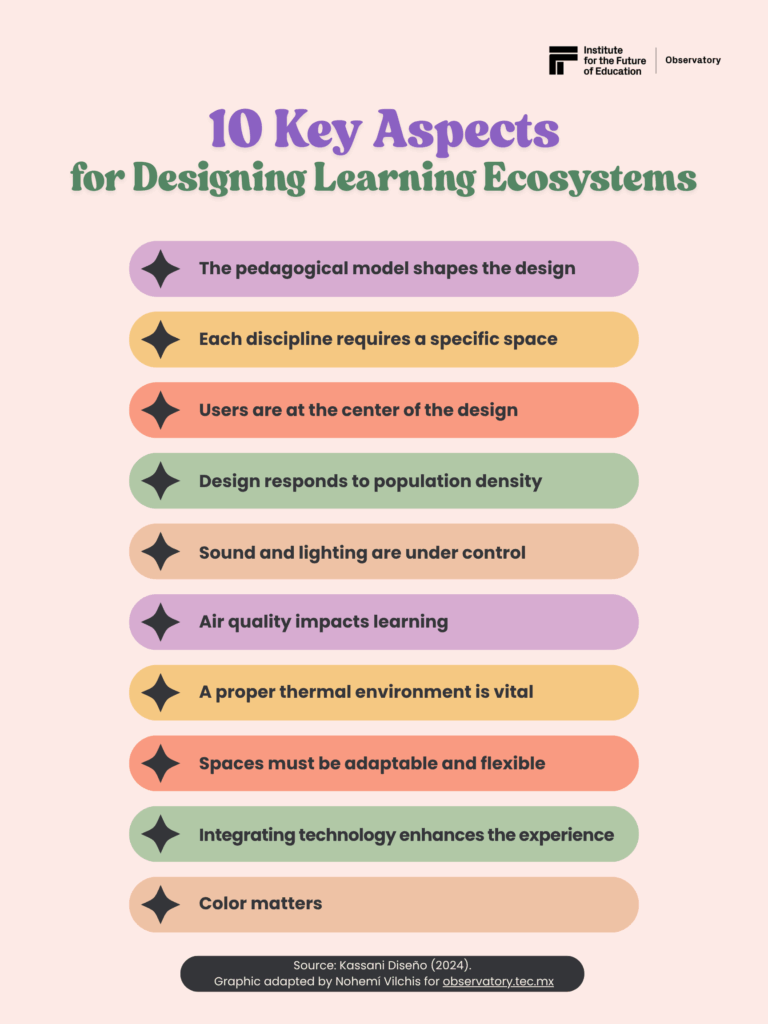
The company Kassani Diseño, based in Bogotá and specializing in furniture manufacture, maintains that design should not be limited to aesthetics, but should also fulfill a pedagogical function in learning environments. For this reason, it proposes 10 key aspects of educational space design that respond to students’ cognitive, emotional, and social needs to develop their skills to the fullest:
10 Key Aspects for Designing Learning Environments
- The pedagogical model serves as the basis for the design: First, the design of the space must align with the pedagogical model to ensure educational coherence and that the classroom functions as an active learning resource. For example, institutions with a constructivist approach require flexible and collaborative spaces that promote active learning, whereas traditional ones opt for a linear and structured approach.
- Each discipline demands a space: Spatial designs that accommodate the area of knowledge adapt environments for specific practices and more immersive learning. Science laboratories require technical infrastructure with areas equipped for experiments, language classrooms with conversation areas, and art classrooms with open spaces and resistant materials.
- Users are at the center of the design: Factors such as age, gender, individual or group preferences, and socio-economic contexts influence spatial needs. Designing with all users in mind creates inclusive and functional environments that benefit everyone.
- The design must respond to population density: The class size influences the design of the classroom. A well-organized layout and the right furniture can improve learning by optimizing space, minimizing distractions, and promoting comfort.
- Sound and lighting are under control: Good acoustics prevent noise distractions. Adequate lighting, whether natural or artificial, enhances attention, well-being, and cognitive performance while reducing eye strain.
- Air quality impacts learning: Adequate ventilation improves concentration, reduces stress and absenteeism due to health problems, and enhances learning, making ventilation and purification systems a design priority.
- An adequate thermal environment is vital: Extreme temperatures affect concentration and academic performance; thus, a sound air conditioning system guarantees a comfortable environment that allows students and teachers to focus on their respective tasks.
- Spaces must be adaptable and flexible: Flexible spaces with modular furniture and transformable areas facilitate various pedagogical dynamics, promoting creativity and collaboration in learning.
- Technology can elevate the experience: Although they must be implemented purposefully, audiovisual media such as interactive screens and mobile devices are essential in modern education for access to digital content and the development of technological skills. This prepares students for current and future challenges.
- Color matters: Colors have a significant impact on emotions and behavior. Warm tones, such as yellow and orange, encourage creativity, while cool colors, like blue, facilitate concentration. A well-chosen color palette improves educational dynamics and motivates students.
In 2021, the design studio Estudio b76 renovated the facilities of the La Salle Maravillas school in Madrid to promote key academic and work skills. In 2016, the German School of Montecarmelo, designed by Grüntuch Ernst Architects, stood out for its emphasis on collaboration and communication. Featuring open spaces that facilitate interaction and learning among students, it was awarded at the World Architecture Festival (WAF).
Likewise, a study conducted by Anna Kristiina Kokko and Laura Hirsto from the University of Eastern Finland revealed that best practices for learning environments are developed in physical spaces through active negotiations and interactions between teachers and students, and among student peers. In this way, learning environments are transformed both inside and outside the school classrooms. This research builds upon the conclusions of previous studies that emphasized the importance of social relationships during times of change.
One criticism of the current educational system in public schools is that it resembles the factory model, where students are grouped by age, sit in organized rows, and progress through successive grades. This approach is far from the path on which education is progressing. Students must be involved, so there are elements that make it easier for this to happen, such as:
- Classroom Layout – The seating arrangement significantly influences the learning process; therefore, students with attention difficulties should be seated closer to the teacher. Students with externalization problems may feel included sitting next to well-known, prosocial peers. Group seating is more effective for collaborative learning. Horseshoe-shaped seating arrangements make classes more engaging and encourage participation in discussions. Seating accommodations for students with hearing impairments may include centrally assigned locations close to the front of the class, swivel chairs, staggered seating arrangements, and placement away from areas of structural noise.
- Dynamic Seating – This feature allows users to adjust their seating position to enhance attention and engagement. Availing different-sized desks and chairs improves the focus and participation of students with autism spectrum disorder (ASD), Down syndrome (DS), or attention deficit hyperactivity disorder (ADHD).
- Flexible Learning Spaces – The furniture can be rearranged to meet the diverse needs of the student body. It can include sofas, adjustable chairs, soft seats, mobile or adjustable desks and tables, and flexible shelves, among others, thereby increasing students’ autonomy and self-regulation.
- Self-regulation spaces– Self-regulation involves monitoring one’s thoughts, feelings, and behaviors. Thus, a private space (such as a corner in the classroom, a bookshelf, or a separate room) should be provided so that any student can isolate and balance sensory stimulation, allowing them to re-compose themselves.
- Illumination – Light influences our perceptions, creates atmosphere, and transforms spaces more profoundly than furniture or accessories. Natural light can be beneficial for students. However, classrooms are often overly lit by fluorescent lamps, which can cause headaches, eye strain, and discomfort, potentially affecting their academic performance negatively. Lighting with a higher color temperature can enhance student performance and reduce morning fatigue.
- Color of the walls – Colors can significantly impact people’s moods and even influence stress, depression, and concentration. A contrast between colors should be created for critical surfaces in the classroom, although it should not be too extreme. Cool tones can improve memory and attention.
- Plants– Houseplants improve the quality of the environment and bring physical and psychological benefits to students. Houseplants can improve air quality by reducing air pollution, thereby enhancing indoor environmental quality. Moreover, the plants’ green colors can lead to greater student creativity.
- Acoustics and music – It is crucial for teachers to understand how noise and music in the classroom can impact learning, as both can have either a positive or negative effect on students. Noise levels impact academic performance, cognitive processing, reading, and numerical tasks. Some evidence suggests that chronic exposure to sound levels can influence children’s cognitive development, and, notably, noise affects young children the most. Open-plan classrooms should use sound-absorbent ceilings 3.5 m high or less, divide the space between classes, limit the number of class bases to three or fewer, and provide sufficient floor space for the children.
- Air Quality and Temperature – Processing speed, concentration, and math skills improve in classrooms with high ventilation rates. Students’ performance on psychological tests and homework increases by an average of 20% when the classroom temperature drops from 30°C to 20°C. It is worth noting that the impact of classroom temperature on students’ cognitive performance is significantly greater than that on adults in office environments.
Tips for teaching practice
The social communicator and editor, Ana Gabriela Rivera Díaz, points out that teaching practice only makes sense when students have achieved the learning outcomes of the curriculum, which requires teachers to have clarity in their work. To do this, they must thoroughly know what they teach, consider how their students learn, provide support and feedback, encourage respectful interactions with high expectations, properly manage time and resources, design appropriate didactic sequences, reflect on their practice, become professional, collaborate with others, and maintain effective communication with the educational community.
For his part, Higor Rodríguez Vite, a research professor at the Autonomous University of the State of Hidalgo, suggests that learning environments in higher education should provide conditions that enable students to explore, understand, and engage with content relevant to their daily lives from their perspective. Beyond infrastructure and resources, its effectiveness largely depends on the initiative, creativity, and interaction of the facilitator, who guides the development of key skills and competencies essential for life. Given this, it is necessary that guides or tutors know the students and can identify their abilities and interests, thereby establishing effective group or individual dynamics.
The Paulo Emilio Macías Higher Technological Institute in Portoviejo Canton, Ecuador, offers a practical guide to the design and development of learning resources and environments with workshops that explain the process of selecting educational materials and environments.
To summarize the recommendations of this text, when planning a learning environment, some essential concepts must be considered. First, the teacher must have a deep knowledge of their students, since each has unique skills, expectations, and interests, to adapt classes effectively. In addition, spatial organization is crucial because a spacious, well-lit, and ventilated classroom provides a welcoming environment that favors learning.
It is also essential to plan the necessary educational materials for each activity and tailor the content to various strategies, utilizing attractive and diverse resources that encourage active participation from the student body. Finally, the diversification of content and its connection to the daily life and social reality of students are essential to make learning relevant and applicable.
Likewise, Rodríguez Vite presents some consolidating educational strategies to stimulate the development of different competencies in learning environments:
- Collaborative learning
- Simulations
- Concept Maps and Mind Maps
- Laboratory or workshop internships
- Conferences
- Shows
- Problem-Based Learning
- For Information and Communication Technologies: the use of the internet, e-mail, and discussion forums
- Recreational activities
The creation of effective learning environments depends on multiple interconnected factors, such as infrastructure, spatial layout, student knowledge, and content adaptation. Teachers must play an active role as mediators, understanding students’ skills, interests, and needs, and adjusting their approach to make learning relevant and meaningful for each student.
A well-structured learning environment must be more than just a physical space. It must also involve an emotional and pedagogical approach that favors students’ integral development and prepares them to overcome academic challenges and build a prosperous future.
Translation by: Daniel Wetta