)
)
)
)
Conflicts, persecution, and human rights violations, among other factors, cause millions of people to be displaced from their homes, either internally in one country or flight to another. According to the UN Refugee Agency (UNHCR), the number of forcibly displaced people (as of April 2024) has already exceeded 120 million (and continues to rise). This means that 1 in 69 people (i.e., 1.5% of the world’s population) is currently experiencing this distress.
Of these figures, children and young people are the most affected, where 40% of the forcibly displaced are children. This reality of stress and anxiety caused by displacement also includes issues that derive from it, such as adapting to new environments, critical economic and social problems, loss of a sense of belonging, mental health disturbances, among others.
Therefore, the International Olympic Committee (IOC) created the Olympic Refugee Foundation to support and empower young people experiencing these displacement conditions.
Olympic Refugee Foundation
Established in 2017, the Olympic Refugee Foundation (ORF) aims to establish initiatives based on Sports for Protection. This approach views sports as a form of support and empowerment for people displaced, accommodated in other regions, and so forth.
How do physical activity and sports function as a support tool?
Studies suggest that physical activity promotes people’s mental health and well-being. In this case, displaced populations are at higher risk of suffering from conditions such as depression, anxiety, and post-traumatic stress disorder (PTSD).
All these mental health disorders affect people’s quality of life. However, physical activity can significantly reduce these symptoms and positively impact people’s cognitive and psychosocial well-being and physical health.
Before proceeding, we must consider that physical activity, sports, and recreation imply different things and cannot be used synonymously. See the following graphic.
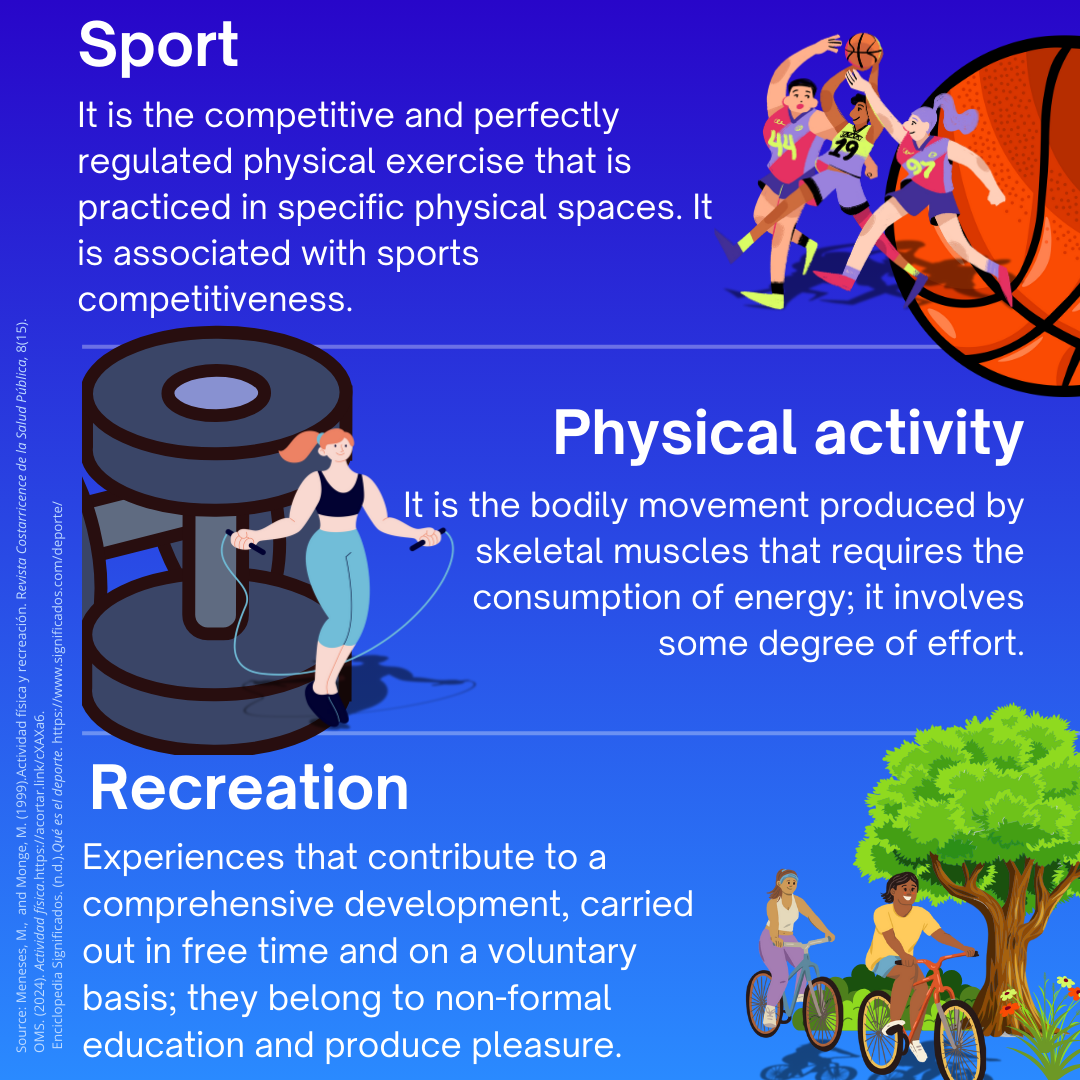
Physical activities can vary and include cleaning the house, walking, playing sports, participating in games, etc. Although all physical activity is classified as exercise, not all physical activity is exercise. According to Meneses and Monge (1999), “Physical exercise is any regular and systematic practice of physical activity that improves physical and motor fitness.”
Benefits of physical activity and sports
The various advantages of physical activity and sports improve people’s quality of life. Some of these benefits include:
Physical benefits
- Reduces stress and anxiety.
- Maintains good sleep patterns.
- Improves cardiovascular health.
- Builds muscle and strength.
- Increases coordination and balance.
Cognitive benefits
- Maintains the functioning and development of the brain, stimulating and challenging it.
- Slows down brain aging.
- Improves academic performance.
Psychosocial benefits
- Increases self-esteem and confidence.
- Reduces feelings of depression.
- Promotes positive relationships.
- Improves sleep hygiene.
- Creates positive and safe spaces for releasing stress.
Therefore, physical activity and sports are vital to providing benefits that promote the protection, well-being, and social development of displaced youth. It can also serve as a means of integration and social inclusion for young people and communities, increasing social, psychological, physical, and economic capital. In addition, it promotes a sense of belonging that reduces social isolation.
The transversality of sports
Sports and physical activity can be transversal (cross-cutting) strategies used in psychosocial and health interventions. They also comply with five of the UN Sustainable Development Goals: Good health and well-being, quality education, gender equality, reduced inequalities, and peace, justice, and strong institutions.
Therefore, the Olympic Refugee Foundation supports protecting, including, and empowering affected young people through safe sports. Its vision is a society where everyone belongs through sports.
Sports for protection
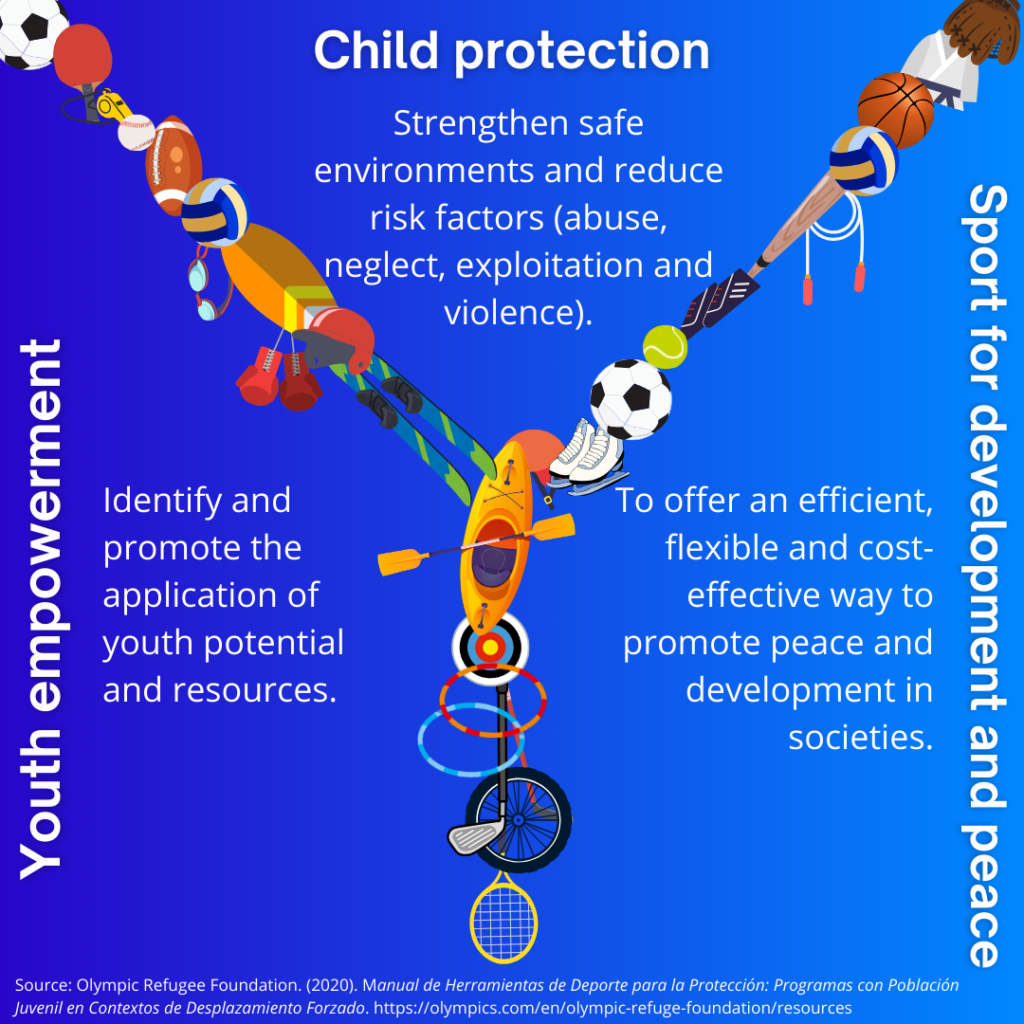
This concept derives from sports’ innate ability to involve young people actively and meaningfully. This approach aims to achieve three fundamental objectives: social inclusion, social cohesion, and psychosocial well-being.
The graphic below shows the three pillars of Sports for Protection: Child Protection, Youth Empowerment, and Sports for Development and Peace.
How is it implemented?
The ORF programs for youth in forced displacement offer manuals or guides developed in conjunction with various institutions, such as the UNHCR, the IOC, the Terre des Hommes (TdH) organization, and the collaboration of humanitarian workers and the affected children and young people, who actively participated in this process.
These manuals are a practical resource for all those working with adolescents and youth in sports, including community organizations, national federations, sports-focused organizations, and NGOs (Local Non-Governmental Organizations).
These organizations can have two primary approaches, one dealing with social problems through involvement in sports in education, developing job skills, and participation; the other focused on competitive sports leading to professional activity because the vision of sports is for youth development.
Refugee Olympic Team
These athletes had their first Olympic Games in Rio de Janeiro in 2016, followed by Tokyo in 2020, and the most recent games in Paris in 2024. According to data from the UNHCR, the 2024 Olympic Games comprised 36 athletes from 11 countries, who were hosted by 15 National Olympic Committees (NOCs). These athletes participated in 12 sports disciplines.
This representative team also included paralympic athletes, promoting inclusion and sports opportunities. The Paralympic team comprised eight athletes in the Paris 2024 Olympics.
ORF’s mission is simple: to shape a movement where displaced young people can thrive through safe sports. It aims to guarantee access and participation in safe spaces for thousands of young people so that they can have a better quality of life and complete development in all aspects of their lives. Physical activity and sports are essential for their benefits to physical health; even better, they can function as agents of change and hope for many people who have lost everything.
Translated by Daniel Wetta

)
)
This article from Observatory of the Institute for the Future of Education may be shared under the terms of the license CC BY-NC-SA 4.0