)
)
)
)
A few weeks ago, I published an article in this Observatory about the importance of being involved experientially in past events while studying them. It is not sufficient to view them as external events apart from us, as things that have only happened to others. Understanding them implies answering the question honestly, “What about me? What does all this have to do with me?” That is nothing more than inquiring if we recognize ourselves in these people, see ourselves living their lives, and manage to “put ourselves in their shoes,” as they say.
The title I chose for that previous article says much about this idea: History is learned through the whole body. In other words, history is not only understood or imagined; it is felt, sometimes in the flesh. There are moments of perceiving visual flashes, like daydreams, in which we seem to “see” the events in front of us and have very vivid intuitions that make us think we are not just wearing the other’s shoes but are perceiving the past events with their eyes.
(The above invites me to open a parenthesis to reflect on the limits of learning history through videos, films, documentaries, and historical series, which – if they do not reach an artistic level – remain just the representation of events still viewed from the outside, as alien, and purely entertainment. Undoubtedly, when they are good pieces, they can be a source of information, but the risk is making the viewer believe they are learning history when, in reality, they are being left out of it. Personally, I think that to obtain information, it is better to resort to talking with experts or intimate reading (close reading), where the reader reads from the inside, ingesting the words as if they were their own, processing the information and testimonies in an “incorporation” that lets knowledge invade and move the whole body).
I am writing this second article on the subject now because I believe that all of the above can be applied to the study of history and any knowledge.
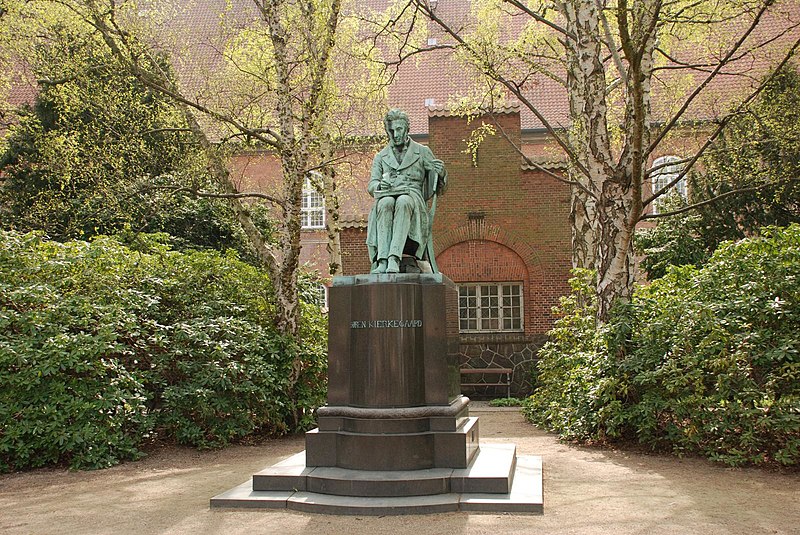
Let’s think about philosophy, the discipline of fundamental questions. Isn’t it just as essential to put ourselves in someone else’s shoes when we want to understand their thinking? Let’s put it this way: when approaching a philosophy text, if we begin by recognizing that behind it is a concrete thinking human being, it will be much easier to understand than to decipher it as an abstract text, self-sustained and independent of the author. Søren Kierkegaard, for example (I assume we have all heard of the good “Kirkegaard”), is totally personal in his dissertations. With him, it is more than clear that “I write to know what I have been thinking,” as he told someone. Let’s say that Kierkegaard, although he starts from a general intuition, understands himself as he evolves. He discovers many things along the way… however he does not resolve them; they are left behind, like loose ends that he then weaves with new ones, in an endless process… or rather, a process that at some point he believes he has finished, as he cuts the last thread and happily shows us his “finished piece,” a canvas of dazzling beauty and lucidity. “That’s it!” he exclaims, and we, who have been left speechless, cannot say anything, which is universally understood as “Yes, I agree.”
But that does not mean that we fully understood or that at the beginning, the text was an incomprehensible tangle, of course, incomprehensible and hypnotizing, i.e., enigmatic, which, like all enigmas, in their obscurity, always promises us a solution, making us continue reading, impatiently. But believe me, the reader who recognizes the “Kierkegaardian style” is the one who accepts that behind this world’s philosophical superhero is a human being like all of us, one who always wrote in search of his own thoughts, opening enigmas for us to inhabit, knowing that this was the only way we could accompany him to experience them. (I think Kierkegaard was a man of lucidity, extraordinary within the extraordinary, and with a literary style almost molded to his skin. So his initial tangles, as I say, were not like mine, which do not convey anything to anyone: I have to revise them several times so that, hopefully, they release some spark).
When one realizes that understanding Kierkegaard means identifying with the human being he was, one feels sorrow for all those who, because of idolizing him, approach him fearfully – like a God or an idol – and take each of his words and phrases as a seamless totality, attributing to themselves the gaps and irregularities that are actually in the text (those comprise its beauty), and forgetting that, precisely, only God writes without defects (if He writes at all).
Some will tell me that Kierkegaard’s example fits me like a glove because he was an existentialist writer and philosopher for whom subjectivity (the most intimate and personal) was the key to all knowledge. Therefore, in his work, it is natural that style equals the human being. Maybe I’m also an existentialist, but I think that doesn’t just happen with Kierkegaard and his allies but with all kinds of thinkers, even the most abstract and analytical. If the logical sequence seems to reach certain conclusions in a philosophical text, it is only because the author has put the full stop in the right place. It happens in romantic comedies that convince us of the triumph of love, thanks to the author making the curtain fall at the right moment. (Five minutes later, the lovers grab each other’s hair again).
But invariably (returning to philosophy), as soon as the author finishes the book (or takes truth for granted), doubts begin to sprout like larvae, swarming and corroding the essence of what has been said. Then, we must write new texts that establish deeper truths and continue in an endless chain! As an influencer expert in the history of philosophy explains, philosophers are thinkers who manage to fit all their ideas inside a box long enough to photograph it; when the box explodes under so much pressure, the photograph still exists; it gets presented in society as evidence for a coherent system of thought.
The difference between Kierkegaard’s texts and those of the analytic philosophers is that in the latter, one takes longer to discover that the human behind them is as perfect/imperfect as everyone else. Only a guy as immaculately honest as the German philosopher Ludwig Wittgenstein (you see, I’m idolizing him!) is capable of creating an entire philosophical system and putting it into a book believing that he has solved all the problems of thought (to the applause of the world philosophical community), and years later recognize that he had solved almost nothing and created a whole new philosophy, which by the way, also earned him the admiration of the world.
In short, the conclusion is that behind every thought, no matter how abstract, there is always a human being with whom we can identify and slip into their shoes as a starting point to understand their steps.
Another thing, perhaps more important, is that by identifying ourselves “in full body,” we open up ways of comprehending the thinking of others that would not open otherwise. I give you a bit of an extreme example, but it can be applied to any author. In his Confessions, St. Augustine narrated the mystical experience that finally clarified and gave structure to his way of thinking, and he also provided the primary key to understanding it. If we can share with him the narrative from within and intuitively experience the mystical as he allows, it will be evident that without this, we would not be able to attribute any unity or meaning to St. Augustine’s thoughts. Without that powerful intuition, which St. Augustine provides us through his majestic style, the rest of his thinking would remain desiccated, cracked, and full of insurmountable fissures and contradictions. On the other hand, viewing it through that mystical experience reveals its coherence and firmness. St. Augustine’s thoughts, like any other thinker’s, are not deciphered but shared experientially, incorporated into what we are, or rather, into the home of knowledge in which what we are dwells.
However, knowing we can identify with and understand any human being does not mean doing so is easy. Nor does it mean that it is equally difficult for everyone. Continuing with our example, surely it was easier for Kierkegaard than for us to understand, say, Hegel for several reasons: To begin with, Hegel was his contemporary, and Kierkegaard could feel many aspects of his life closely. Above all, Kierkegaard was a person who sincerely accepted and respected his own thinking; thanks to this, he could approach the thoughts of another great without feeling as vulnerable before him as others might. Relying on his own style allowed him to follow in Hegel’s footsteps and enjoy when the master’s feet were raised, but also be alert to notice when they tripped and even to recognize when he could not follow them at all.
This example sums up my view of the history of human thought and exchange, a history to which we are all invited. We can approach it anytime, and no one has to stop us. However, we will surely enjoy it more if we come to it with our own style, our uniquely personal way of thinking, feeling, living, and being.
In everything we try to learn (and teach), it will always be better if we dare to compare ourselves – in human terms – with our fellow men, even if they are great teachers. It does not matter how good or bad we compare. Moreover, the more poorly we look beside them, the more reality shows us that we should not compare ourselves with the elders; instead, we must always cling to being equal with them and with all human beings in the world and history. Will some label us as arrogant? Perhaps, but they will be wrong: pride consists of comparing ourselves with the divine and not knowing we are human. However, we will recognize ourselves as human, which is called humility.
Translation by: Daniel Wetta

)
)
This article from Observatory of the Institute for the Future of Education may be shared under the terms of the license CC BY-NC-SA 4.0