)
)
)
)

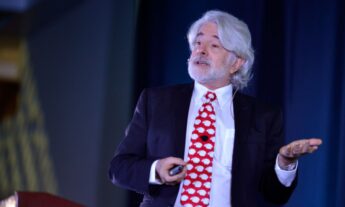
The philosopher of science Daniel C. Dennett achieved great popularity for being a fierce defender of “physicalist” ideas, that is, those that assert that nothing exists beyond physical reality (which we also call the “material world”). I know his thinking from his 2013 book Intuition Pumps and Other Tools for Thinking (the word pump refers to the apparatus that serves to pump – extract, suck – which Dennett, in this case, applies to intuitions). It is a set of mental exercises – simple and fun – that he invented to challenge our reasoning beyond its usual boundaries and lead it to new perspectives on reality and knowledge (always in favor of physical science, of course). Danny, as he was known to his friends and followers, was a lucid and playful philosopher, and – if my thinking were not so contrary to his – I would gladly recommend him to teachers to incorporate his exercises into their classes. What I can do, so as not to waste Danny’s ingenuity, is to explain one of his pumps and show where it falls short and how it can be used to explore the opposite of what he proposes. In addition, perhaps my analysis will help the reader of the book to enjoy it while remaining alert to its arguments and deceptions. Dennett, in addition to being amusing, is mischievous and sets traps. That’s what we all do when we strive to be right beyond a reasonable limit. So, without blaming Dennett too much, I’ll bring one of his intuition pumps to focus.
It is entitled The Fall of the Teleclone from Mars to Earth and is presented as a story that unfolds as follows: A woman is stranded on Mars due to the failure of her spaceship. Her only chance of returning home is by using a Teleclone Mark IV Teleporter, capable of disintegrating her body gently and painlessly into the smallest particles and instantly reassembling identical ones on Earth (where the machine accesses the identical particles from a perfectly stocked warehouse; the original ones remain on Mars). Bam! Using the teleclone, she immediately reappears on Earth, where she receives a joyful welcome and resumes her life as before. However, after a few days of reflection, she anguishes over the question, “Am I the same woman who entered the transporter on Mars, or was I pulverized and now I am just a replica that preserves all her memories?” After a few days, she concludes calmly, “Yes, I’m the same person. At least, it seems so.”
Dennett, the cautious one, does not explicitly agree with her, but he seems to conclude the same thing: that she is the same woman. Why shouldn’t she be, he asks, if, after all, absolutely nothing about the woman differs from the woman who boarded the teleclone? Everything in her disintegrated and was reassembled particle by particle, which means (again, from the physicalist perspective) memory by memory, idea by idea, feeling by feeling.
Dennett firmly believes that the human “I” is a physical thing comprising information that, like digital movies and songs, can be transmitted from one point to another, without loss. Cautiously, as I say, he poses the question: “Is our reluctance to admit the possibility of teleporting people a bit like the anachronistic resistance (recently overcome in all areas) to legal documents with electronically scanned signatures?” Thus, he insinuates that affirming the existence of an “I” that is not composed of transmittable information is anachronistic resistance.
The physicalist faith is flawless in this case: the “I,” or consciousness (i.e., the person), arises from the organization of matter; the person disappears completely if that organization vanishes, but reappears if identical molecules reorganize and interact exactly as before. The woman who was disintegrated on Mars is the same one who the telecone reintegrated later on Earth. They have, in other words, the same “I.”
Aren’t these ideas brilliantly amusing?
However, this is where I reveal a hidden trap: the tendency to fall short and tell only the part of the story that supports the argument. Obviously, the story continues. Let’s propose to our students to carry it to its ultimate consequences, which is where, I anticipate, things get very interesting.
Let’s imagine Hypothesis 2: the situation on Mars is the same, but the woman who enters the teleclon is not disintegrated. Just at the last moment, the device malfunctions, and her body is only scanned, leaving her intact on the red planet. The woman, then, remains there, but the necessary information for reassembly does manage to transmit, so she also appears, almost immediately, on Earth. Now, there are two women, one here and one there, about whom, according to the logic we have followed, it should not be said that they are identical, but instead that they are “the same.” It would be paradoxical for a person to be in two places at the same time, but, as good teachers, we cannot be content to admit the obvious. So, along with our students, we ask, “Why?” Well, it would be paradoxical because, following Dennett’s logic, both women would have the same “I.”
Can two people have the same “I”? Of course! Or would both women only be “the same” if one had disintegrated and thus one of the two “I’s” had disappeared? No, the truth is that there is no sense in thinking that the first “I” had to disappear for the second to appear. As Dennett insinuated, both women would be one person (although, of course, from that moment on, their trajectories and experiences would begin to diverge, one on Mars and the other on Earth).
“Imagine,” we say to our students, “that one day you come face to face with yourself” (thus fulfilling, futuristically, the great precept, “Know thyself”). It must be made clear that this is not simply a case of confronting a copy. No, it’s not a replica, it’s them! They are not even looking at themselves as they were in the past, as in the story The Other, by Borges, where the old author finds himself as a young man. They are themselves at that very moment. We tell our students, “That’s where you are, both laughing nervously, reacting the same, having the same feeling of hallucinating, waving your hands, writhing in anguish, saying (almost) the same things. It is not a dream; rather, it is as if the image in the mirror has stepped out of its frame. Yes, exactly that!”
Me? After surviving a heart attack, I would wake up feeling crazy. And you, dear reader, this is a good script for a fantastic comedy, or, better, about a supervillain who, after inventing the Mark IV Teleclone, conceives the plan to dominate the Earth by creating millions of replicas of himself! “Only Earth?” refutes the physicalist, who advises the screenwriter, “Why not the whole universe? If a human being could be reassembled remotely, and even be in two places simultaneously, there would be no impediment to reassembly in countless places throughout the cosmos at the same time.”
Does anyone – perhaps one of our students – think that we are falling into an idle game? It is worth mentioning that the above is not limited to philosophical speculations; these concepts are already being experimented with in science. Around the time Dennett published his book, physicist and science communicator Michio Kaku published another, equally surprising work: The Future of the Mind. In it, he describes impressive experiments that, if physicalism were true, could lead to the creation of teleclones and the ability to teleport to any corner of the universe.
Starting with the scanning of the body and psyche, Kaku tells us about already successful research in the digitization of mental phenomena; apparently, the first case was the digitization of a mouse’s “memory.” Yes, years ago, a team of experts managed to transfer images transmitted by the rodent’s brain to electronic data sketches when it recalled a previous experience. Based on this, Kaku futurizes that at some point it will be possible to digitize the complete psychic life of a human being. This psychic life could be preserved in a computer, transferred to a reassembled body, or encoded as information in an electromagnetic wave (such as light) and sent anywhere in the universe, where that person could continue to live. (The truth is that, even at the speed of light, it would take millions of years for information to reach some destinations; however, converted into digital material, we would be immortal, so would we even care about the duration of the trip?)
As you can see, it is highly amusing to discover and describe a physicalist reality, which can be disassembled and reassembled, extending infinitely in time and space. In our society, this mentality has acquired – as we know – enormous strength, permeating all of reality, whether in our continuous philosophical and scientific debates about the scope of artificial intelligence (AI even in the soup!, as one of The Observatory’s quotes of the week exclaims) or in the unstoppable contents of the popular imagination. (At this moment, my thirteen-year-old son is reading aloud with me the graphic novel he has just bought, and I am surprised to hear that it is about the transplantation of the digitized brain of a tyrannical leader into his new electronic body.)
But again, in the midst of all this, questions arise that we cannot avoid, but that the physicalists do skip. (I don’t blame them. In the human contest to be right, jumping has always been one of our best achievements.) Let’s start again with the digitization of our “I,” our psyche. In the case of the mouse’s memory, note that we have told things such that by reproducing the mouse’s mental images, the computer had somehow begun to become the rodent, so that if all the animals’ mental content could be transferred to the machine, the machine would acquire as much consciousness as the mouse. Similarly, the consciousness of a human being could be transmitted to an electronic device, and the person could be protected there.
This reasoning assumes that when the information contained in the psyche passes, the subjectivity of the person (i.e., the part that converts that information into material of consciousness) is also transferred along with it. In other words, it affirms that along with the data, the “I” would also travel. This is, obviously, a physicalist conclusion, which is very easy to accept because, in our materialistic faith (which today almost all of us share, consciously or not, including myself), we like to know that we are self-sufficient and feel that our brain and body are enough for us. But is it a fact that the information transmitted would include the whole person?
The first to refute these ideas will be the so-called religious dualists, who distinguish between the body and the soul and consider the soul to originate from a mysterious beyond. Here, this point of view enables us to explain the reservations one may have about physicalist experiments, even ironically. In this perspective, our teleclone story would unfold as follows: On Mars, the woman climbs onto the teleporter, and after it scans and disintegrates her, she finds herself standing before a dark tunnel at the end of which shines an incandescent light. The light draws near until it completely envelops her, and in her center, she sees a host of angels, from which, finally, emerges God himself, whose company she will now have forever. An instant later, a body identical to the woman’s is reassembled on Earth, but since her soul is already in heaven, the body collapses lifeless, entering a process of decomposition that, with time, turns it into dust. In this way, the scientists confirm that this new version of the teleclone (the Mark IV) does not work either, just like any of the previous three.
This little fairy tale (in which, despite our physicalist faith, we all believe, because in reality it is -no way – irrefutable) is enough to discourage anyone from jumping into the teleclone and dissuade even the most skeptical governments from financing its costly development. Perhaps, it is also true that one day, some supervillain will manage to build it, teleport, and even clone himself, leaving us all speechless.
Before concluding, I would like to share my perspective on all this. I think that the problem with physicalism is not that it assumes that everything is matter, but that its concept of what “matter” (the physical world) is entails the certainty that, deep down, it will not hold any mystery for the human being, and that sooner or later, thanks to science, we will be able to know everything about it. So, according to me, before asking the physicalists to explain the miracle of the multiplication of selves, we could ask them to explain why they take it for granted that one day we will know matter perfectly (“as if we ourselves had created it,” María Zambrano ironizes), to the point of being able to create a device that scans it to its infinitivesly small details. Similarly, we may want to know what enables them to establish that in the future we can supply a warehouse with all the matter required to assemble a human body, again, as if inevitably the world of the small would reveal all its truths. Are we really just those “particles” that we detect and manipulate today in immense laboratories? Well, we can’t take for granted that this is possible or impossible. That’s why I believe that any “intuition” based on this supposed knowledge will always place us before the mysteries of the self, the soul, the body, and the universe.
Now I’ll finish! My final proposal is to leave our students with the last questions, feeling confident that all of them will continue advancing, whether in constructing a teleporter that allows us to go to and from Mars, collectively creating the script for the next Disney film, or simply having a good time together (even, perhaps, when the time comes to go and sing hallelujahs with the choir of angels).
Translation: Daniel Wetta

)
)
This article from Observatory of the Institute for the Future of Education may be shared under the terms of the license CC BY-NC-SA 4.0