
For Cristina Múgica
Elegía, by Miguel Hernández, is one of the great poems of the Spanish language. It was written in mourning for the death of a friend, and begins with the following dedication: “In Orihuela, his town and mine, Ramón Sijé, with whom I loved so much, has died like lightning”. Some editions say “… whom I loved so much”, but it is a mistake. This, many years ago, my friend Claudia García Silva made me understand, when she told me that the poet intended to show that the essence of that friendship was not that he loved Ramón, but that they both loved, together, many things:”… with whom I loved so much (so many things).”
With this idea, I now move on – perhaps hastily – to attempt a first description of what friendship is.
Friendship is an intense, shared love for something in common.
That common is not just anything, but something precise: in friendship we love, together, the human, everything human, the human in specific.
Let me explain. Unlike couple love, which is a love of the spiritual and divine in the other, and unlike complicit relationships, which indicate more “animal” aspects (such as success, conquest, the expression of strength, the seizure of power, and even being right, all elements associated with subsistence)…unlike these, I say, friendship points to the human in ourselves and others. But, once again, what is this?
If you, dear reader, have already seen Guillermo del Toro’s beautiful version of Frankenstein, you will be able to discern better that the human being is, in the first instance, the result of a daring experiment. This consists of taking something united and dividing it into parts, to study them, know them, understand them, and reassemble them, in the hope that, once again, they will adopt a perfect harmony – body parts which, separately, would be nothing but organic matter tending toward decomposition, but which, united and rejuvenated with a new breath, with a new form of light, will overcome this degradation and be reborn.
That, at least, is what the researcher expected, eager to achieve, with the new being, a very personal victory.
However, the result was completely different. Driven by the ambition to unravel the origin of human life, to appropriate that knowledge and replicate it, and even to surpass it (“To know the human as if he himself had created it,” María Zambrano would have said), the product of his research turns out to be a disaster. What is now, there, in front of him, is a clumsy and battered being, helpless and needy, just an embryo, a fetus, something not fully developed, which imitates its creator badly and does nothing but mechanically repeat its creator’s name. It learns nothing; it produces nothing new; it is a broken machine.
What Dr. Frankenstein’s creature faces from its “birth,” with its structure made of pieces, we also experience daily – and perhaps from the moment we arrive in the world – with our mind, body and heart (referring to the emotional device), which, although being a unit, seem separate and with different tasks, as if they were opposing beings (often even enemies) tragically doomed to travel together, to be always united. Or – to put it optimistically – they are like passengers on different ships arriving at the same port and who must find each other, without knowing each other and without many clues, except for a blurred portrait, a vague memory.
Science says that we come completely helpless, defenseless, devoid of the resources to subsist on our own. I think the problem is even greater, that we arrive not only without the means but with a frank disadvantage, a failure in what we do have, which is poorly created, poorly assembled, still torn-apart pieces like the monster in the movie – hurt and painful beings who suffer from the naivety of wanting to build ourselves, deciding who to be, wishing to self-determine).
Etymologically, the word that describes this type of condition is “failure.” From Latin, it literally means to take a blow in the middle and be torn to pieces. We are, like Frankenstein’s monster, failed creatures. We are born defeated, beaten, fallen (like vases), cracked. From then on, human beings set out, overcoming all kinds of contradictions and paradoxes with the help of others, those others of whom we have already spoken: at one extreme, God (and all our sacred ties); at the other, the complicit herd, and in the middle, our friends, who love the human with us, starting with our failure.
In a world of total disorientation, our friends are our peers. We love and learn together. Born as the fruit of excessive ambition, we truly begin to live only by recognizing our fragility. That recognition comes from the loving, usually joyful, reflection that our friends give us, the only beings who truly celebrate us and help us draw strength from weakness.
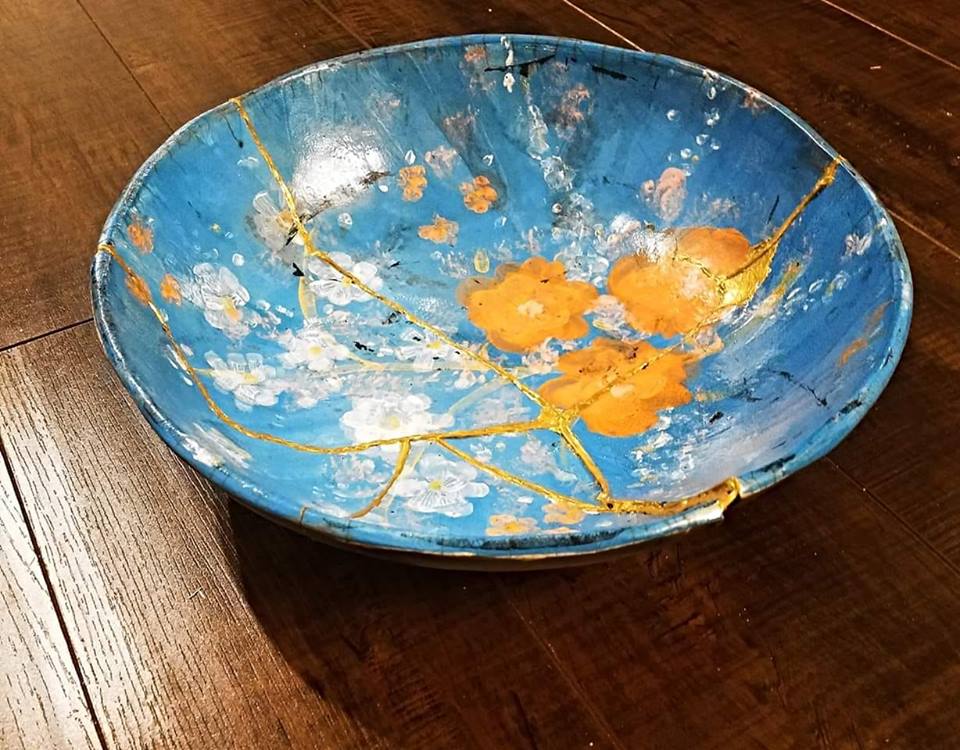
That little Japanese in all of us knows well that the best and most beautiful vase is the one that has been repaired. This is taught in the art of Kintsugi, which takes a broken piece of pottery and joins its pieces with assemblages that leave a visible scar, a golden tracing.
Like Kintsugi, friendship does not rush to repair our failure. It starts by embracing it, by honoring our history, including that blow we received at birth. Our friends know that they cannot restore anything if they do not become the destroyed being themselves, if they do not first and fully recognize themselves in that pain. I sense that the true master of Kintsugi first learns to live with the broken object, becomes intimate with it, sees himself in it, recognizes in it his own fissures, in its damaged edges his own deteriorations, until the moment comes when he becomes it, in all of its pieces. The object also becomes a master, and both coexist until, at last, they begin to repair each other together, becoming friends. Wikipedia says, beautifully, that with Kintsugi “the piece comes back to life.” I would add that they both do.
Friendship has never existed to recognize achievements, moments of success, or triumphs. Such a thing would make it an easy, fatuous feeling, completely insufficient to create the bond that it authentically is. Friendship is something more crucial, more radical. In fact, if we are honest, we will admit that it is quite the opposite ( just as Hans-Georg Gadamer, the great thinker, affirms that philosophy is the art of being wrong ): we can say that friendship – even with its universally positive sign – is the art of embracing human failure.
“Defeat has dignity that noisy victory does not deserve,” said Jorge Luis Borges.
Instead of motivating us to get up after falling – as self-help books do – our friends tend to be sad with us, to cry our tears, to love with us the fact that there is something neither of us can do.
I believe that what we call our freedom, and which we value so much (a distinctive human footprint, by the way, of the wonderful creature that Dr. Frankenstein gave us), is nothing more than friendship, that is, the ability to rebuild ourselves together, to arm each other – and with others – differently than a burst of self-constructive arrogance destined us; to be mutual teachers in the human experience, re-educating each other.
P.S.
By way of postscript, I want to confess to my readers (still somewhat obvious) that, like the writer that, daily, I consider myself to be, my richest illusion, even my intimate hope, is to establish a relationship of friendship with you. With this in mind (and in body and heart), I try to show my weakness in each letter and share with you the love toward that to which I feel united. If I ever succeed, the first law of friendship would be demonstrated again: that friendship has no limits, that it transcends time and distance, and that it unites all those who want to reassemble their fragments together and love what is human.
Finally, I leave you this minipoem I wrote years ago as a pact of hope.
Life lies in pieces at my feet.
Through each one I can pass
As one enters the sea through every port.
Translation by Daniel Wetta