
The integration of AI has not occurred overnight. Still, the introduction of ChatGPT has created a reality where these technological tools are prevalent in education, work, and personal sectors, beginning to minimize or even eliminate tasks. Some may see this as a fatalistic scenario where machines displace human occupations. In contrast, others may view it as an excellent opportunity to count on a digital assistant that can enrich and accelerate many processes, one being creativity.
California State University, Northridge, defines creativity as the ability to generate or recognize ideas, alternatives, or possibilities helpful for problem-solving, communicating with others, or entertaining. Humans’ creativity in formulating ideas comes from their imagination, formed by their mental models, experiences, and influences. Creativity uses this imagination as a basis for solving problems in practice; that is, it is applied imagination, said Sir Ken Robinson (2006). On the other hand, the famous computer corporation IBM defines Artificial Intelligence as the technology that allows computers and machines to simulate human intelligence and problem-solving capabilities.
Many types of AI benefit people differently; however, the emergence of generative AI has profoundly impacted the creative industries of graphic design, music, art, writing, and audiovisual media. Generative AI can alarm and even demotivate people in these industries when they see that a machine can create logos, illustrations, music, and other creations in seconds.
Based on users’ prompts or requests, generative AI selects ideas from a massive amount of data previously fed to deliver the best answer with the most accurate information relevant to what a person is looking for; from there, the technology proposes one or several options. As mentioned above, generative AI uses stored information from different articles, bibliographies, etc., so its answers are not new or innovative; instead, it combines ideas or proposes those closest to what a user seeks or the most popular in a specific medium.
AI is limited to imitating human creativity, so it does not emanate from it. That is why responses from ChatGPT, for example, can often sound generic or robotic in such a way that sometimes it can easily expose a person relying extensively on the platform. Its content lacks human feelings, styles, experiences, and even mistakes that only people can make, things that cannot be easily artificially constructed.
The ease and speed with which technologies automate specific tasks and produce and create content can make it extremely tempting for people to over-exploit them. However, dependence on generative AI can have counterproductive consequences:
- Relying excessively on AI and people not performing their own work can cause them to lose their personal touch on other projects over time.
- People who overuse generative AI are anxious to generate ideas to solve problems or complete jobs. As a result, they are limited to an algorithm’s response instead of creating solutions beyond what the technology can produce.
- Overreliance on technology can invalidate the integrity of a person’s work. The University of Maryland affirmed in 2023 that many artificial intelligence models still do not validate whether the information they provide is correct; i.e., they can provide the user with incorrect answers, omit information, and even mix reality and fiction.
- We must remember the ethical implications of using material entirely generated by AI. When using generative AI for illustrations or music with other creators, the user can face moral dilemmas and plagiarism because many algorithms use the style or works of other artists.
Dependence on Artificial Intelligence leads to skills deficiencies in users who use it excessively. Trusting blindly in these technologies can severely affect creativity and critical thinking. A study published in February of this year found that university students over-relying on generative AI also experienced procrastination, memory loss, and low grades. Likewise, abusing these tools encourages laziness and decreases knowledge acquisition and people’s decision-making ability.
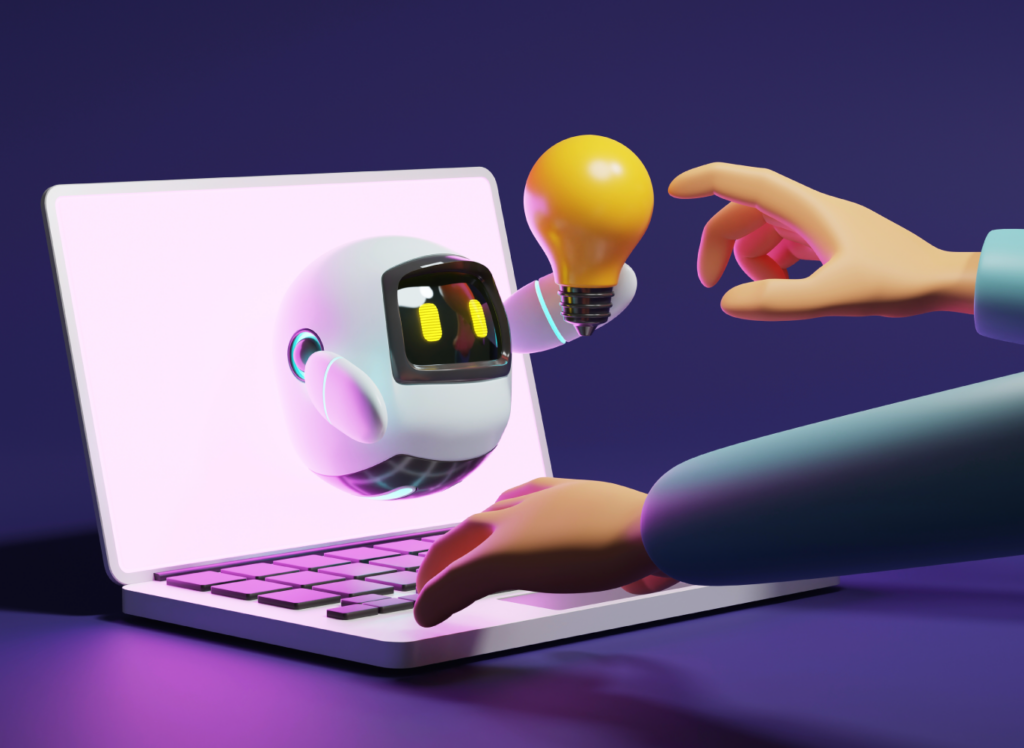
A healthy coexistence with current and emerging technologies is necessary to balance the use of generative AI and their creativity. Generative AI should be used to support overcoming creativity blocks and finding inspiration or assisting idea structure. Here are a few ways to boost your creativity using AI:
- First, when resorting to AI support, define the objective for its use within the creative process: perhaps it is to have a notion of how to start a project, visualize a specific image, or generate ideas, among other things. Being clear about AI’s particular tasks will limit AI’s functions for the creative process. Also, establishing the objective makes it possible to choose the best tool to produce the desired results.
- When brainstorming, the more ideas we have, the better. AI algorithms can provide many options for displaying results, but not all will be good. However, they can help stimulate imagination by developing an idea or finding a correlation with a new one, thus lightening the spark to begin a creative process.
- You can use AI as a starting point and ask for statements or introductory paragraphs to get a general idea of how to begin and structure the content.
- Generative AI can perform tedious or repetitive jobs, which can help free up time for the creative process. For example, it can shorten text or suggest hashtags for a social media marketing post.
“Generative AI’s greatest potential is not replacing humans; it is to assist humans in their efforts to create hitherto unimaginable solutions.” (Eapen, T. et al., 2023)
Artificial Intelligence still has far to go. It depends on human-fed information, which can also contain misinformation and biases. It cannot be treated as a source of absolute truth. Like the arrival of Wikipedia years ago, AI can be a reference, but we should not be credulous; skepticism when using these kinds of tools is essential.
Moreover, there are ethical issues. Generative AI is still a relatively new technology, so the original artist may not authorize much of its content to create images, music, art, etc., which can cause severe plagiarism concerns.
Critical thinking, research skills, and creativity cannot be replaced by AI anytime soon. They are imperative skills for the workforce and must be used with these tools to obtain the best benefits. Regarding creativity, it is essential to emphasize that humans have an advantage over AI. Creativity, understanding of social and cultural contexts, and individual experiences make people an unbeatable opponent. Additionally, culture and current trends change faster, so it is difficult to train these technological tools quickly to keep pace with current events.
Human judgment, moral reasoning, and innovation will be reserved exclusively for people. AI should not be treated as a threat but as an assistant that we can prudently balance as a valuable addition to our creative process, not a tool that damages our cognitive abilities. Carefully adopting these technologies is vital to healthy coexistence with them and discovering other ways they can continue to benefit different aspects of our lives.
Translated by Daniel Wetta