)
)
)
)

Brain-based learning (BBL) applies neuroscience principles to education. It considers how the brain works and learns to devise an instructional style that potentiates students’ learning. BBL uses neurology and cognitive sciences research techniques to improve instruction and understand how the brain works in the educational context. Thus, it allows teachers to know how, when, and why learning occurs from a psychological perspective, which aligns naturally with how the brain learns.
BBL is described as a set of principles and a foundation on which knowledge and skills are built to make better decisions about the learning process. Various studies, such as Mustiada, Agung, and Antari (2014), have shown that this model is very effective in improving science teaching.
What are the main characteristics of BBL?
- BBL proposes the brain as the primary receptor of learning, which can be affected by environmental factors, individual psychosocial qualities, and the chemical structure of the organism; their interactions affect the learning process.
- It applies the concept of neuroplasticity to instruction, referring to the brain’s adaptability.
- It actively focuses on the student to promote meaningful learning.
- It recognizes and favors diversity within the classroom.
- It fosters positive learning environments, promotes learners’ sense of belonging, and motivates them emotionally; both significantly impact learning and memory.
- BBL incorporates memory activation techniques to reinforce learning (e.g., spaced practices and concept mapping).
- It prioritizes kinesthetic activities in the classroom (simulations, physical exercise, experimentation, role-playing, etc.).
Advantages of BBL
- It improves critical thinking skills while increasing arithmetic and mathematical thinking.
- It integrates appropriate teaching strategies for all types of students.
- Effective implementation of BBL results in meaningful learning.
- BBL increases positive achievement in biology, chemistry, physics, and mathematics.
- It enhances the learning experience by stimulating social skills in the classroom.
The 12 Principles of BBL
These practical BBL principles enhance the implementation of this teaching-learning method in the classroom.
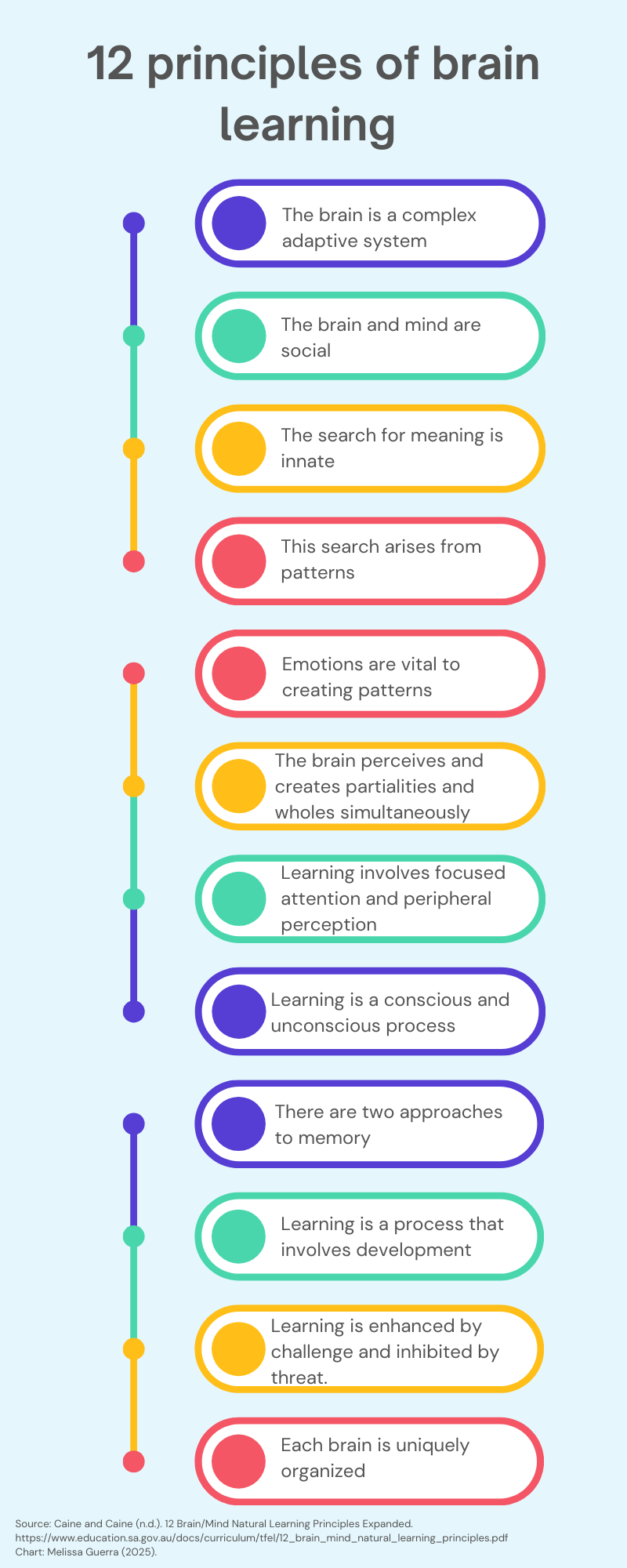
- The brain is a complex adaptive system: All brain processes involve interaction and simultaneity. The body and mind are interconnected.
- The brain and mind are social. Physiological factors (neural development, nutrition, life experiences, etc.) can increase or inhibit learning. Social relationships influence the construction of learning.
- The search for meaning is innate: Every person has the fundamental need to find the meaning of life.
- This search arises from patterns: BBL understands life through order because the brain is designed to perceive and generate patterns.
- Emotions are critical to creating patterns: Emotions and mindset affect learning as they involve thoughts, decisions, and responses.
- The brain/mind perceives and creates partialities and wholes simultaneously. This refers to the brain’s ability to concurrently process information at the macro and micro levels.
- Learning involves focused attention and peripheral perception: In other words, it consists of the brain’s ability to process all stimuli (paying attention) and make a selection, discarding the rest.
- Learning happens consciously and unconsciously: Although much learning is conscious, sensory experiences and sensations are processed under degrees of consciousness. It is vital to incorporate activities that promote metacognition.
- Two approaches to memory: Mechanical and spatial memory. The former retains information, while the latter involves a more complex cognitive process.
- Learning is a developmental process: Cerebral, physical, and/or emotional stages of brain processing affect comprehension and skills development in a continuous cycle of changes throughout life.
- Complex learning is augmented by challenges and inhibited by threats: Negative emotions retain higher-order executive functions, so optimal learning requires appropriate challenges.
- Each brain is uniquely organized: A person’s particular accumulation of experiences and emotions affects their brain structures.
How can BBL be implemented in the classroom?
This method can be implemented with three techniques in the classroom to promote the necessary learning environment: relaxed alertness, orchestrated immersion, and active processing. The first is a safe environment, free from fear of errors; the second has varied activities with real contexts; and the third is a meaningful internalization and consolidation process of information.

Brain-based learning is not a recent method. Some of its principles can strengthen classroom work generally and at the student’s level. It should be noted that no method, approach, or technique by itself acts like a magic wand where everything is instantly solved.
Education is a joint effort of institutions, teachers, and parents, depending on the educational level. Any method must be tested and approved before it can be inducted. Although the BBL is very promising, its execution requires teacher training and an understanding of the principles governing the human brain’s learning.
Translation by: Daniel Wetta

)
)
This article from Observatory of the Institute for the Future of Education may be shared under the terms of the license CC BY-NC-SA 4.0