)
)
)
)

Origin
The origin of ikigai in Japanese literature dates back to 1966, with the publication of the book “Ikigai ni tsuite,” by Mieko Kamiya, a psychiatrist, translator, and writer originally from Okayama, Japan.
While working with leprosy patients, Dr. Kamiya wondered why some had more resilience and hope than others, despite their difficult circumstances. She concluded that some patients had an experiential sense (ikigai) that made a difference and gave them a sense of life and hope.
Kamiya emphasized in her work that ikigai is not conceptual and therefore cannot be understood without experiencing it. In this sense, for Kamiya, ikigai is a feeling that arises in a person pursuing their mission (Kotera et al., 2021).
Meaning
Etymologically, the term is composed of “iki,” meaning “to live,” and “gai,” meaning “reason,” which, according to Ijeaku et al. (2025), encompasses the sense of purpose and meaning in a person’s life. Note that the word ikigai lacks a widely agreed-upon academic definition, but it has been translated as “life worth living” or “life purpose” (Sartore et al., 2023).
Basic elements of ikigai
According to Japanese authors, ikigai can satisfy seven needs: survival, growth, and change; things related to the future (goals and dreams); influence; freedom of choice; self-realization; personal development; and the meaning of life.
Contemporary authors, attempting to formalize the term to provide greater structure and definition, identified four psychological states and five cognitive mechanisms, establishing the following key components:
- Vital affirmation
- Goals and dreams
- Meaning of life
- Existential value
- Feeling of plentitude
- Commitment
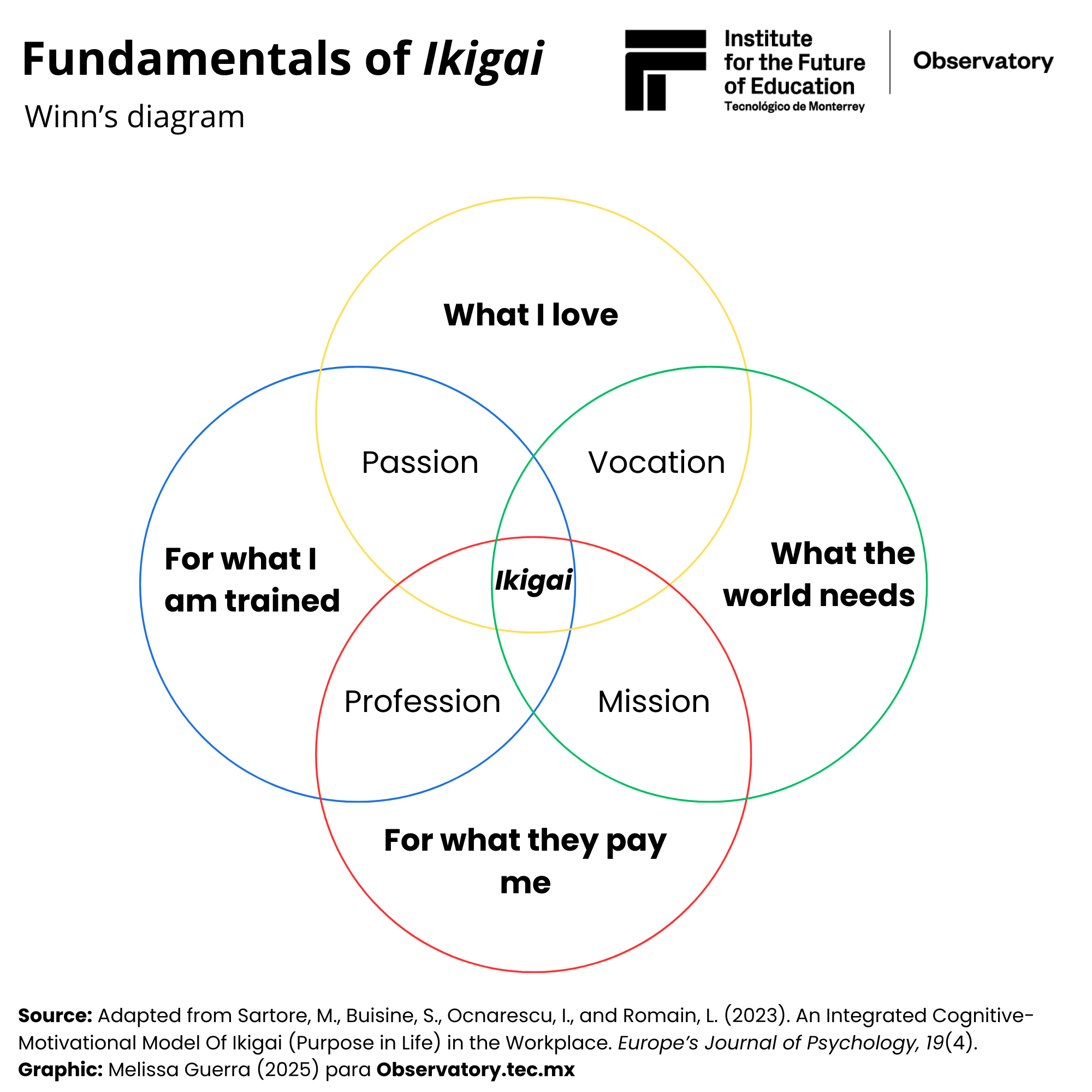
Given the complexity of ikigai, the concept was represented in the United States using a Winn diagram. Although it does not include the same elements as the models established by Kumano (2006) or Kamiya (1966), it is the most popular online representation because of its simplicity. However, Sartore et al. (2023) explain that this diagram does not appear in the scientific literature and that its initial representation was used to define “purpose”.
Benefits of ikigai
In the scientific literature on the effects of ikigai, longitudinal, cohort, and mixed studies have shown that this concept is associated with benefits for physical and emotional health, as well as positive effects on social health. Initially, ikigai studies were conducted in blue zones (regions of the world with populations that have extraordinary average longevity) to examine the longevity and quality of life of older adults. But given the wide-ranging benefits of this Japanese philosophy, it was introduced to the Western world for study of its effects on health and well-being.
Additionally, an exploratory review by Ijeaku et al. (2025) reported on the following health and wellness benefits of applying ikigai in people’s lives.
Subjective well-being
Ikigai is associated with improved subjective well-being, a central indicator of psychological vitality in old age. According to Regan et al. (2022), this concept refers to the ability to adapt to life and remain satisfied, maintaining a balance between positive and negative aspects (including diseases, losses, physical or cognitive deterioration, etc.).
Stress
A study during the COVID-19 pandemic found that higher levels of feeling meaning in life were associated with lower levels of anxiety and stress. Similarly, having ikigai is associated with lower allostatic load (wear and tear on the body from prolonged or chronic exposure to stress), which translates into less damage to internal systems.
Mental Health
Ikigai is associated with a decrease in symptoms of depression and hopelessness, and an increase in feelings of happiness. It is also related to reduced anxiety and higher levels of life satisfaction.
Physical health and performance
People who practice ikigai in their lives have a 36% lower risk of developing dementia, a lower risk of premature mortality (from all causes), and better overall physical health. It is also associated with a significant improvement in rehabilitation processes. On the other hand, the absence of ikigai is associated with reduced brain activity. In addition, integrating this philosophy into cognitive-behavioral health improves physical health in the workplace.
Ikigai in daily life
Ikigai answers the question, “Why do you get up in the morning?” In other words, it directs our attention to our purpose in life. Defining life intention helps maintain and meet goals, making the effort feel less burdensome and encouraging a full life.
Theikigai philosophy requires living with purpose, doing what you love, knowing what you are good at, doing what the world needs (to have a positive and profound impact), seeking balance (between all areas of your life), cultivating focus (practicing mindfulness), and finding flow (deep concentration on an activity).
In this new year, it is not only important to set goals and eat grapes (a Spanish tradition of eating 12 grapes at midnight for luck in each month), but also to define or redefine our life purpose, since having a sense of life helps to achieve goals more easily and to lead a full life. Our priorities determine the direction of our actions. If they are not underpinned by meaning or purpose, life can become tedious or frustrating, making everyday life monotonous and eroding value and motivation.
The Japanese philosophy of ikigai teaches us to live with purpose and meaning. Would you like to apply ikigai in your life?
Translation by Daniel Wetta

)
)
This article from Observatory of the Institute for the Future of Education may be shared under the terms of the license CC BY-NC-SA 4.0