
What first jumps into view (and to all the senses), and the first thing one might wonder about when dealing with the difference between didactics online and face-to-face didactics in the classroom, is the lack of direct human contact that exists in the first. When I talk about it, I remember a friend who said that what she missed most from printed books when reading online was the smell of paper. Do we miss the smell of the teacher and our classmates when we study online, when we take a course where the teacher is behind the screen, and the only senses that put us in contact with it are sight and sound? There is a lack of smell, the possibility of touch, and well, another sense that it should never intervene in the face to face classes: the sense of taste. (In reality, the latter, which here is a silly joke, can make us wonder if our whole body does not actually participate in the classroom, and if the interchange with real people does not even have a particular flavor, even making us say that a lesson left us “a very good – or bad – taste in the mouth.”).
Does this happen when we take a lesson or an online course? That is one question. Another, and more important question: Is it necessary a sensory/body involvement to occur so that we can say that a pedagogical objective has been accomplished? Does it matter if the teacher is near or far for the interchange to be fruitful? I suspect that answering this question is difficult because it puts us at the center of the difficulty of thinking of the modern era as a time when people, young people above all, have privileged virtual relationships, diminished the importance of direct human contact, and prioritized behavior that studies (it is still not known how reliable) say are modifying substantial parts of our brains.
The truth is that, for example, something similar happened centuries ago when the printing press was invented, and books proliferated. We must take into account that in the origins of modernity is this instrument that we use so much today but that in its time, among other effects, caused a sharp estrangement among people by making private (through personal and silent reading) the art of hearing stories (which was formerly public or at least in families), banishing human contact as important as that of a group gathering around the table or in the middle of the town square to hear a tale, or others that we can consider more “transcendent,” such as the faithful congregating obligatorily in the temple to listen to the word of God, replacing that with the possibility of reading the Bible at home alone (perhaps that was one of the reasons why this practice came to be prohibited).
One of the most influential books in literature, Don Quixote (the origin of the modern novel), continues to expound a critique of this new means of printed expression, through which Alonso Quijano is absorbed into so many stories of cavalry that he goes mad. Cervantes not only tells us an innocent bad joke; he puts before our eyes a fact that began to transform the values of the world, denouncing and pondering at the same time a means of communication that, in its time, increased as cell phones do now. (Did the reader know that Quixote arrived in Mexico on a boat with at least a hundred copies, only five years after having been published in Spain?).
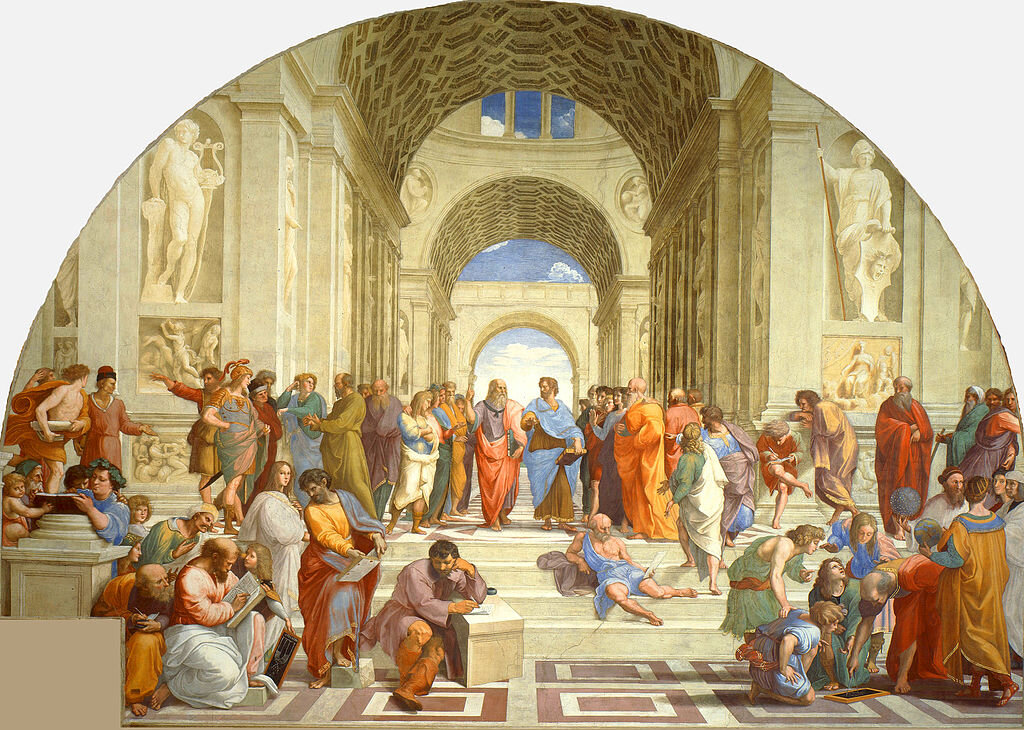
Books, as a means of expression and learning, affected the physical contact between people; their appearance implies a milestone in the behavioral changes of people, for example, changes in the relationship between the teacher and his disciples. Let us compare the university professors of the last five centuries, surrounded by books and commissioning readings to their pupils, with two Western teachers, mainstays of our civilization, who taught without writing anything or reading anything, and who transmitted everything not only personally but often in social gatherings and even feasts where food was shared and where the bodies touched each other, sometimes lying on each other. I am speaking about Christ and Socrates.
When Academia arrived a little later, that vision of the lesson began to be imposed as something that flows in a unidirectional way from the teacher to the student, where no one touches each other, and everyone listens and sees the sage. If we imagine those social gatherings in which Socrates helped give ideas to his interlocutors, and we compare it to the modern classrooms where the teacher is in front of the students… if we make that comparison, then online teaching is no more than a small step farther in history, one step perhaps not as dramatic as we sometimes imagine.
Many supposed as dramatic the appearance of cinema at the beginning of the last century, an art that distanced the actor from the spectator, replacing Theater with its images full of frigidity and without a soul. And, nevertheless, the seventh art has imposed itself with all its power to transmit the most endearing human values and sentiments, also providing the possibility that more people can share them (without banishing Theater, by the way, insists on not ending).
What is lost among how those ancient teachers taught, and what happens now? The great worry, which seems to be nothing new, is that the much-feared prevalence of the mind over the body will occur and the disappearance of human contact, that we stop seeing ourselves in person, that we abandon caresses, the physical presence, the living voice that makes the air vibrate, the possibility of touching or smell others; that children stop being present (increasingly at ages less advanced), that education jumps out of the hands of parents and becomes a privilege of electronic means; that values be standardized, leaving to the side all originality, all personal criteria, and all tradition; that communication is mediated, that presence is digitalized, the body is abandoned, sensuality passes out of style, and, little by little, is realized the horrendous fantasy of human beings with hyper-developed heads and atrophied small bodies, for whom not even the hands are useful, because the hand is not useful. After all, the mastery of devices is carried out by electronic brain implants. Not a few reflexive minds relate this ugly panorama to the abandonment of nature, the technologization and robotization of the surroundings, the indifference to the environment, the ecological deterioration, and the extinction of the species.
Will love disappear? Will everything become cold and insensitive, like the materials that electronic equipment is made of? Recap: Did the stage show turn cold when it became a cinema, did the voice turn cold when it transferred itself to writing, the music cool down when the radio and all the reproducers of sound arrived, did family relations chill when the shared space of the house was divided into private compartments, and the doors and bedrooms appeared? Did love grow cold when instead of expressing it with physical contact, “I love you” is said, or, worse, this is written in a card, or more recently, in a WhatsApp message (not to mention synthesizing it in a heart emoji)? Is truth banalized?
It changes, yes, that is certain. It seems that online courses can be as good or bad, as uplifting or harmful, as stimulating or boring as the commitment, affection, and preparation that the production team invests in them converted into a true collective teacher now responsible for the staging of the pedagogical fabric. The truth is that, as always, these producers/teachers have all the resources today to make their online courses useless and tedious or real works of art through which to transmit all the mystique of knowledge and the human spirit.
There are always excuses from those who fail to do so, and accusing electronic screens of impassable barriers is a perfect one. But the ultimate responsibility remains with those who are called “teachers” and who dare to educate and teach something to someone.
Translation by Daniel Wetta.
Disclaimer: This is an Op-ed article. The viewpoints expressed in this article are the author’s own and do not necessarily reflect the opinions, viewpoints and official policies of Instituto Tecnológico y de Estudios Superiores de Monterrey.