


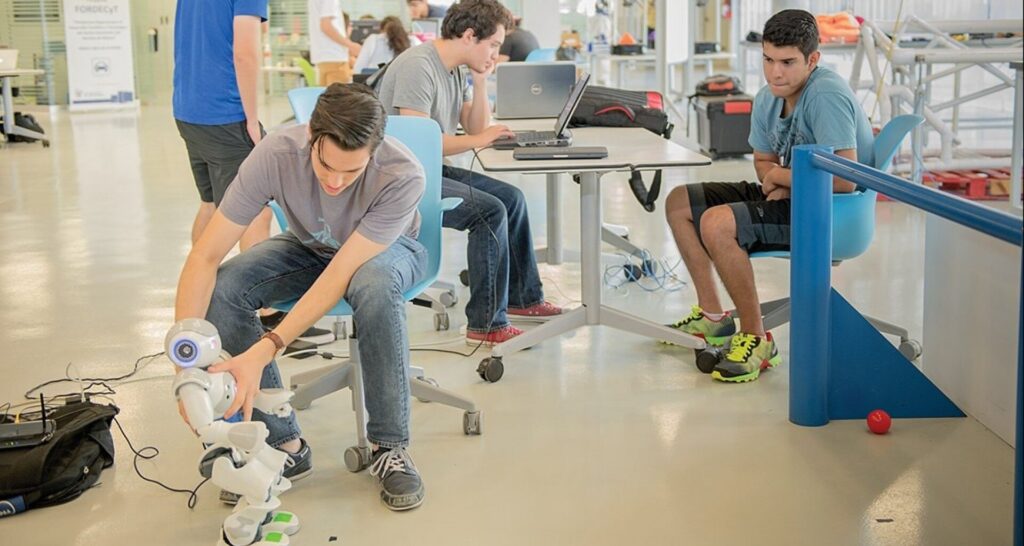
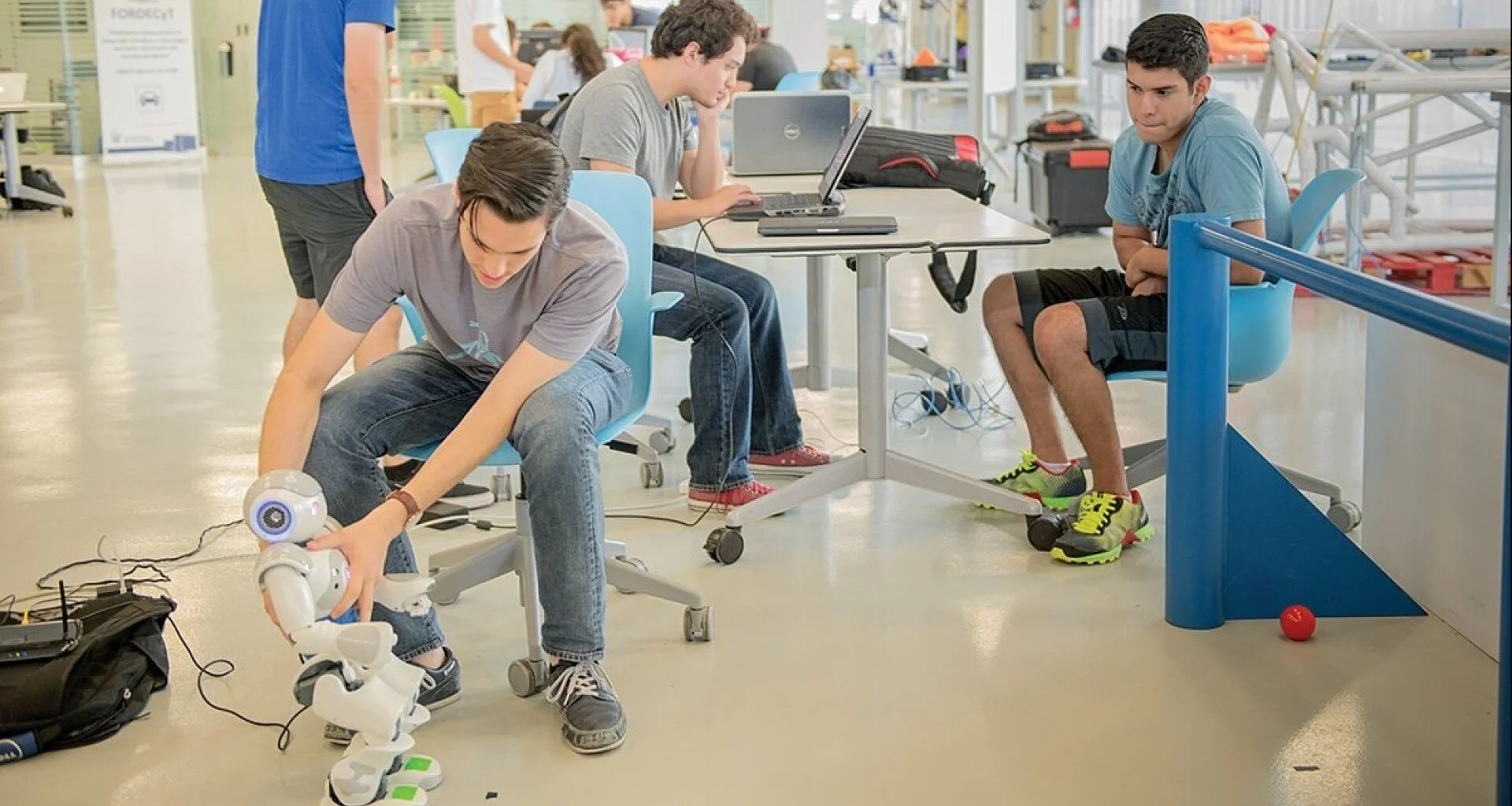
“Students, teachers and professionals integrate robotics solutions and innovative technologies that change lives.”
¿What do a robot, a teacher, a therapist, and a doctor have in common? The answer is that all of them, working together, can change lives.
Advances in artificial intelligence and automation inevitably will change labor dynamics in many productive sectors. According to one study, about 40% of the jobs in the United States are performed by workers whose ages range from 18 to 34 years old; these jobs could disappear over the next decade due to automation. (McKinsey Global Institute, 2019). It is important to note that many of these jobs are performed by students about to graduate or recent graduates looking to gain experience to enter the workplace.
“Students generate social impact with their knowledge and creativity, but they also realize that they need to develop many skills to implement communication bridges between teachers, patients, therapists, professionals and specialists for the benefit of another person.”
So how can we prepare our students to anticipate this inevitable reality and not see it as a threat but as an opportunity?
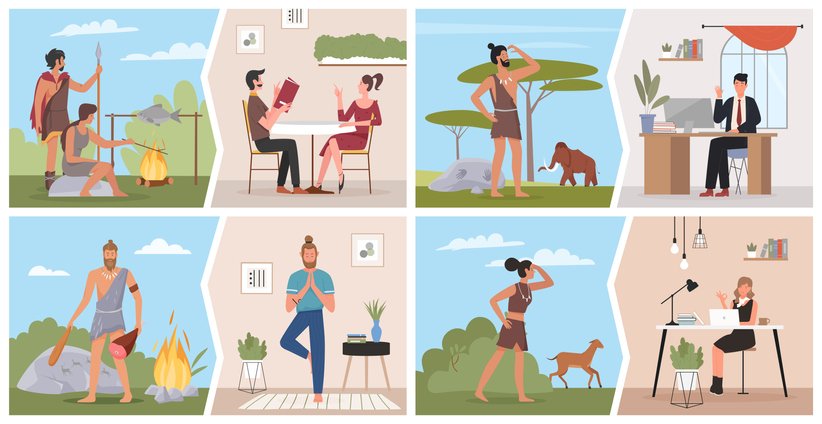
In the future, the nature of work will focus less on performing repetitive or manual tasks and more on the creation of functions where creative and strategic thinking is applied. The ability to learn will be more highly valued than having only one specific knowledge (Deshpande, 2019). The jobs will require more creative talent, communication abilities, digital skills, people skills, creative thinking, and problem-solving (Hilton y Lund, 2019).
The students of Tecnológico de Monterrey perform social services that strengthen their ethical commitment and citizenship through training that includes human sensitivity and empathy; this “human touch” is accomplished primarily through experiential learning that involves activities and service projects. With this objective and making use of the technology of NAO robots from SoftBank Robotics, Tec students have developed several community service projects. To date, eight projects have been developed whose results have been published in journals and conferences. In this article, I share the most relevant projects.
Our experience with these robots began in 2014 when the humanoid robotics team was formed with six engineering students. We participated in the 1st NAO Robotics and Artificial Intelligence Contest 2014. Currently, the team is made up of more than 30 students from different curricular disciplines. In the latest edition of the NAO contest 2018, the students of Tecnológico de Monterrey achieved excellent results.
Tec’s Mexico City Campus has three robots named Atom, Itzel, and Telsa. To have access to these robots, it is not necessary to be a member of the humanoid robotics team; it is sufficient for students to submit a proposal or project for their use or exploration and have the accompaniment of a teacher who follows the project. If the teacher is part of the project, he or she has to be familiar with using the robot with respect to the possible interactions such as sensors, voice commands, cameras, and movements, etc. Teachers can also be trained in how to program robots.
The projects that have been implemented having the integration of NAO robots are mainly focused on areas of health, education, and technology. Below is a brief summary and scope:
-
Accompaniment for children with autism who are in rehabilitation therapies
Atom helped in therapy sessions for children with autism; he was accompanied by another robotic platform called TECO, and they interacted with the patient. TECO is a robot created on the Mexico City campus. This robot teaches children with autism to understand human gestures related to emotions and to express their own emotions in order to improve their social skills. The NAO robot was responsible for the quality assessment of these sessions.
-
Accompaniment for older adults
Tesla has the function of serving as a bridge between geriatric patients and older adults. Our robot took care of applying a questionnaire to the patient or his/her companion, processing the data, and making a diagnosis with the oversight and approval of the specialist. The diagnosis helped the patient for his/her next appointment. The robot was very well received by older adults and geriatric patients.
-
Encouraging children to read via a reading cycle with the robots
A campaign to promote reading among children was carried out in coordination with the IBBY Library in Mexico City. On that occasion, Itzel was the principal reader during the event, reading the stories, and giving the children their turn to read. In the end, the children asked the robot questions about the book they read and sometimes about robotics. Itzel also asked questions about the story read and solicited the opinion of the parents.
-
Instruction of Mathematics in elementary, high school, and preparatory school
The three NAO robots have been responsible for supporting teachers in physical education and math classes. In physical education, the robot gave instructions for the exercises and even did some of them himself. In some parts of the math course, the robot helped the teacher to stimulate the students and increase class attention. Sessions and interventions were coordinated and approved by every teacher or group of class mentors. In the end, the teacher received feedback from the class and decided when the robot’s help had been the most useful.
-
Delivery of play therapy and motor rehabilitation therapies for children with mainly cerebral palsy
Tesla was charged with the responsibility of attending the National Institute of Rehabilitation and the Fund of Support for the Mentally Weak, where he was programmed by a group of 12 students from different disciplines for the application of occupational therapies and motor rehabilitation for children principally with cerebral paralysis, together with the therapists, doctors, and specialists who give the therapies.
-
Workshops for nurses and doctors
The Atom robot attended an IMSS Clinic in the State of Mexico to give a workshop directed to nurses and resident physicians for the preventio
n of abuse against older adults. A geriatric specialist coordinated the session and approved the contents of the workshop as well as the analysis of the results. In Mexico, we have a shortage of health personnel, and the provision of such workshops would be very useful to reach more of the public in the medical environment. -
The children’s play, “SAGA, the Acting Robot.”
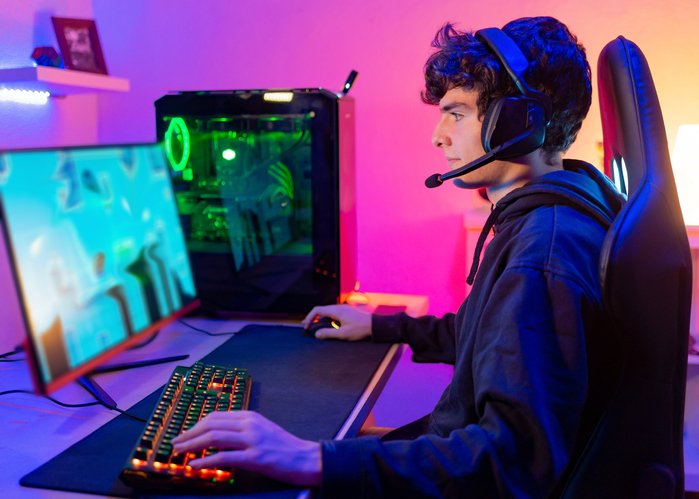
Tesla and Atom participated in the play “SAGA, the Acting Robot,” in which they took turns performing in this play that was presented at the National Center for the Arts in Mexico City. The script was about a child facing the danger that he can become abstracted in the world of video games, and our robots helped him. The students had rehearsals with the actor, reviewed the scenes and always had to be aware of the correct dialogues of the robot and its interactions with the audience present. Each function had new challenges to be resolved by the students.
Learning for the students
After participating in these projects with robots, the students reflect on the possibility of using these systems for the benefit of others and, also, on the impact of applying their knowledge to real problems. Through these reflections, students realize that they can generate change through what they have learned in their different disciplines by integrating robotic solutions and innovative technologies.
I believe that the competencies and skills that students develop in these types of projects align with the Educative Model Tec21 of Tecnológico de Monterrey, namely, the competencies of leadership, critical thinking, problem-solving, ethics, citizenship, community service, intellectual curiosity, passion for self-learning, teamwork, and, of course, management of information technologies.
Reflection
Do we need robots to achieve this? The answer is no. Instead, the idea is to identify scenarios based on academic learning in which students apply their knowledge, feel part of a team, and can attest to the social impact they can achieve through experiences outside their classrooms, experiences such as the examples mentioned in this article.
Students realized that their knowledge and creativity could have a direct social impact and also that many skills are necessary for building bridges of communication among the students, teachers, patients, therapists, professionals, and specialists involved for the benefit of someone else. It is not easy, but once one starts walking, the generational footprints of the students themselves lead to discovering new trails and routes that we can explore.
About the author
Edgar Omar López (edlopez@tec.mx) is currently an SNI research professor at Tecnológico de Monterrey, Mexico City Campus. He also coordinates the work research and application group on social robotics and leads the group called the NAO Team CCM, which has obtained first places in consecutive national competitions of the Robotics and Artificial Intelligence NAO Mexico and the NAO Challenge Mexico.
References
[1] T. de Monterrey, “Concurso de robótica NAO,” TECREVIEW, 2019. [Online]. Available at: https://tec.mx/es/noticias/ciudad-de-mexico/educacion/brillan-en-concurso-de-robotica.
[2] P. Ponce, A. Molina, E. O. L. Caudana, G. B. Reyes, and N. M. Parra, “Improving education in developing countries using robotic platforms,” Int. J. Interact. Des. Manuf., 2019.
[3] E. O. Lopez-Caudana, O. Quiroz, A. Rodríguez, L. Yépez, and D. Ibarra, “Classification of materials by acoustic signal processing in real-time for NAO robots,” Int. J. Adv. Robot. Syst., 2017.
[4] E. Lopez-caudana, “Use of NAO Robot in Training of Primary Care Clinicians for Treatment of Elderly Patients,” J. Lat. Am. Geriatr. Med., no. November 2017.
[5] E. Lopez-Caudana, P. Ponce, L. Cervera, S. Iza, and N. Mazon, “Robotic platform for teaching math in junior high school,” Int. J. Interact. Des. Manuf., 2018.
[6] I. Mexico, “Fomento a la lectura IBBY Mexico,” 2016. [Online]. Available at: https://es.wikipedia.org/wiki/Archivo:Robot_NAO_en_Biblioteca_BS_IBBY_México_A_Leer.JPG#/media/Archivo:Robot_NAO_en_Biblioteca_BS_IBBY_México_A_Leer.JPG.
[7] E. S. de Mexico, “SAGA el Robot Actuante,” 2017. [Online]. Available at: https://www.elsoldemexico.com.mx/cultura/teatro/la-ciencia-y-el-arte-juntos-en-la-obra-saga-el-robot-actuante-246879.html1.
[8] Ponce, P., Molina, A., & Grammatikou, D. (2016). Design based on fuzzy signal detection theory for a semi-autonomous assisting robot in children autism therapy. Computers in Human Behavior, 55, 28-42.










Kathia Rebeca Arreola Rodríguez
Kathia Rebeca Arreola Rodríguez
Kathia Rebeca Arreola Rodríguez