
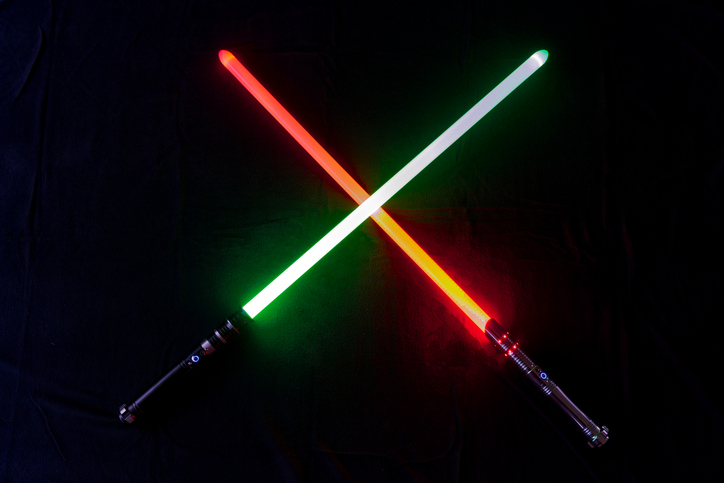
“A long time ago, in a galaxy far, far away…” are words that vividly remind me of what I felt at the Star Wars premiere in 1977. It was a film that left a deep impression on me because of its epic story between good and evil and its special effects, particularly the sound and light of the Lightsabers used by the Jedi.
This memory motivated me to plan a class in which the protagonists would be the laser beam (lightsabers), my students in the Architectural Acoustics class (the Jedi Order), distraction and apparent apathy (the dark side of the force) that, on many occasions, students demonstrate in the classroom; and finally me, the brave teacher who guides them (Yoda). The objective was to capture the students’ attention, especially toward the essential theory topics they usually regard as “filler.” Also, considering Andragogy (education for adults), according to Malcolm Knowles (1980), adults are motivated to learn something when they perceive it will help them face a problem.
The battle against apathy and motivation loss in learning begins now
The induction session began with the following question for my students: What is this image about? On the blackboard, I projected a 1938 photograph of Orson Welles gesturing in front of a microphone while broadcasting “The War of the Worlds” by H. G. Wells on the radio. Given the students’ bewildered faces as they stared and looked at each other, I explained that this historic broadcast caused nationwide panic in the United States. The collective hysteria hurt some people because listeners thought that it was breaking news reporting an extraterrestrial invasion of Earth.
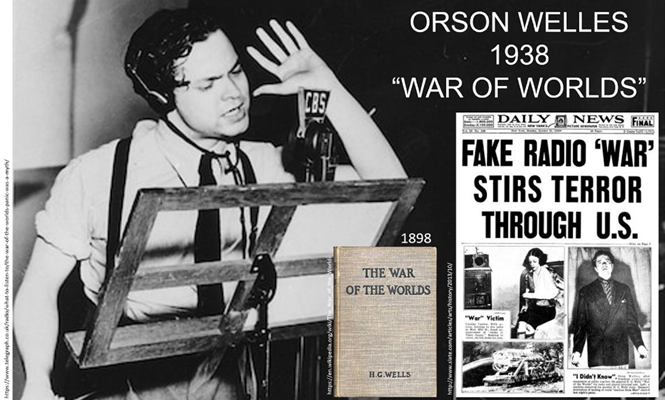
Once I caught their attention, I explained that in those days, families gathered in their living rooms to listen to the radio, unlike today when we have authentic entertainment rooms in our homes equipped with screens, consoles, and sophisticated sound systems requiring specialized architectural acoustic treatment.
At that moment, I asked them if they would like to know how these types of spaces are designed. Their response surprised me: the whole class raised their hands in agreement. I had captured their attention!
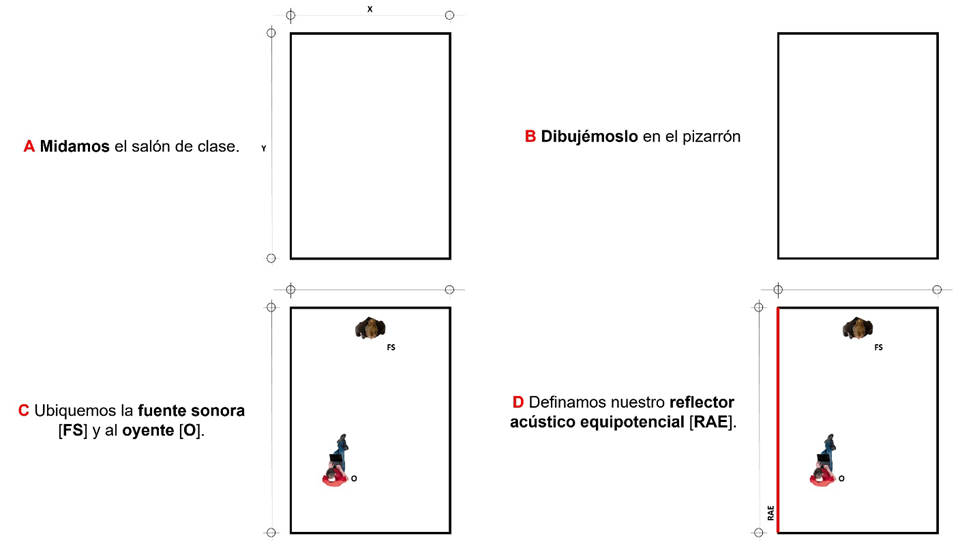
Having garnered their enthusiasm, I told the students we would conduct a “Star Wars” type practice (their faces were surprised and skeptical). To do this, we would need to do the following: [A] measure the classroom, [B] draw it to scale on the board; [C] locate a sound source (professor) and a receiver, an “Indies” student who, by the way, I asked in a serious tone if his medical insurance covered laser burns (when I saw his frightened face I told him that it was a joke), and [D] choose the wall that would be the equipotential acoustic reflector. See Image 2, figures A – D.
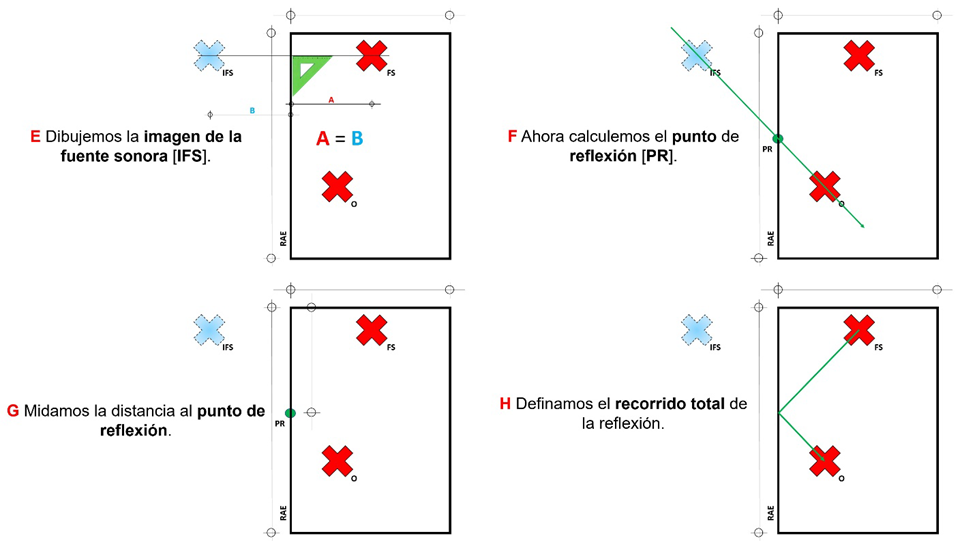
Subsequently, we performed graphic-mathematical calculations on the blackboard: [E] drawing the sound source image; [F] calculating the reflection point; [G] measuring the distance to the reflection point; and [H] defining the total path of reflection. See image 3, figures E to H.
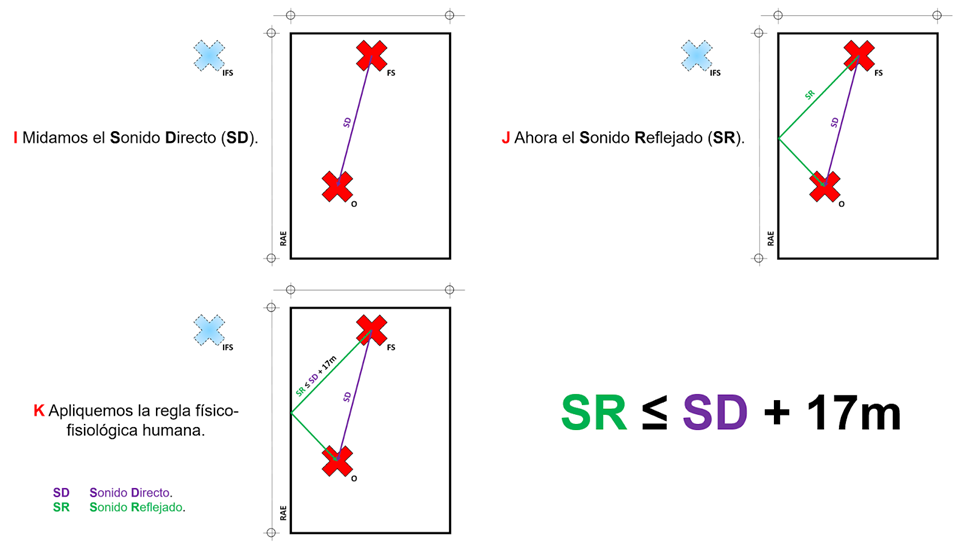
We continued with the echo check: [I] measuring the direct sound, [J] measuring the reflected sound, and [K] applying the human physical-physiological rule of sound integration in the ear. See Image 4, figures I – K.
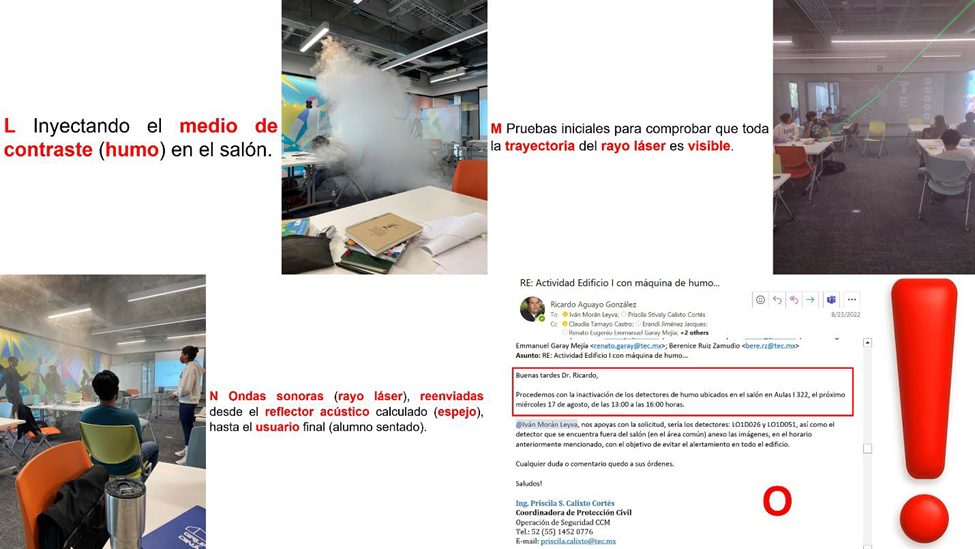
After that, I announced it was time for the battle with the lightsabers (you can imagine their excited faces). See Image 5, figures L—O.
[L] injection of the contrast dye into the room (smoke); [M] initial tests to verify that the laser path was visible; [N] verification that the laser ray went from the sound source (professor) to the mirror (equipotential acoustic reflector) and from there to the receiver (the Indies student), thus demonstrating that the graphic-mathematical calculations we had made on the blackboard were correct (a Wow moment!).
As an anecdote: we had to notify the campus physical plant security department in advance so they could disconnect the smoke detectors, thus avoiding alarming users and requiring them to vacate the classrooms in the building [O].
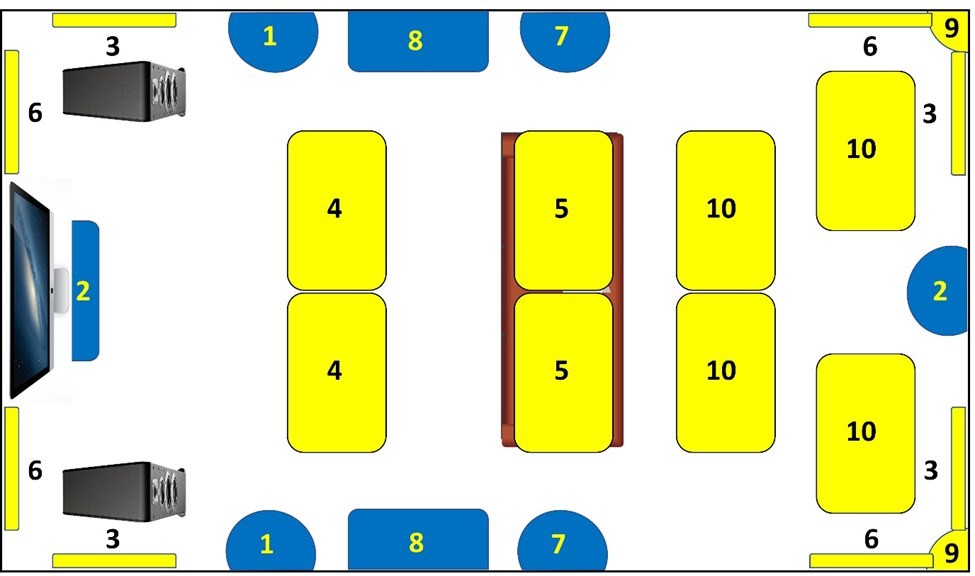
With this new competency (“being, knowing, and doing” geometric acoustics), we continued with the detailed explanation of the acoustic design of a home entertainment room, i.e., the location in space of [1,2,7] vertical cylindrical diffusers; [2,8] horizontal cylindrical diffusers; [3,6] vertical absorbers; [4,5 & 10] zenith absorbers, and [9] corner bass traps for optimal sound design. See Image 6, figures 1 – 10.
At this point, I asked them what they thought of learning this specialized architectural design so quickly. Now they know they can apply it in their professional lives, not only to a home entertainment room design but also to an auditorium, theater, or concert hall. Once again, all the students raised their hands.
At this time, I told them that to learn architectural design was necessary to draw on knowledge of diverse topics, including history (the rules of geometric acoustics discovered by Athanasius Kircher in 1650 and published in his work: “Musurgia Universalis”), the fact that sound does not travel in a vacuum (discovered by Robert Boyle in the seventeenth century), and Wallace Clement Sabine’s 1898 formula, which tells us that reverberation time is directly proportional to the volume of space and inversely proportional to the absorption of its materials. Another necessary knowledge is the physics of sound, which says that the speed of sound in air is 340 m/s. Complex sounds can be broken down into pure sinusoidal tones. The sound hitting a wall is reflected, absorbed, and transmitted. Also, three types of sound reflections are determined by the surface that reflects them (flat, concave, and convex). Then there is sound physiology, which states that the human brain can integrate reflected sound reaching the ear no more than 1/20 of a second from the direct sound). The psychology of sound states that the color of space generates synesthesias that alter the perception of sound. Generic sound parameters refer to characterizing sound in a venue based on the sound’s level, pitch, timbre, directionality, and reverberation. Acoustic materials are generally divided into diffusers, absorbers, Helmholtz, and anechoic materials). Architectural systems include double walls, floating floors, and elastically suspended ceilings. Concert hall design rules mainly premise that sound envelops spectators from all directions.
Subsequently, I presented the course syllabus that included all these topics and asked the students if they would like to learn them as necessary scaffolding to master this science applied to architecture: again, the resounding answer was the whole room with their hands raised. (Man, did I have them in my pocket!)
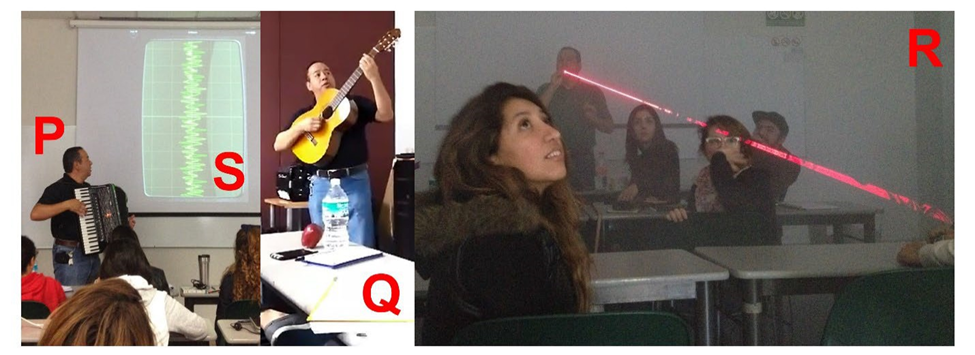
It is important to note that the first time I implemented this laser activity [R] in 2016, I spiced it up by using an oscilloscope [S], an accordion [P], and a guitar [Q] to demonstrate some essential acoustic physics concepts such as the frequency spectrum, fundamental notes, harmonics, pure sounds, etc. See Image 7, figures P—S.
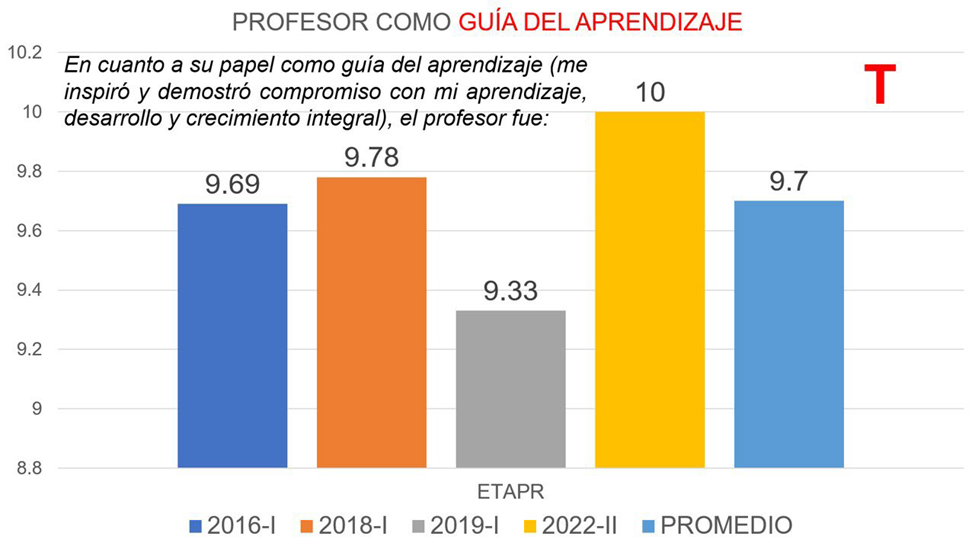
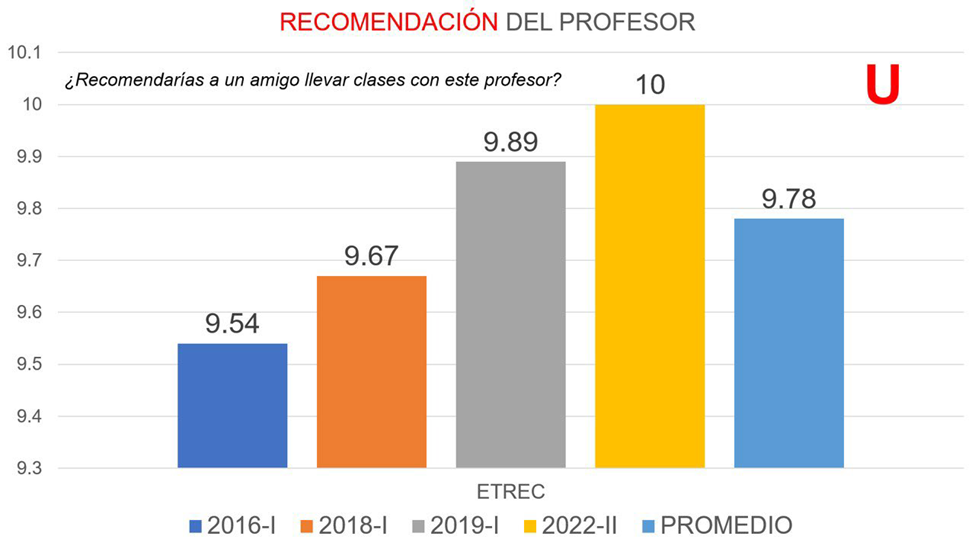
Regarding the results achieved with this activity, the ETAPR [T] and ETREC [U] questions in the ECOAS (TEC Student Opinion Survey) [1] were analyzed for the semesters in which the topic was taught in person. (Omitted were those classes conducted nationally via ZOOM due to the pandemic and those interrupted by the earthquake.) See Figures T and U.
Also, I share with you some representative comments analyzed in the previous semesters:
“You can see his love not only for what he teaches but also for teaching. He is one of the best teachers in the entire career curriculum; he explains well and simply, and you can see that he seriously likes it.” 2016-I.
“Excellent teacher. He always gives classes differently. He tries to innovate in his teaching; I think he does it well. Very cool and topical; 100% recommended.” 2018-I.
“He is very passionate about his subject, which makes him enjoy it. He masters the concepts, and how he teaches them makes them easier to understand.” 2018-I.
“I would recommend him because he is an extremely passionate teacher of his subjects; he leaves no room for doubts, and as students, we always feel his support.” 2019-I.
“The class is a lot of fun. The technical concepts are made very digestible through the teacher’s proposed activities. The activities complement much of what was seen in class, and he is open to receiving questions. Super passionate about the subject.” 2022-II.
Reflection
Through this practice, I was able to verify that we can capture the attention of the students and motivate them to continue learning despite the general opinion among teachers that the students we currently have in the classrooms (Generation Z) are disinterested, apathetic, easily distracted, and have little tolerance for frustration. I found that it is possible to “hook” them by using classic didactic tools such as induction (which must be motivating, independent, and relevant), active learning (“hands-on”), and the principles of Andragogy (adult teaching applying problem-solving learning and practices).
Additionally, we complement the above with teachers who are passionate about teaching and have enough creativity to generate ideas in class that intrigue students to develop the disciplinary and transversal competencies indicated in the subject’s objectives. In that case, we can make our classes fun, stimulating, and inspiring.
About the Author
Ricardo Aguayo González (raguayo@tec.mx) is a full-time research academician at Tecnologia de Monterrey’s Mexico City campus. Recognized as an Inspirational Professor in 2016 and 2022. He is a member of the EAAD Outstanding Professors Circle 2021, 2022 and 2023. 2014, he won second place in the Educational Innovation award in the “Innovation Management” category. He also won first place in the 2013 Educational Innovation Award in the “Teaching-Learning Process” category. He was awarded the 2005 Medal of Academic Merit. He was a member of the SNI from January 1, 2004, to December 31, 2007. Professor Aguayo-Gonzales has a Doctorate LAUDE (with honors) from the Barcelona School of Architecture (2000).
References
Knowles, M. S. (1980). The Modern Practice of Adult Education: From Pedagogy to Andragogy. Revised and Updated. Accessed at: https://www.umsl.edu/~henschkej/articles/a_The_%20Modern_Practice_of_Adult_Education.pdf
Fairstudio (2014). Malcolm Knowles Educational Theorist Abstract. Accessed at: https://www.scribd.com/document/240553212/Malcolm-Knowles
Jiménez, M. (2023). Andragogía: adaptando el aprendizaje para los adultos. Accessed at: https://observatorio.tec.mx/edu-news/andragogia-adaptando-el-aprendizaje-para-los-adultos/
Tec de Monterrey (2024). “Sistema de encuestas”. “Mi espacio”. ITESM. Retrieved 7-03-2024 from: https://encuestastecadmin.tec.mx/teacher_reports/group_details?q[period_eq]=202013&q[survey_group_eq]=10
Editing
Edited by Rubí Román (rubi.roman@tec.mx) – Editor of the Edu bits articles and producer of The Observatory webinars- “Learning that inspires” – Observatory of the Institute for the Future of Education at Tec de Monterrey.