
The “Introduction to Biomedicine” course at Prepa Tec Campus Morelia allows students interested in pursuing a health-related career to learn more about this area of knowledge. Biomedicine is a branch of science that studies biological and medical processes to understand the functioning of the human body, converging biochemistry, genetics, and cellular and molecular biology (Arias, 2024). Students who have taken this course to pursue a career in medicine or another health-related area consider it burdensome because it covers a lot of theory and material to memorize, the exams are complex, and the students doubt whether they will ever apply its learning in practice during their professional careers.
For this reason, we changed the subject’s teaching method, incorporating inquiry processes for learning science and implementing practices where students employ theoretical knowledge with scientific skills and attitudes, always under the teacher’s monitoring and direction. To this end, we conducted a study to determine whether implementing guided practical research activities would improve students’ motivation and academic performance compared to a regular class of readings and book activities.
Flipped Learning in Guided Research Practices
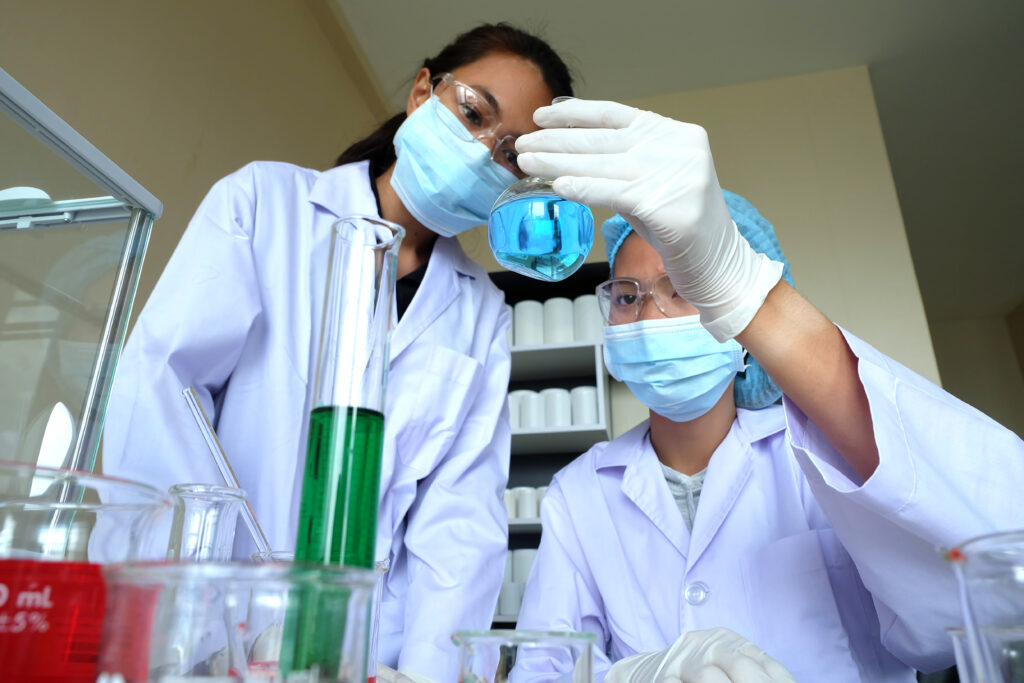
The guided research practices used the flipped learning dynamic. After the students reviewed the theoretical topic at home and in the classroom, they conducted research practices in the laboratory and other workspaces. Their task was to solve different challenges collaboratively. The teacher’s role was to guide them, allowing them autonomy to learn in a safe environment where they could prove themselves and even make mistakes. Flipped learning teaches students to be responsible for their knowledge and acquire cognitive skills through challenging and genuinely interesting activities like the guided inquiry practices shared in this article.
Involving students in research activities improves their abilities to formulate questions, design procedures, and reach conclusions by making the learning process their own and motivating them to see the relevance of their learning in their daily lives and the careers they would like to pursue (Varadarajan, 2022). Also, according to Barral et al. (2018), active, practical, and research-based learning approaches positively impact student learning and engagement.
Guided research practices for learning Biomedicine
The activities chosen for this study aligned with the class topics found on different websites and repositories, for example, yourgenome.org, gtac.edu.au, hematology.org, scienceinschool.org, HHMIBiointeractive, thinkib.net/biology, PDB-101, web.mit.edu. /education/, Cornell Institute for Biology Teachers Cerebriti, Forensic Science, and PocketLab. The research practices carried out by the students were:
Biomedical learning activities selected for this study
- Hereditary Genetic Traits: The Thomson Family Fortune: Who Receives the Inheritance? In this game, students received enough clues to establish a family’s pedigree (family tree) and track hereditary genetic traits to find the proper heir to the family’s fortune.
- Gene Editing: CRISPR-Cas9 Activity: Students explored how the CRISPR-Cas9 RNA molecule, also known as genetic scissors, functions. Scientists use this complex to edit organisms’ DNA. The activity involved building a paper model of this system and manipulating it to see how the DNA editing complex works.
- Biochemical processes: “I love ice cream, but it does not love me.” This activity explores the biochemical processes of lactose intolerance, the reaction of the lactase enzyme, and the detection of lactose and glucose in dairy products, especially in ice cream.
- Virology: A virus card game. This card game aims to isolate a healthy body and eradicate a virus before it infects other bodies. The cards represent viruses, vaccines, drugs, and biological systems.
- Viral Structure: Viral Business Card. Through augmented reality with the HALO AR mobile application, students describe a virus, its three-dimensional structure, and the different parts comprising it.
- Antigens Viral Proteins: Performing COVID-19 Tests with Antigens. The students performed rapid antigen diagnostic tests using samples from nasal secretion swabs.
- Clinical Criminology: Criminology Laboratory. In this activity, the students analyzed evidence collected at a crime scene, performing DNA, drug, ballistics, and fingerprint tests.
- Genetic Inheritance: Sweet Baby – an autosomal recessive inheritance case study. In this activity, a baby’s pedigree is analyzed to obtain information about a characteristic or disorder, allowing a subsequent diagnosis and potential treatment.
- Mutations and Oncogenesis: Mutation activity of the Kras gene (homologous oncogene to rat sarcoma Kirsten virus). Kras is one of the oncogenes that is frequently mutated in various cancerous tumors, including lung, colorectal, or pancreatic cancer. This activity uses accurate genomic data from the Cancer Genome Project to investigate common mutations in the KRAS gene associated with oncogenesis. Students must find the six mutations in the protein’s sequence.
- Hemostasis: Blood clotting to the rescue and blood types. This simulation uses colored water and gelling agents to investigate blood coagulation and how its interruption can cause blood disorders, such as hemophilia. The students performed blood type and RH factor tests using their samples and performing the tests to check their blood types.
- Blood Glucose Tests, Diabetes: Blood Sugar Balance. This activity measures blood sugar levels to study hyperglycemia and hypoglycemia and understand the causes of diabetes. Each student used a lancet to obtain their sample and analyze it with a glucose meter.
- Emergency Medical Care: Case activity in the emergency room. The students analyzed various cases of patients admitted to the emergency room. They had to decide the first steps to stabilize the patient and provide an accurate diagnosis.
- Neonatology: From head to toe—newborn evaluation and care. In this realistic activity, the students used programmable baby dolls to simulate a thorough clinical examination of a newborn in the nursery within the first 24 hours of life.
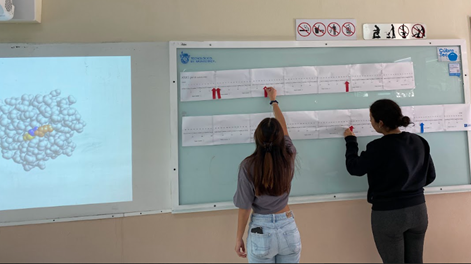
These two-hour activities occurred every Tuesday during the semester, either in the classroom or the laboratory. All students actively participated, presenting their findings and answering reflective questions (see Image 1).
Results
The student’s grades in the control and innovative research practices groups were compared. The control group’s mean score was 89.26, compared to 95.89 in the innovation group, a difference exceeding 6 points (see Table 1).
| Final Grades | |
| Control group | 89.26 |
| Innovation Group | 95.89 |
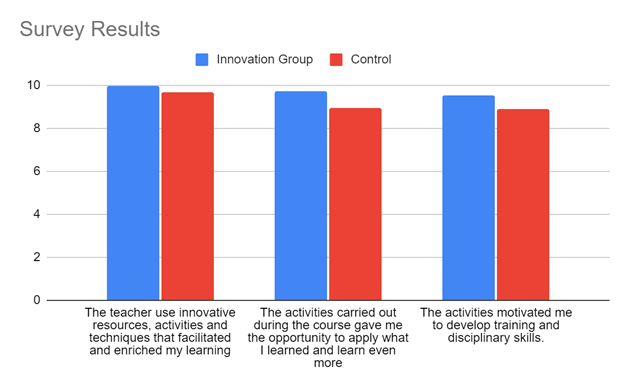
At the end of the semester, Likert scale surveys were applied to both groups, with one indicating “totally disagree” and ten indicating “totally agree.” In the first statement, “The teacher used innovative resources, activities, and techniques that facilitated and enriched my learning,” the control group means was 9.65 compared to the innovation group’s 9.95. (See Table 2.)
| The teacher used innovative resources, activities, and techniques that facilitated and enriched my learning. | |||
| Opinions | Result | Standard deviation | |
| Control group | 21 | 9.65 | 0.79 |
| Innovation Group | 21 | 9.95 | 1.15 |
Regarding the second statement, “The activities carried out during the course allowed me to apply what I learned and learn even more,” the control group mean was 8.95 and 9.7 for the innovation group (See Table 3.)
| The activities carried out during the course allowed me to apply what I learned and learn even more. | |||
| Opinions | Result | Standard deviation | |
| Control group | 21 | 8.95 | 1.39 |
| Innovation Group | 21 | 9.7 | 0.56 |
Finally, the third statement, “The activities motivated me to develop formative and disciplinary skills,” resulted in a mean of 8.89 for the control group and 9.53 for the innovation group. (See Table 4.)
| The activities motivated me to develop formative and disciplinary skills. | |||
| Opinions | Result | Standard deviation | |
| Control group | 21 | 8.89 | 1.45 |
| Innovation Group | 21 | 9.53 | 0.88 |
The results of both control and innovation groups were compared graphically to visualize the innovative group’s superior results over the control group (See Image 2).
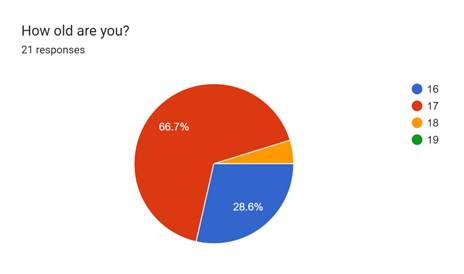
Twenty-one students between the ages of 16 and 18 participated In the “Introduction to Molecular Biology” class, which implemented the guided practical research activities (see Image 3).
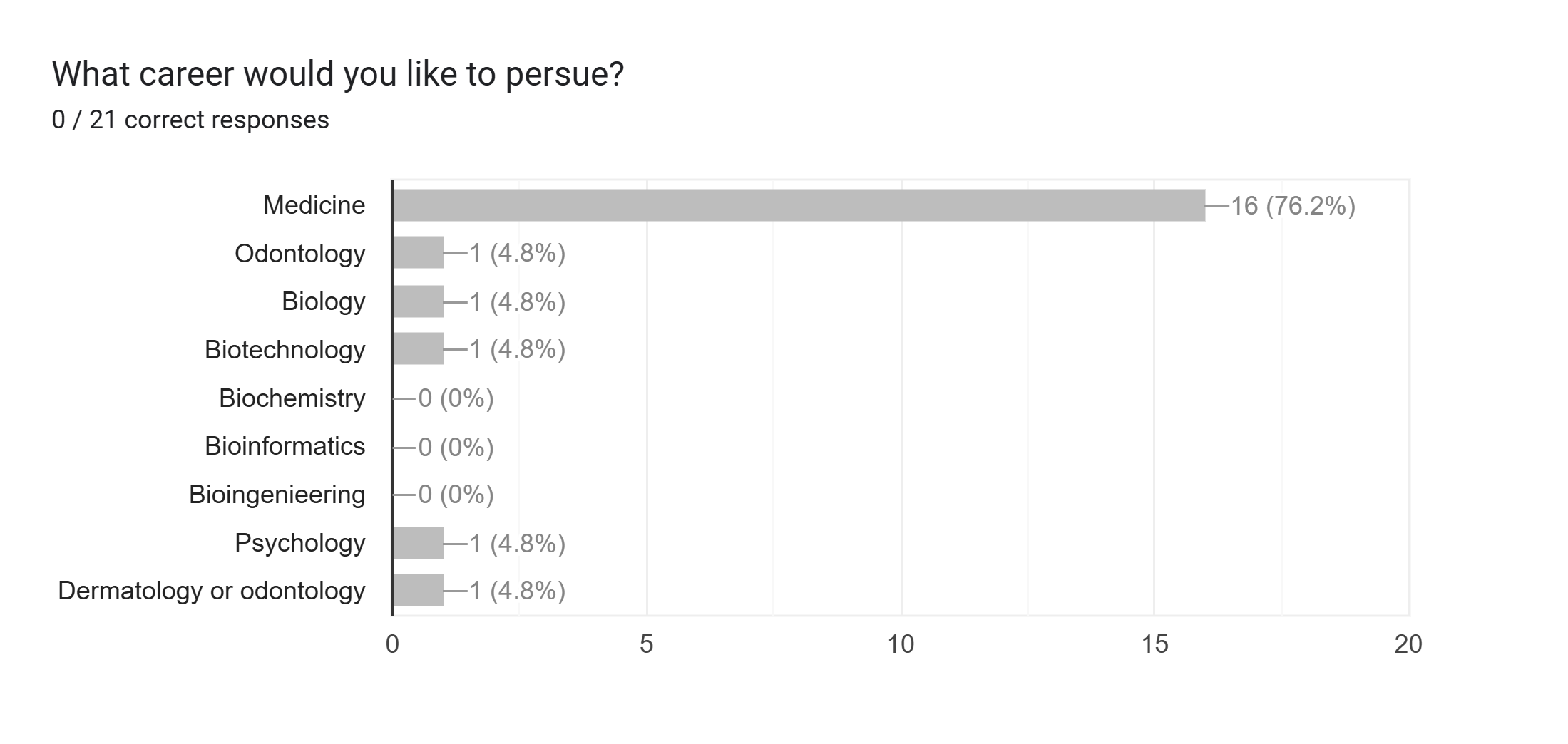
Students taking this class were interested in pursuing health careers. Of the 21 students, 16 wished to study medicine, and the rest wanted to study dentistry, biology, biotechnology, psychology, and dermatology (see Image 4).
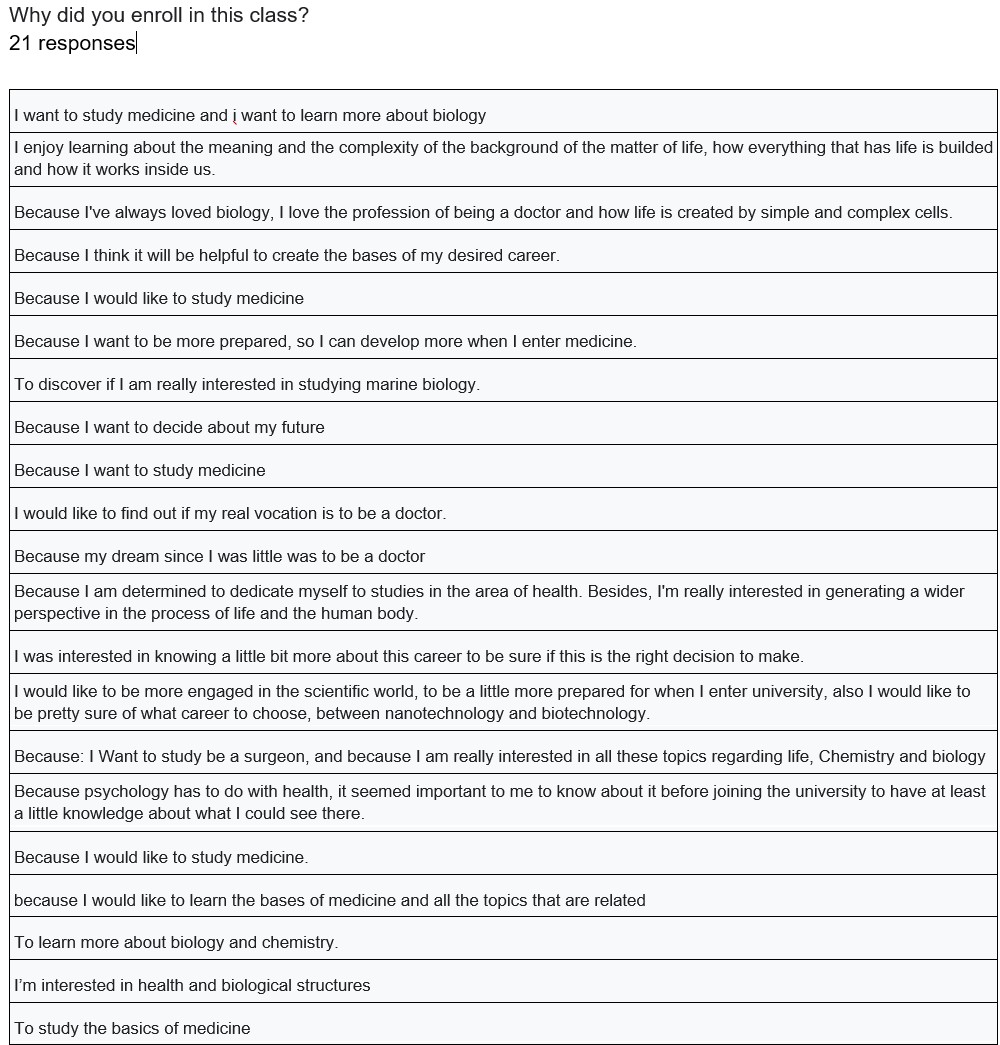
For this study, it was essential to know why the students enrolled in this topical health course and not others to understand their motivation and expectations (see image 5).
Reflection
This research showed that guided research practices combined with the flipped learning approach proved very efficient for learning Biomedicine. The study results indicated that using both teaching strategies allowed students to put into practice what they learned, enriching their learning and making them responsible throughout the process. Also, the students improved their academic performance and increased their motivation by applying what they had learned in the laboratory. Thus, these activities reinforced their knowledge and increased their learning.
At the end of the semester, the students’ comments about liking the guided research practices because they were very dynamic, didactic, and fun were gratifying. Through these activities, they experienced theoretical learning more realistically, helping them to learn and apply what they learned.
I want to invite the teaching community in biological sciences and health-related topics to explore these pedagogical approaches in their classes and share their experiences through the Observatory of the Institute for the Future of Education at Tecnologico de Monterrey.
About the Author
Arlette Audiffred_Hinojosa (arlette.audiffred@tec.mx) was born in Uruapan, Michoacan, Mexico. She obtained her bachelor’s degree in Chemical Sciences and diploma in Biotechnology from the Monterrey Institute of Technology and Higher Education (ITESM). She served as a Ph.D. Alfonso Valencia Rotation Student in the Protein Design Group of the National Center for Biotechnology, Universidad Autonoma de Madrid, Spain. She served as Biotechnology Laboratory Coordinator and Teaching Assistant at ITESM, Tecnologico de Monterrey, and later as a Laboratory Assistant at Guillermina (Gigi) Lozano. She was a Ph.D. Professor of Genetics at the University of Texas MD Anderson Cancer Center. She co-authored the research, “The p53-Mdm2 network in the expansion of progenitor cells during postnatal development of the mouse,” Journal of Pathology, September 24, 2007. She obtained a Master’s Degree in Education and a Master’s Degree in Technology for Education with the “Blockchain-based Insignia Award” thesis to encourage student participation. She currently works as a teacher at PrepaTec Morelia.
Gratitude
I want to give special thanks to Mtra. Cinthya Paola Fernández De la Peña for her contributions to this study, and Martha Ysabel Echeverria Martínez for her support in developing criminology practices. Also, thanks to Dr. Gustavo Luna Silva for his COVID diagnosis workshop and Ms. Georgina Gaytan Zuno for allowing me to implement these practices.
References
Arias López, B. (2024). Didactic strategies for the teaching of nucleic acids in molecular biology.
Akani, O. (2015). Laboratory teaching: implications for student achievement in chemistry in secondary schools in Ebonyi State in Nigeria. Journal of Education and Practice, 6(30), 206-213.
Barral, A. M., Ardi-Pastores, V. C., & Simmons, R. R. (2018). Student learning in an accelerated introductory biology course is significantly enhanced by a flipped learning environment. CBE—Life Science Education, 17(3), ar38.
Castillo, L. B. H. (2023). Strategies to Strengthen Formative Research through Microlearning and Flipped Learning in a Pedagogical Institute of the Junín Region (Master’s thesis, Pontificia Universidad Católica del Perú (Peru)).
Crawford, BA (2014). From inquiry to scientific practices in the science classroom. In Research Manual on Science Education, Volume II. (pp. 529-556). Rutledge.
García-Carmona, A. (2020). From research-based science education to a scientific practice-based approach: a critical analysis and suggestions for science teaching. Science Education, 29(2), 443-463.
Ncala, LE (2020). Case studies of research-based instruction in life sciences classrooms of selected high schools in Standerton.
Nelson, B., Wang, H. H., & Tucker, M. (2022). Teachers’ perceptions and practices of research-based teaching and learning using the curriculum
CASE. Journal of Agricultural Education, 63(3), 117-134.
Onuegbu, EC (2023). Guided inquiry lab-based instruction and chemistry learning outcomes of senior secondary students in Rivers State, Nigeria. International Journal of Advanced Academic Research, 9(7), 10-21.
Urdanivia Alarcón, D. A., Talavera-Mendoza, F., Rucano Paucar, F. H., Cayani Cáceres, K. S., &
Machaca Viza, R. (May 2023). Science and Research-Based Teaching and Learning: A Systematic Review. In Frontiers in Education (Vol. 8, p. 1170487). Fronteras Media SA.
Varadarajan, S. (2022). Problem-Based Learning in Undergraduate Chemistry Laboratories in India (PhD Thesis, Tata Institute of Fundamental Research, Mumbai).
Wheeler, L. & Morkowchuk, L. (2020). Project-Based Guided Research (PBGI) in Introduction to Chemistry. Active Learning in University Science: The Case for Evidence-Based Practice, 341-357.
Editing
Edited by Rubí Román (rubi.roman@tec.mx) – Editor of the Edu bits articles and producer of The Observatory webinars- “Learning that inspires” – Observatory of the Institute for the Future of Education at Tec de Monterrey.
Translation
Daniel Wetta