

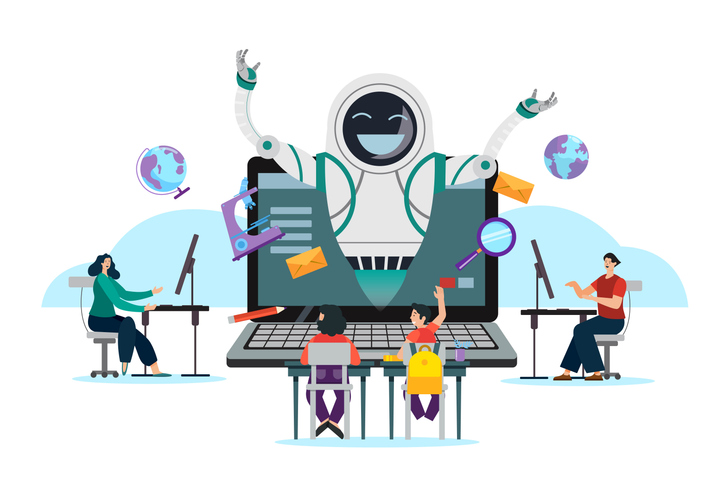
Artificial intelligence (AI) does not replace the act of thinking but expands, amplifies, and enriches it. Its value lies in imagining new ways of learning, accepting the unknown, and uniting humans with technology to discover what previously seemed impossible together. These ideas arose from my virtual participation in the CIIPEC 2024 Congress of the CEMAR Foundation. This experience led me to integrate AI into my teaching practice with a critical and humanistic perspective that has transformed my teaching.
In this article, I share five key points we must consider in integrating AI into the classroom to effectively combine the technological and human components of the teaching and learning process.
Five key points for integrating AI into the classroom
1. AI is a tool, not a substitute.
One thing AI cannot replace is human contact. As teachers, our role should not be limited to asking students to write an essay or a composition that a chatbot can do with greater or lesser quality. We must accompany the students in their learning process, monitor their interactions with AI, and teach them to ask better questions. For example, in a literary analysis activity, I proposed that students use AI to generate questions about an excerpt from the novel The Purple Flower by Chimamanda Ngozi Adichie. Afterward, we discussed in class why the AI produced those questions and how they could be improved. This approach helped them develop critical thinking and reflect on technological limitations.
Our students are not unethical about using available technology; they are contemporary. When we accept that the student community uses various artificial intelligence tools to perform their tasks, an optimistic perspective is to direct their curiosity circularly to start from their ideas and, after consulting the tool, use their criteria again for decision-making, i.e., the student first and at the end the student – so there is always human intervention in the learning process.
Also, it is very important to set specific limitations on using AI in classes. For example, in mine, I allowed them to use AI to generate initial ideas but not to write complete assignments. It helped foster creativity and accountability. In addition, I supervised their learning by tracking individual progress, identifying knowledge gaps, and suggesting personalized strategies for improvement.
2. Learning occurs on the intellectual plane but primarily at the emotional level.
With the support of AI, I designed emotionally healthy classes for my students. To do this, I used Khan Academy’s ”Khanamigo Individualized Education Plan Assistant” to adapt content to the learning paces of my various classes and thus promote their self-confidence. For example, in a narrative activity, students created short stories and personalized them with elements that reflected their emotions and personal experiences. The Khanamigo tool allowed me to offer different levels of support in generating these stories, making suggestions for structure, and provoking some ideas appropriate to the level of each student. This approach inspired their curiosity and strengthened peer bonds as they shared their stories in class.
We remember the best teachers by how they made us feel. My goal is to inspire each learner with the love and curiosity to learn, personalizing their learning processes and, along the way, making good use of technological tools. For example, in my class on humor in art and literature, I invited my group to work collaboratively using AI to create parodies of social issues linked to the Sustainable Development Goals (SDGs). Ultimately, they shared their creations, discovered their potential, and strengthened their bonds. These peer-to-peer interactions connecting the class contents with the real world allowed them to assess whether the humor developed by the AI was hilarious or if this characteristic was still in development or inappropriate in the context.
3. Prioritize the pedagogical moments in the teaching intervention.
Human intervention in the classroom remains irreplaceable. This semester, I incorporated activities such as “conversing with the literary character,” where the students developed questions about literary characters and used AI to simulate their answers. This exercise stimulated curiosity and deep discussions. Likewise, in the “Theory of Knowledge” class, we work with AI-generated, specifically biased news about natural disasters, helping each participant identify errors and reflect on how AI can replicate human biases if used imprudently.
To reduce cognitive overload, I focused on the essentials, designing activities that allowed students to produce concrete results with the information they had already mastered. For example, after working with AI and uncovering the details of each resource for text analysis, students summarized their learnings in hand-made concept maps. This type of activity helped them consolidate their ideas for class discussions.
4. Evaluate the process, not just the result.
Evaluation should also focus on critical thinking and metacognitive reflection. An activity where we used Personify to correct essay drafts allowed students to compare their ideas with suggested improvements generated by the tool and assess the quality and depth of their reasoning. It promoted a greater understanding of their learning processes. Some students were surprised by the accuracy of the AI in pointing out their strengths and areas for improvement, feeling that the feedback was personalized and relevant to their learning. Others desired clear and specific recommendations without waiting for a concrete guide. In addition, several highlighted that receiving recommendations from both the teacher and the AI allowed them to compare different perspectives, complementing their learning with a balanced approach.
In addition, the students learned to reflect on how they use AI and what they learn from it. For example, in the final self-assessment, each student explained how AI tools had influenced their creative decisions and understanding of the topic. This assessment allowed them to improve their skills and develop a critical view of using technology.
5. Consider the environmental and ethical impact of AI.
Through an interdisciplinary activity, my classes investigated how using AI affects the environment, and they proposed creative solutions, such as campaigns to reduce energy consumption in their homes. These activities foster critical thinking and commitment to responsible digital citizenship.
Using AI responsibly requires digital citizenship programs that train people to be critically aware of this technology’s environmental and ethical impacts. My next priority is to work collaboratively with colleagues from different academic departments to promote digital literacy for the entire educational community. We will explore topics such as training AI models and the energy consumption associated with their use. We will also teach students to cite AI-generated content and distinguish what is created by these tools from what is created by humans.
Reflection
Using AI technology with human guidance produced a nurturing learning environment where students felt supported and challenged. My students are motivated by this innovative component and reinforced with self-confidence. The ability to adapt class content to their paces and learning needs gives them a sense of autonomy. Intelligent feedback also helps them identify opportunities for improvement immediately, an advantage that previous generations did not possess. Today, the student community has more dynamic and flexible access to knowledge, potentially reducing frustration and leading to a more inclusive educational process. The pedagogical challenges lie in leveraging AI tools with balance to keep strengthening the active participation of each learner.
AI offers an unprecedented learning rhythm, but the real challenge is pedagogical. We must rethink our practices, encourage critical thinking more than ever, and accompany students in exploring the unknown. Let’s challenge our beliefs and embrace change, building a more humane and meaningful education together. I invite you to share your classroom teaching and learning experiences in The Observatory of the Institute for the Future of Education of Tecnologico de Monterrey.
About the Author
Aurora María Tovar Martínez (auroratovar@tec.mx) has a degree in Spanish Literature and a master’s degree in education with an emphasis on Cognitive Development. She has over fifteen years of experience teaching at PrepaTec in the Spanish, Literature, and Social Sciences and Humanities departments.
Editing
Edited by Rubí Román (rubi.roman@tec.mx) – Editor of the Edu bits articles and producer of The Observatory webinars- “Learning that inspires” – Observatory of the Institute for the Future of Education at Tec de Monterrey.
Translation
Daniel Wetta