


Generative artificial intelligence (Gen AI) does not replace teachers, but it does transform their role. This article proposes what I call “the pedagogy of conscious input.” It is a method of teaching and learning for industrial design engineering students at Instituto Tecnológico de Pachuca (Pachuca Technological Institute). This approach involves reflexively using AI tools as strategic allies. Students can creatively experiment with Gen AI technologies while analyzing and contrasting the information provided by these tools, which encourages them to develop critical thinking for well-argued decision-making.
This proposal, “the pedagogy of conscious input,” stems from practical observation in the classroom. The word “input” in English, which in the context of computer science means “(data) entry,” refers to the information given to a system for processing. We have observed that the results provided by AI primarily depend on the quality of the questions asked as input (prompts). If we inquire clearly, refine with precision, and provide feedback with criteria, the tool will respond better. Therefore, using Gen AI in the classroom becomes an opportunity to teach better thinking, not just to get faster answers. According to the OECD (2021), asking good questions is a vital action of critical thinking.
In teaching practice, integrating AI has opened new paths to exploring, imagining, and building. We have used it to support key moments of understanding complex issues, generating initial ideas, visualizing concepts, or rethinking solutions. More than automating tasks, it has allowed us to accompany each student’s processes better, show paths to different ways of learning, and cultivate a more active and reflective attitude towards technology (Harouni, 2023).
Gen AI tools for the industrial design class
The ChatGPT and DALL·E generative AI tools were incorporated into the Industrial Design Engineering specialty classes for eighth-semester students. The learning objective of this practice was for students to know and apply the properties of materials related to ergonomic design, functionality, and design costs. To approach this, strategies such as simulated interviews with AI were used. In these interviews, students, in their role as designers, interviewed potential end users, internal customers, and technical experts, while I, as a teacher, acted as a facilitator and observer.
Simulating interviews with engineering and design Gen AI “experts”
Various prompts were used to activate each interview, indicating to the Generative AI the role it should assume, the context, and the objective of the interaction. The rule of thumb was to begin with “You are…” and add design conditions such as ergonomics, materials, process, cost, and times.
Work template for generating different roles with Generative AI
“You are [role] in [environment]. You have [features/limitations]. You need/prioritize [objective]. Respond in a [technical/concise/with examples] way, considering [ergonomics/materials/process/cost/time] and indicating risks and commitments.”
Roles assigned to ChatGPT by the students
| Role | Prompt |
| End customer | — “You are a person who uses the product daily in limited spaces. Medium-low budget. Prioritize comfort, safety, and minimal maintenance. Describe three non-negotiables and three desirables.” |
| Supplier | — “You are a supplier of materials. Propose two durable and cost-efficient alternatives, with unit price ranges, lead times, and storage requirements.” |
| Manufacturer | — “You are head of manufacturing. Evaluate the feasibility in series: cuts/assemblies, cycle times, critical tolerances, and bottlenecks. Suggest Design for Manufacturing (DFM) changes to reduce waste without losing ergonomics.” |
| Quality/Safety | — “You are responsible for quality. Point out use and process risks, essential verification tests, and acceptance/rejection criteria.” |
| Purchasing (internal customer) | — “You are head of institutional purchases. Request total ownership costs for 12–24 months, warranty conditions, availability of spare parts, and award criteria.” |
| Technical Expert | — “You are a specialist in (materials/processing). Compare two options with key properties, process limits, and effects on ergonomics and cost.” |
Brief excerpt from a fictional conversation as an example
**from a conversation previously started**
Designer: In your current capacity, does the assembly attain 40 units per day?
Head of Manufacturing (AI): Not when taking 18 minutes per unit to sew, no. The bottleneck is stitching. I propose reducing panels (9→6) and margin guides to lower the time to ~12 min.
Designer: Will it affect ergonomics?
Head of Manufacturing (AI): No, if we keep support in pressure zones and tolerances ±2–3 mm. I suggest a pilot of 10 units.
**the conversation continues**
Topics addressed in the interviews included needs and context of use, ergonomics criteria, materials selection, manufacturing processes and costs, sustainability, and ethical implications of using AI. The educational purpose of these interviews was to exercise qualitative inquiry, active listening, and validation of assumptions; to translate findings into design requirements; and to justify decisions (ergonomics, functionality, costs, and trade-offs) based on evidence.
Once all this information was analyzed, the students created their project proposals that included the problem definition, user information, context, materials selection, ergonomics, performance, costs, and sustainability. An iteration log (recording what was changed and the justification) was also included, and an annex of the AI prompts and the key results. It ensured the traceability of the inquiry, decisions, and prototypes. AI was treated as a co-worker, not as a definitive source, privileging the dialogue between humans and technology.
Project Evaluation: Rubric Focused on Thinking and Decision-Making
The projects were evaluated using rubrics focused on thinking and decision-making. The rubric was carried out through a brief evaluative interview (10–15 min) in which the student explained why they used each design element and why they ruled out other options, providing evidence (sketches, functional tests, and cost estimates). The score given in the project evaluations prioritized the quality of the argumentation and the informed decision-making using data over the completion of the prototype.
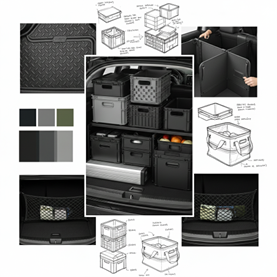
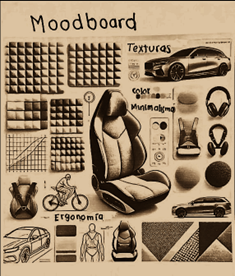
Among the products generated, the students created preliminary conceptual moodboards. Moodboards are visual panels that bring together images, materials, color palettes, textures, typographies, and keywords to synthesize the conceptual and sensory universe of the project. They are used to guide early design decisions (see the example moodboards below). To create these, students had to justify decisions about form, texture, function, and end user. These decisions were guided by AI-assisted processes and evaluated using rubrics focused on project thinking.

Learning benefits observed from class Generativ AI integration
In this practice, the benefits included greater student autonomy, evidenced by their voluntary delving into class topics, anticipating the content of the next session, and planning iterations without waiting for specific instructions. Also, they prepared the technical questions and assumptions to be tested, citing references and data to support their decisions. They used AI as a critical support to explore alternatives and verify criteria instead of relying on its definitive answer.
Moreover, students documented their process, managed their time and deliverables more responsibly, requested specific feedback, and defended their proposals with cost and material + ergonomic + functional arguments. Also, they demonstrated better understanding of complex concepts, willingness to work through trial and error, and had more confidence in exploring ideas with technological support. Some students expressed surprise and excitement at discovering their ability to build with AI instead of relying entirely on it.
Areas of opportunity to improve this practice with Gen AI in the classroom
While incorporating Generative AI clearly brings benefits, two priority areas of opportunity remain.
1) Training and culture of use. It is essential to develop a critical literacy among students that avoids treating AI as a shortcut and, instead, positions it as an expert tool through the effective formulation of prompts, quality criteria, description precision, strategic thinking, and ethical considerations. This training will help them to use AI as a creative partner and not as a substitute for their judgment.
2) Adaptive accompaniment. It is necessary to consolidate the use of AI as a personal tutor that adjusts the pace and depth of each student’s learning. Also, it must facilitate the exploration of complex concepts and the resolution of questions at any time, reducing anxiety while enhancing proactivity and confidence.
Addressing these two areas of improvement will transform AI from an auxiliary instrument to a structural component of the educational process, strengthening the professional development of each student.
Reflection
Generative AI is a powerful tool, but its true potential is released when it is incorporated with intention, judgment, and pedagogical sensitivity. Adopting a pedagogy of conscious input goes beyond using AI only to obtain answers, but also to ask better questions, think deeper, and create with intention. This way of teaching becomes more powerful when the teacher also experiments with AI, uses it, makes mistakes, and learns.
I invite those who work in education to experiment with this approach, adapting it to their contexts and needs. More than completing tasks, this perspective seeks to train critical, autonomous people capable of living with technology without unquestioningly depending upon it.
About the Author
Yamila Caridad Rodríguez Gómez (m23201307@pachuca.tecnm.mx) is a teacher and designer interested in developing meaningful creative processes in the classroom. She combines her engineering and design training with context-sensitive pedagogical approaches. In her practice, she integrates artificial intelligence as a strategic ally to promote autonomy, critical reflection, and purposeful innovation.
Acknowledgment
A special thanks to the 8th-semester students of the Industrial Design Engineering degree at ITP (2025) for their contribution to the material produced in class, as well as for their enthusiasm and academic spirit, which made this work possible.
References
Harouni, H. (2023). “Embracing artificial intelligence in the classroom.” Harvard Graduate School of Education.
HolonIQ. (2023). “Global Learning Landscape.” https://www.globallearninglandscape.org/
OECD. (2021). “AI and the Future of Skills, Volume 1.” https://www.oecd.org/education/ai-and-the-future-of-skills-2021.htm
Rodríguez Marín, M. (2025). “IA en la educación superior: ¿una revolución o un riesgo?” Observatorio IFE. https://observatorio.tec.mx/edu-bits/ia-en-la-educacion-superior
Tovar Martínez, A. M. (2025). “La IA en el aula es un reto pedagógico, no tecnológico.” Observatorio IFE. https://observatorio.tec.mx/edu-bits/la-ia-en-el-aula-es-un-reto-pedagogico
UNESCO. (2023). “Reports on the implementation of the Information for All Programme (IFAP) (2022–2023)” (217 EX/11). Executive Board, 217th session. https://unesdoc.unesco.org/ark:/48223/pf0000386795
Editing
Edited by Rubí Román (rubi.roman@tec.mx) – Editor of the Edu bits articles and producer of The Observatory webinars- “Learning that inspires” – Observatory of the Institute for the Future of Education at Tec de Monterrey.
Translation
Daniel Wetta