


How to study designer competencies in their professional practice through the analysis of their creative processes?
Historically, there are many design research projects focused mainly on the analysis of the designers’ creative models and processes, as shown by studies conducted by Archer (1963), Duberly (2005), Lawson (2004, 2005), or Munari ( 1983). However, research about competencies related to creativity in the design field is scarcer, although, in recent years, authors such as Conley (2004), Cross (2011), Hsueh and Huang (2014) or Lawson and Dorst (2009) proved their relevance.
Currently, design skills and creativity are increasingly valued in the professional arena (Wilson and Zamberlan, 2017), as designers face broad challenges that sometimes extend beyond their own fields (Runco, 2004). Studies such as the one developed by the Design Council (2017) highlight the value of design skills, relating them to economic growth in the United Kingdom, arguing that people with design skills are more productive than average.
Under these premises, from Decoding the Design Process, it was decided to study the competencies presented by designers in their professional practices through the analysis of their creative processes, which will now be called Creative Competencies. This research focuses on studying competencies because they are identifiable, measurable, and can be improved (Alles, 2009). In addition, beginning with the implementation of the Bologna plan at the European level, learning is structured in the form of skills training (ANECA, 2004), training students capable of employing competently the knowledge acquired for their future work and being lifelong learners (Kumar, 2012).
Various actions were carried out for this purpose. First, fourteen interviews were conducted with designers and design engineers with the aim of identifying the common competencies in their creative processes; then a case study was completed in a product design company in Barcelona with the objective of validating and defining the competencies identified in the interviews; three Creative Challenges (more about this below) were also carried out to identify qualitatively the specific behaviors that show how these competencies are put into practice; and, finally, in parallel, the Creative Decoding Tool was developed, an online tool that permits mapping the competencies on an international scale.
Phases of the research design
Interviews with designers and design engineers
A bibliographic review of the main authors working on creativity, competencies, and creative processes in the field of design allowed developing a first draft of the competencies. This was used as a guide to conduct critical incident interviews with fourteen professionals and students of design and engineering in the metropolitan area of Barcelona. A list of the designers’ common competencies was extracted from these.
A case study in a design company
With the objective of validating and defining the identified competencies, we performed a case study at a product design company in Barcelona. This was done through in-depth-critical-incident interviews conducted with members of the company’s design department, and the creative processes they use were analyzed. The results obtained from the interviews with the designers were examined to determine the presence of these competencies in a mature design team that develops its work within a production company.
As a result of these first two phases of research, ten Creative Competencies were defined and validated, divided into two dimensions each:
-
Learning (Curiosity; Internalization of Knowledge)
-
Aesthetic Sensitivity (Aesthetic Appreciation; Aesthetic Criterion)
-
Teamwork (Delegation; Tolerance)
-
Critical Thinking (Questioning; Proposals for improvements)
-
Oral Communication (Planning; Charisma)
-
Social and Ecological Sensitivity (Awareness; Commitment)
-
Autonomy (Self-management; Initiative)
-
Leadership (Strategic Vision; Motivation)
-
Research (Search for Information; Experimentation)
-
Innovation (Originality; Realization through action)
Creative Challenge
Thanks to the support of the European Union’s Creative Europe program for the Decoding European Creative Skills project, this phase of the research was developed in collaboration with the Eindhoven University of Technology and the University of Applied Sciences, Salzburg.
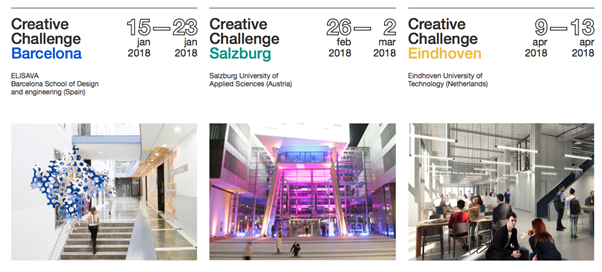
“The Creative Challenge” consists of three workshops that last a week where students and designers under the age of 35 have to work on a challenge proposed by a local company, institution, or organization that does not do design work in their usual processes. At the same time, a group of senior professors and designers from each university make non-participating observations of the work teams, identifying those behaviors that show the presence of the competencies in the creative processes of the participants. Once the challenge and observations were completed, a session was held where the participants reflected on their competences and those of their co-workers, contrasting the observations made and allowing the participants to discuss and know their strengths and weaknesses in the design process. In addition, five participants from each university were selected to work for two months in design companies in Barcelona, Eindhoven, and Salzburg.
Creative Decoding Tool (CDT)
At the same time, the Creative Decoding Tool (CDT) was developed, a digital tool that allows designers to identify their competencies through an online questionnaire composed of 50 questions. Once completed, the user receives a graph that shows his level of competencies based on his self-perception, letting him be able to identify his strengths and weaknesses, being a tool of self-reflection on his project practice.
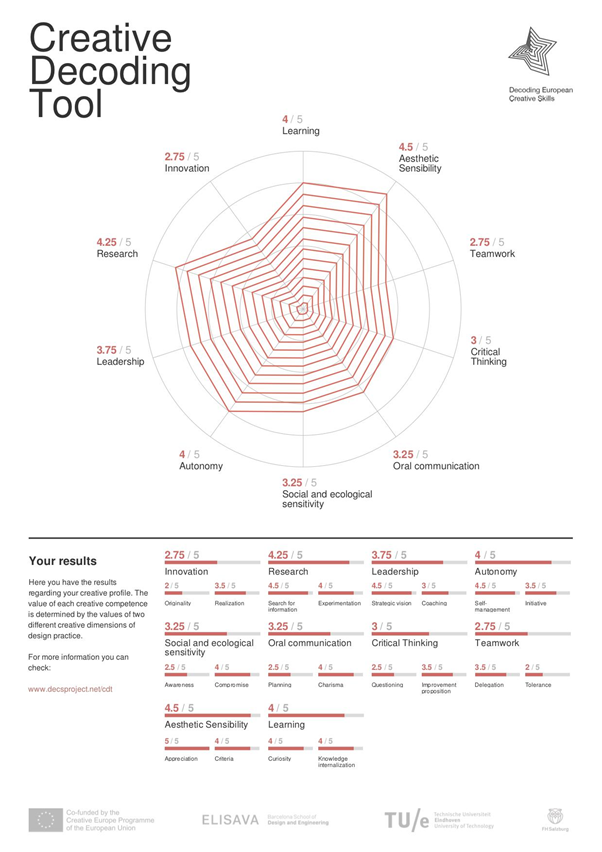
In addition, the data collected allowed analyzing the competencies at the international level, being able to contrast the competency results based on parameters such as the level of education, gender, age, design scope, or country of origin.
Prospective
As the project grows and the database grows, more in-depth analyses of the competencies presented by designers can be undertaken. Currently, on the project website, the data collected through the CDT can be consulted in real-time, showing graphs of the data analyses.
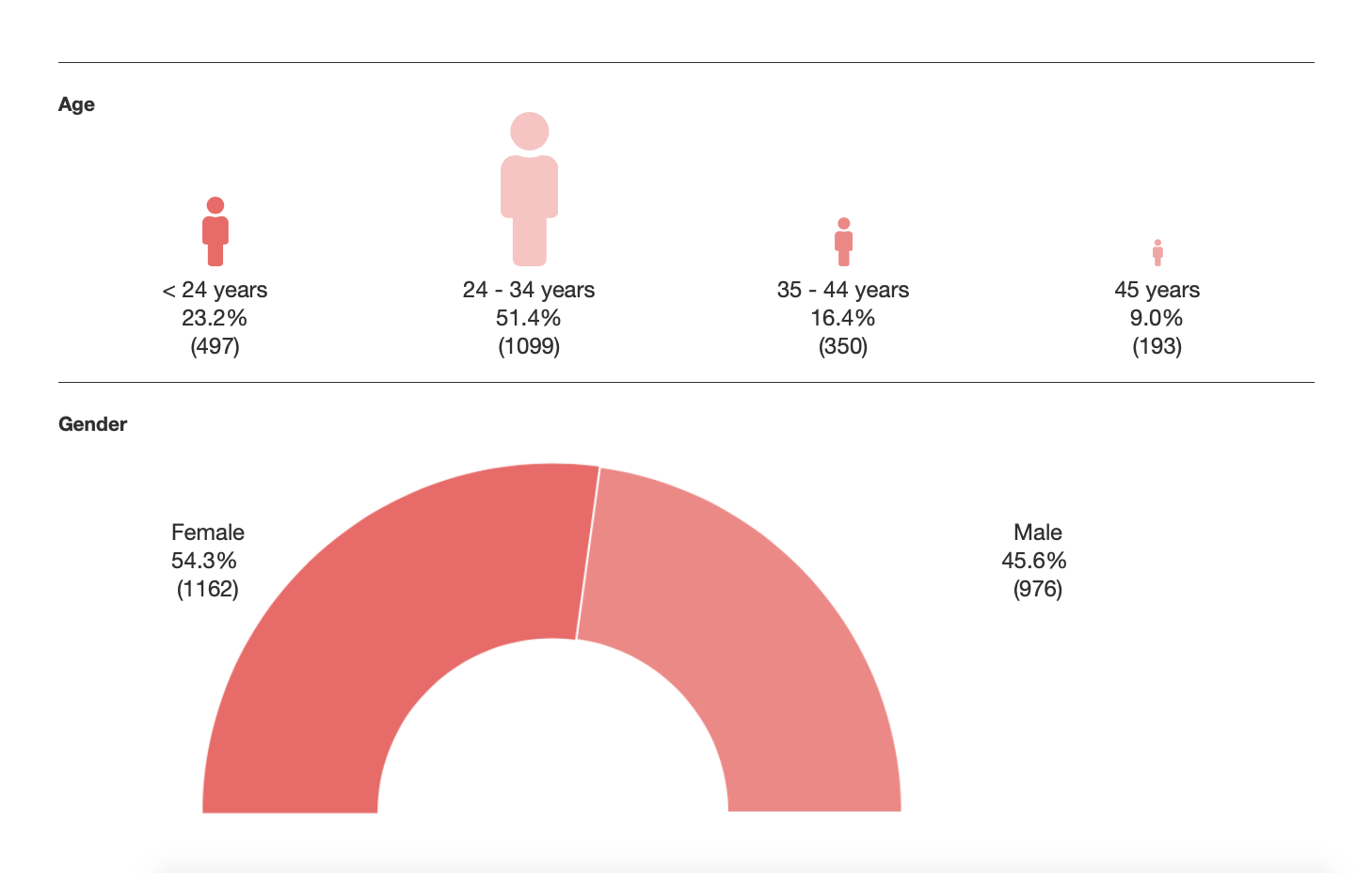
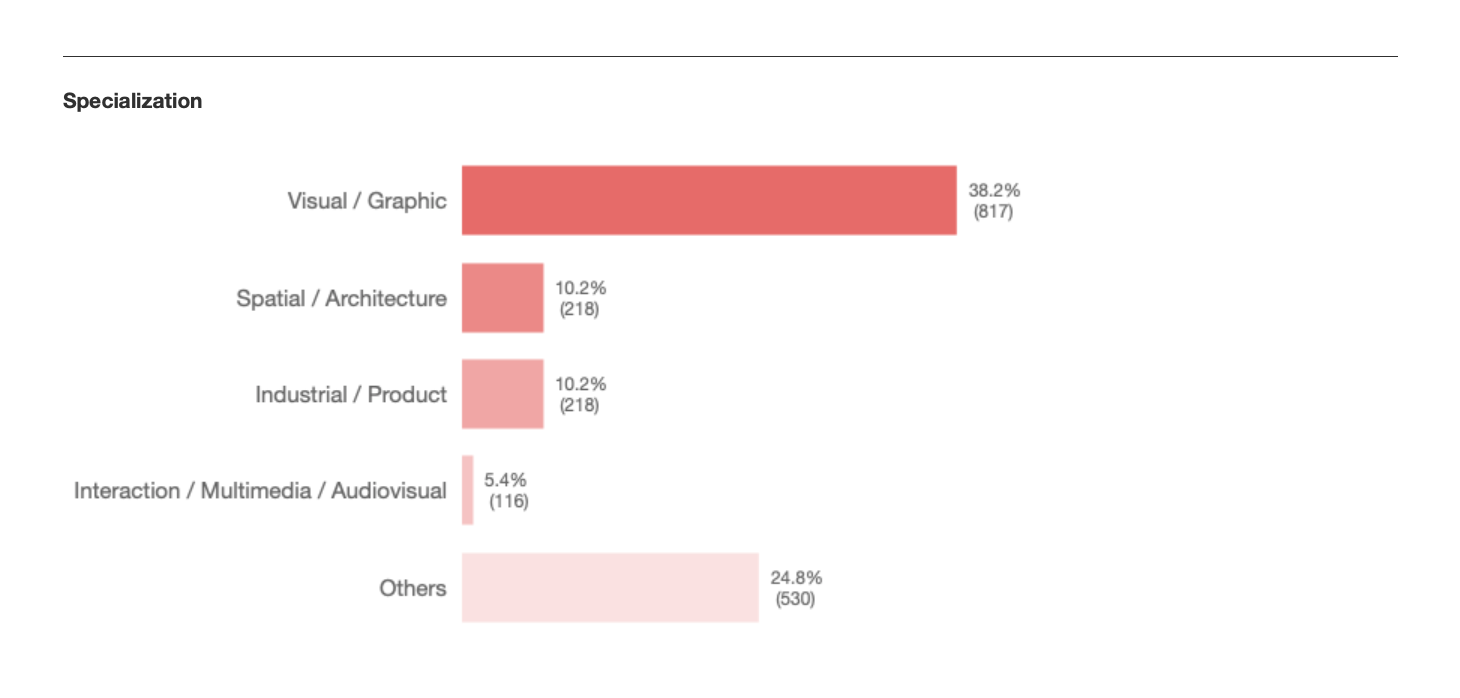
Visualization of the data analysis of the CDT as of September 3, 2019, with a sample of 1912 users.
——————
This article was originally published on the webpage of the Teaching Designers Alliance (TDA) project.
Beatriz Martínez-Villagrasa (bmartinezv@elisava.net) studied Fine Arts at the Complutense University of Madrid (2010-2014). In 2011, she coordinated and participated in her first collective exhibition, after which several exhibitions took place in Spain, the United Kingdom, and Italy. During 2014-2015, she studied for a master’s degree in Communication and Design (MUDIC) at ELISAVA, while doing practical studies as a graphic designer at Bosch & Serret and Luki Huber Studio. In 2016 she began her doctorate in the Research Group in Scientific Communication (GRECC) in the Communication Department of Pompeu Fabra University in Barcelona, an activity that is combined with research at ELISAVA Research.
The research that is presented originated in the research group Decoding Design Process and is part of the doctoral thesis of the author of this article. Both the methodology and the first analyzed results to date are shown in greater detail in the four publications that are part of the doctoral thesis, by compendium:
Martínez-Villagrasa, B., Esparza, D., y Cortiñas, S. (2019). Creative Competencies: Between Practice and Education in Design. The International Journal of Design Education 13 (3), 27-38. doi:10.18848/2325-128X/CGP/v13i03/27-38
Martínez-Villagrasa, B., Esparza, D., Llacer, T., Montaretto, N. y Cortiñas, S. (2019). Creative Decoding Tool: una herramienta para la medición de las competencias de los diseñadores. Análisis de los primeros resultados. Grafica, 7(14), 109-118. doi: https://doi.org/10.5565/rev/grafica.155
Martínez-Villagrasa, B., Esparza, D., y Cortiñas, S. (2018). The Creative Competencies Dictionary, Between Design Practice and Education in the 21st Century. In Proceedings of the International conference on engineering and product design education (E&PDE). London: Dyson School of Design Engineering. Accessed from: https://www.designsociety.org/publication/40868/THE+CREATIVE+COMPETENCIES+DICTIONARY%2C+BETWEEN+DESIGN+PRACTICE+AND+EDUCATION+IN+21ST+CENTURY
Martínez-Villagrasa, B., Esparza, D., Llacer, T. y Cortiñas, S. (2018). Las competencias creativas. Metodología y Desarrollo de los Creative Challenges. In Identidades culturales, narrativas creativas y sociedad digital, Sierra Sánchez, J. y Gallardo-Camacho, J. (Eds.) Global Knowledge Academics, 2018, 203-221.
Bibliography
Agencia Nacional de Evaluación de la Calidad y Acreditación (ANECA). (2004). Libro Blanco. Títulos de Grado en Bellas Artes, Diseño y Restauración. Accessed from: http://www.aneca.es/var/media/150332/libroblanco_bellasartes_def.pdf
Alles, M. A. (2009) Diccionario de competencias: la trilogía, nuevos conceptos y enfoques. Argentina: Ediciones Granica.
Archer, B. (1963). Método sistemático para diseñadores. Londres: The Design Council.
Conley, C. (2004). Leveraging Design’s Core Competencies. Design Management Review, 15 (3) pp. 45-51
Cross, N. (2011). Design Thinking: Understanding How Designers Think and Work. Oxford, UK: Berg Publishers.
Design Council (2017). Designing a future economy: Developing design skills for productivity and innovation. Report. Accessed from: https://www.designcouncil.org.uk/sites/default/files/asset/document/Designing%20a%20future%20economy%20executive_summary.pdf
Dubberly, H. (2005). How do you design? A Compendium of Models. Accessed from http://www.dubberly.com/wp-content/uploads/2008/06/ddo_designprocess.pdf
Hsueh, S., & Huang, C. (2014). Using Fuzzy Multi-Criteria Assessment Model for Evaluating Student’s Core Competencies-A View of Cultural and Creative Design Education. International Journal of Engineering Education 30(2), 276–282.
Kumar, V. (2013). 101 Design Methods. A Structured Approach for Driving Innovation in your Organization. New Jersey: John Wiley & Sons.
Lawson, B. (2004). What Designers Know. London: Routledge.
Lawson, B. (2005). How Designers Think. The design process demystified. London: Routledge.
Lawson, B. & Dorst, K. (2009). Design Expertise. London: Routledge.
Munari, B. (1983). Cómo nacen los objetos. Apuntes para una metodología proyectual. Barcelona: Gustavo Gili.
Runco, M. A. (2004). Creativity. Annual Review Psychology 55, 657–687
Wilson, S. E. & Zamberlan, L. (2017). Design Pedagogy for an Unknown Future: A View from the Expanding Field of Design Scholarship and Professional Practice. The International Journal of Art & Design Education 36(1), 106-117.













Judith Pérez Arceo
Judith Pérez Arceo
Judith Pérez Arceo