
To die sane and live mad: this is how his friend, Samson Carrasco, sums up the life of Don Quixote in the poem-epitaph he dedicates to him at the end of the novel. The text also says that living and dying like this “proved his fortune,” meaning that this way of living justified the ingenious gentleman’s entire existence and his goodbye.
For some strange reason (as strange as the spirit of the work), the phrase captivates me as if it contained, in addition to its literal meaning (dying and living in different ways), a kind of enchantment, a magical riddle. It promises me that, if I solve it, it will show me the whole meaning of Cervantes’ novel.
Who can resist such a promise?
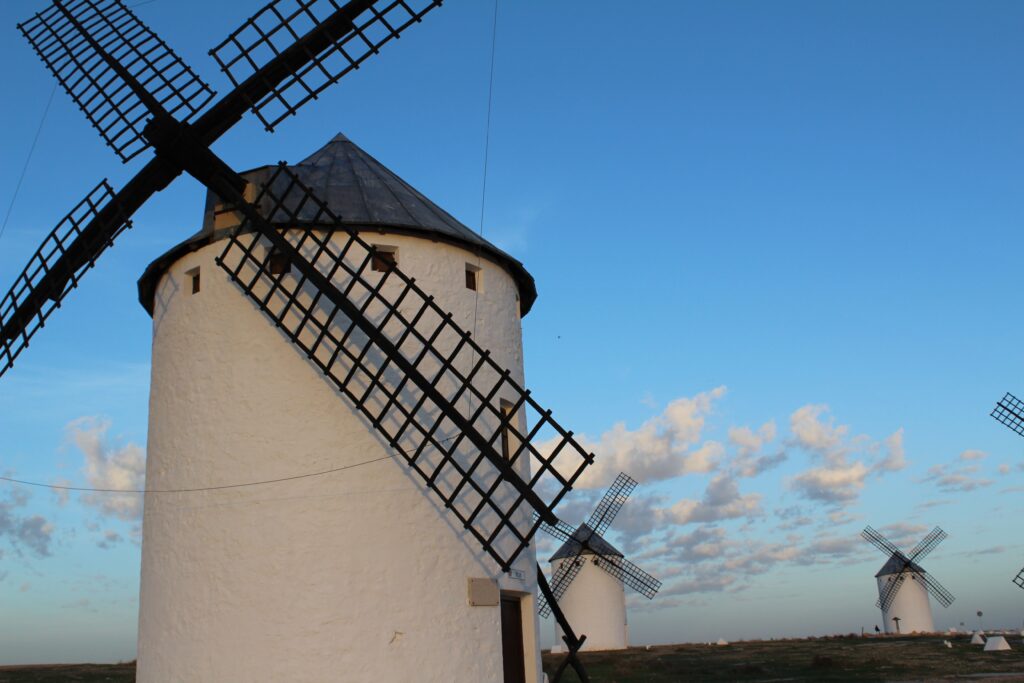
The influence of those words – of that poetic talisman – comes together with another sentence in the book, much better known and equally magical, both for its linguistic force and for the dazzling quality of its enchantment. I am referring to the one with which the novel begins (Cervantes’s and, incidentally, as they say, the modern novel): “In a place in La Mancha, whose name I do not want to remember…”.
To me, that first sentence about life and death -with which the book closes-, and this other -with which it opens-, appear to me as linked by that strong enchantment, a bridge stretched between them that is revealed by a hidden conjunction; connected to such a degree, that I come to feel that the ideal synopsis of the book is the following: “In a place in La Mancha, whose name I do not want to remember, one dies sane and lives mad”.
What do I mean? I still don’t know completely; however, I have already explained that my adventure is to solve that mystery.
To begin with, I confess that I am tempted to think that these riddles and enchantments are nothing more than superstitions of mine, but accepting them as a magical challenge encourages me, knowing this is how literary critics proceed, allowing themselves to be bewitched, first, by what they read, that is, inspired and writing under that charm, and then, in the final stage, analyzing and correcting what has been written sanely.
Perhaps it is no coincidence that in Cervantes’ time there was a dilemma similar to mine. Indeed, it was a time when life transpired between two waters: on the one hand, the attachment to ancient magic and the inexplicable, and, on the other, the enthusiasm for a new fashion of questioning everything and trusting only what could be verified (this fashion, later, would be called rationalism and modernity).
Not only Cervantes’ Spain, but all of Europe, as well as the incipient colonies of America, increasingly faced the demonic dilemma: to leave behind charm and fantasy in favor of the new science, or to preserve the spirit of what is now called the Middle Ages, whose holistic perspective would have allowed, perhaps, the coexistence of mysticism and realism. The dilemma was, therefore, whether or not to move towards the “disenchantment of the world” (in the words of the German sociologist and philosopher Max Weber). If we chose yes, human beings would no longer be “inside” reality but “in front of” it, processing it scientifically, cognitively, memorably, pedagogically, bureaucratically, and socially, and would be clear about the difference between knowing and living.
In writing Don Quixote, Miguel de Cervantes manages to oppose, with magical force, the distinction between experience and knowledge (an opposition that, in pedagogical terms – as I said above – means learning by doing, not by memorizing).
Thus, in a world where sanity loses its central organ (not the brain but the heart: cordis, in Latin), Cervantes sits down to write a novel, which is nothing more than being willing to go astray to find and return that organ to its place. (Another possible etymology reminds us that the word “madman,” which is the subject of the book, describes someone who, precisely, has lost their place.)
Cervantes sits down to write, then, and the first thing that comes to mind is a magical phrase that throws into oblivion the very place where the story begins: “… whose name I do not want to remember.” The explanations are many: some say that he wanted to forget that place because he had lost a great love there; others, because he had spent time in jail there. I have my very personal certainty: Cervantes does not want to remember that name, not only because it brings back bad memories but because he wants to forget all names: not the old names, not the magic words that label reality on a one-to-one basis and fuse with the things (they become the thing: who does not lick their lips hearing the word bread?). Instead, he wants to fortet the fashionable names, those of the new discourse, those which, posing as the former, are only tools of judgment, ideas of the existent, mediators between thinking and living: in a word, impostors, that adopt the form of living words, seize reality to create their own disenchanted reality, for its learned, objective truth, its “interesting” world. This happened, for example, when the word “judgment” was first used to refer to good understanding, that is, to the way of thinking that sensitively examines acts and their consequences, and engages in them; the word was later infused with a disenchanted, meaning: inquisitorial judging – we cannot forget this; it is an action that separates, that looks from the outside, that discerns “objectively”. It divides laws and acts, duty and living, responsibility and desire, and sentences to fire everything that still wants to combine them.
From the first sentence of his novel, Cervantes tries to forget the names with which the new reality threatens the world. Thus, Don Quixote goes out to confront them, to dissolve once and for all that mania of separating everything, of ignoring the sacred and common origin of words and things; to put an end to that discourse that stops the action to start discussing such learned things as if his surname, Quijano, would instead be Quijada, Quijana, Quesada, or Quesadilla, putting brains into everything without leaving room for imagination and luck.
Don Quixote prepares to replace the magic words, the enchanted names, beginning, obviously, with his own, and continuing with that of his horse, Rocinante, and that of the woman he chooses as the receptacle of his victories, who, from Aldonza Lorenzo, gets renamed Dulcinea del Toboso, ideal beloved, hers and ours.
The same happens throughout the book with the names of places, objects, potions, animals, and fantastic characters, many of them invented by Quixote himself or taken from books of chivalry: from these, because they are among the few things that still preserve a world in which opposites coexist. This unified image does not seek balance outside, as the new science does, which, experimental and observant, inaugurates a type of judgment based on external scrutiny. In the former, the balance is internal: every hero finds his rational justification there, as well as his demons; Pagan gods share the world with the Ark of the Covenant and the Sacred Host, under a cosmos governed by an ancient and very precise astronomy (really precise for its time). Those who inquire into universal laws, those who pursue the Holy Grail, and those who go to fight dragons are blessed. An incipient chemistry is complemented by magic and the sacraments, and everything is a syncretism of fantasy, knowledge, and faith.
To do good, Don Quixote does not concern himself with whether what he puts into practice is paganism, science, or Christianity. Obey the universal laws of chivalry, whatever creed they are practiced under: love of neighbor, humility, justice, fulfillment of one’s word (the word, let us remember, is as good as oneself). He does not care what people say, whether the opinion is well-founded or not; he bets a thousand-to-one on his skinny muscles and his broken weapons. He does not entertain any demonstration – no matter how “objective” it might be – that he has no chance of winning, of coming out triumphant.
As an author, Cervantes helps to unite all these apparent contradictions. Laughter is, as always, the antidote that protects reality from being divided in two: it unites madness and sanity, failure and victory, fantasy and reality; or, rather, stands as evidence that they have never been separated. As the Nicaraguan poet Rubén Darío sings, Don Quixote’s struggle is…
… against certainties, against consciences
against the laws and against the sciences,
against lies, against truth.
There is no shortage of those who react and bring that character’s attitude to trial. To the tribunal of divided reality (the origin of our double standards), Don Quixote’s opponents arrive sure of winning; however, they soon realize that, in the unified world of their rival (the one we all yearn for), the one who loses wins. Don Quixote loses his mind: he neither judges nor is judged. That’s why, although he is destined to be defeated, he will always win the game.
Finally, the day comes to return home and give his soul to it. Already ill, on his deathbed, he knows that he is Alonso Quijano and that he is not crazy. But dying sane is much more than returning to the consciousness he had before he was Quixote.
It is to recognize eternity.
Cervantes, too, we can be sure, contemplates that light. He knows, for a moment, that he has become immortal, and he understands it just when he reaches the end. Both he and his ingenious hidalgo become one in that beautiful and magical moment.
The rest of us are invited to witness the scene: we have crossed the enchanted bridge that stretched from beginning to end, and we trust that it will reveal its full meaning to us. Now we see it simply. It goes like this: the mad knight, who had lost his place, is back in it, bringing with him, together with his squire, his horse, and his donkey, the Holy Grail, the Heart of Sanity.
Translated by Daniel Wetta