
A constant in the creative writing classes I teach at the university is students’ inclination to imagine and build their own narrative worlds, which cannot always be fully represented in words and require more dynamic forms of exploration. Their creativity leads them to create characters who must experience, engage in, or get out of various situations as the plot evolves. This trend raises a central pedagogical concern: what happens when traditional expressions of writing are insufficient to materialize the students’ imaginings? The response in my classes has been the use of interactive digital tools to bridge narrative intention and its ultimate expression. In this context, technology transcends complementarity to become an essential creative resource.
Educators are now challenged to adapt writing programs to an environment in which narratives no longer exist exclusively on paper, but also on screens, in code, through hyperlinks, and within interfaces. The integration of digital tools into creative writing allows students to create interactive stories that respond to their concerns, simulating sensations that would be difficult to represent in text, for example, the feeling of disorientation, calmness, moving forward without getting anywhere, discovering clues, generating universes containing other worlds, returning in the story to choose another plot path, collecting objects, etc. The incorporation of these tools enables narrative decisions that affect the story’s rhythm and perception. Depending on the technological resources used, the story may convey different feelings, such as tension, calmness, surprise, and tenderness, among many others.
Researchers Veiga and Andrade (2021) report that incorporating digital resources promotes more active participation in writing tasks, while Williams and Beam (2019) note that their integration improves peer collaboration and social interaction. In addition, Nurmieva and Soboleva (2018) demonstrated that the use of technology stimulates creative thinking, which directly impacts the quality of the texts produced by students. So, well-applied technology can positively transform the teaching and learning process into creative writing.
Literature beyond paper
The incorporation of digital technologies gives rise to new forms of creation that escape the linear text, expanding into multimedia and interactivity. In class, we explore how literature has transcended the confines of paper. We start with classic genres such as novels, short stories, and poetry, which are fundamental to the printed book. Then, we move on to hybrid genres that mix characteristics of the printed book with digital resources. For example, the enriched e-book incorporates elements such as audio and video, hypermedia, which allows the reader to navigate between fragments and experience non-linear reading, and transmedia, where the story can be expanded to platforms like blogs or social networks that contribute to its development. Finally, in class, we explore the new formats that arise with the latest technologies, such as those that integrate interactivity, immersion, and algorithms or Artificial Intelligence (AI). In my experience with students, I have observed that applications that involve play and the use of AI significantly promote their motivation, commitment, and autonomy of their ideas.
The nature of the class requires strategies that are aimed at developing stories in a traditional format. We work with various creative writing exercises that focus on ideation, conceptualization, textualization, and revision for a final delivery. During ideation, the students brainstorm or discuss the plots of writing exercises done in class, without worrying about the final result. In the conceptualization stage, they experiment with digital tools to bring their idea to life. Before this, the written part must be completed. Then we move on to textualization, where the ideas are converted into writing that is later structured according to the selected resource. If they choose to write a narrative, they must create a story with a conflict, and if they opt for poetry, they must compose a poem that uses literary conventions, such as metaphors or images. It is expected that the digital resources and the story will be coherently integrated into the chosen format, as each imposes different limitations and possibilities.
Digital tools for creative writing
I have observed that my students in Creative Studies, across majors such as Architecture, Communication, Design, Digital Art, Literature, Educational Innovation, and Music Production, among others, share a strong passion for storytelling. Therefore, to guide them in integrating digital technologies into their writing, I focus on aspects that address their concerns in creating interactive stories. For example, “How do I make the reader feel like they’re moving along with my character, but can come back in the story?” uses Bitsy. “I want them to know what the room looks like without inserting the image,” uses Halo AR. “I want words to have movement like ocean waves,” uses an AI that generates code to create poetry. Below, I explain how these applications are integrated into class.
Bitsy
Bitsy is a web-based game engine that allows you to design small-format (8-bit-style) interactive creations in an agile manner, without requiring extensive technical knowledge, and publish them easily in HTML. In the first approach to the tool, we start by immersing ourselves in the itch.io community, where users from all over the world share their bitsys. There, we discover a surprising diversity from simple narratives to complex universes that contain other worlds, which are revealed as the avatar progresses.
After familiarizing ourselves with the basic instructions in Bitsy—designing the avatar, placing sprites, writing dialogues, and plotting the world—it’s time to bring the narrative to life. To do this, students incorporate game mechanics such as collecting items or using blocked doors that add layers of narrative complexity and enhance immersion in the small world they have imagined.
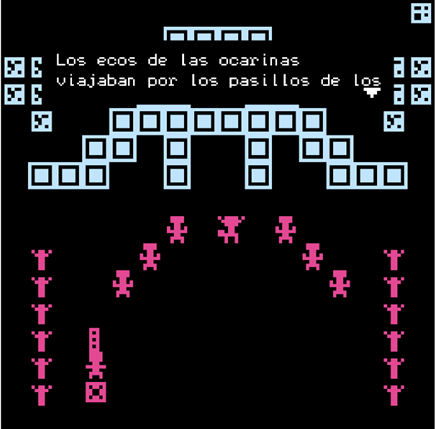
The most successful classroom exercises have been those in which students adapt the story of a hero or heroine or create characters in the animal kingdom who “speak” their own language. The bitsy created gives meaning to the whole story; it is an adaptation of a traditional piece of writing to this format. Incredibly, those who write poetry also create a bitsy that, as the avatar progresses, reveals the poem’s verses.
Halo AR
Halo AR is an augmented reality tool that links multimedia content – including images, videos, audio, or 3D models – to real-world objects. Then, simply focusing the phone’s camera on a physical medium activates the augmented reality.
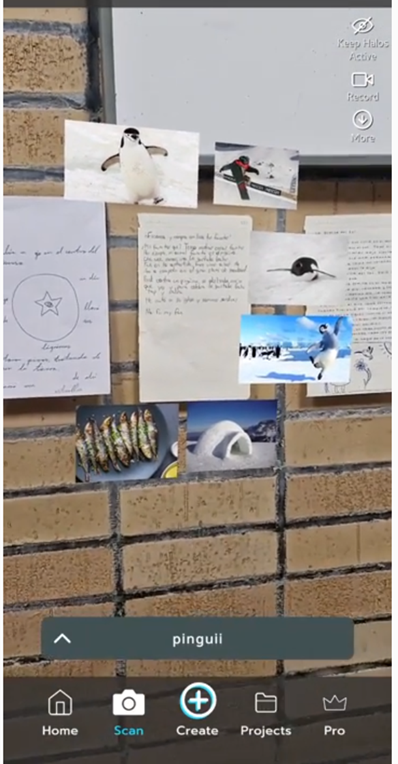
In the classroom, we use Halo AR to write short stories in which the reader must discover clues or complement their interaction through the application. For example, a character is reading a book, and the title is not mentioned. To know it, the reader must scan an object or a triggering drawing that displays the cover or even watch a video of the character reading. Each of these activations comprises a halo and functions as a narrative key, connecting the physical world with the digital one.
One of the most widely used resources in education today is augmented reality (AR), which creates immersive and interactive learning environments (Lampropoulos 2025). It facilitates the integration of virtual information into students’ physical environment, improving how they perceive and interact with it.
Epoetry
Poetry also holds a special place in the classroom, and technology offers us new ways to explore it. Through electronic poetry (Epoetry), we experiment with digital poetic creation, incorporating AI tools to generate code in the desired format. Even those who have a personal website integrate it as a sample of their writing.
In this exercise, accuracy in writing prompts becomes crucial. Students must understand that vague instructions produce ambiguous results, while specific, well-structured prompts produce output closer to the original creative intention. The exercise involves not only practicing poetic writing, since they must first write the poem traditionally, but also acquiring skills in formulating instructions and editing content generated by the tool.
The possibilities are multiple: from interactive poems that change with each click, to verses that unfold on screen as if they were waves in the sea. In this way, poetry expands beyond the page to inhabit a hybrid territory between the literary and the digital, inviting the reader to be an active part of the experience.
Among the difficulties students have encountered in their writing are the initial desperation of being in a situation where they interact with these tools for the first time and the challenge of adapting to the delivery time. However, at the end of the process, they realize, as part of their oral feedback during the presentations, that they have defined the central conflict by making the plot more direct, leveraging the tools’ options. In several cases, they found their voice by not copying other structures, but instead dedicating themselves to exploring their own ideas. In the presentations, they usually feel happy and excited to see their peers’ positive reactions. This gives them confidence in their creations.
Reflection
Some teachers are afraid to integrate artificial intelligence into their teaching process, but the arrival of AI does not have to replace the students’ creativity or original thinking; on the contrary, using AI is an opportunity to empower them. If teachers, professors, and facilitators integrate various digital tools into the creative writing process, they will generate new challenges in the classroom. In this way, they will see that translating the ideas sketched by hand before taking them to the chosen digital format will strengthen their students’ ability to structure and imagine them.
It is not about using all digital resources at once; it means experimenting with the one that can help the narrative. If students manage to use the chosen application to enhance their story, the purpose of promoting creativity has been fulfilled.
By gaining confidence in developing a story and in materializing their imagination within the limitations of each application, students can face the dreaded blank sheet of paper with greater confidence. For this reason, I believe that it is necessary to incorporate technologies that enhance imagination, critical thinking, and digital literacy. What better way to do that than through creative writing!
About the Author
Olivia Torijano Navarrete (otorijano@tec.mx) has a degree in Spanish Literature and a PhD in Humanistic Studies. She is a professor in the Department of Humanistic Studies at the Monterrey campus of Tecnologico de Monterrey. She teaches Literature, Creative Writing, Digital Culture, and New Media. She also teaches “Development of Creative Thinking” as part of the Certificate of Educational Innovation credentialing program in the School of Graduate and Continuing Education.
References
Lampropoulos, G. (2025). Augmented reality, virtual reality, and intelligent tutoring systems in education and training: A systematic literature review.Applied Sciences, 15(6), 3223. ProQuest One Academic; Publicly Available Content Database.
Nurmieva, R.R. & Soboleva, N.P. (2018). Using the technology of creative writing to develop students’ creative thinking in teaching English. The Journal of Social Sciences Research. 7,458-463.
Veiga, F., & Andrade, A. (2021). Critical Success Factors in Adopting Technology in the Classroom. International Journal of Emerging Technologies in Learning, 76(18), 4-21.
Williams, C, & Beam, S. (2019). Technology and writing: Review of research. Computers & education, 128, 227-242.
Editing
Edited by Rubí Román (rubi.roman@tec.mx) – Editor of the Edu bits articles and producer of The Observatory webinars- “Learning that inspires” – Observatory of the Institute for the Future of Education at Tec de Monterrey.
Translation
Daniel Wetta