

As an educator with 12 years of experience in teaching, I have witnessed disengagement and lack of motivation as learners rely on memorizing information to pass their exams without understanding the relevance of what they learn to real-world situations. As an educator who values meaningful learning, seeing students unable to apply their knowledge beyond the classroom is disheartening. Standardized assessments and structured learning failed to ignite curiosity or promote critical thinking, so I incorporated project-based learning (PBL) into the curriculum, where students could actively participate in solving real-world problems. They designed a LEGO smart city where they had to integrate renewable energy solutions and sustainable infrastructure. This practice helped them experience learning as something meaningful, transforming them from passive to active learners. In this article, I will share how to implement PBL within the New Curriculum.
According to Prensky (2016), we should eliminate the traditional curriculum because it is misaligned with the 21st-century skills that learners should apply today, as traditional education remains fixated on students’ academic achievements, measured through grades and standardized tests rather than helping students to improve the world. Prensky (2016) argued that students should engage in real-world projects that allow them to activate both knowledge and skills immediately. In contrast, the outdated model assumes that knowledge must come first, with real-world applications occurring later. So, I wanted to provide my students with more authentic learning experiences. Working with project-based learning in class, I’ve seen how students become more engaged, take ownership of their learning, and develop cognitive and social skills. Therefore, education must move beyond memorization and standardized testing toward an educational model encouraging learners to foster creativity, inquiry, and problem-solving habits.
From routine to learning purpose
Students today struggle with the daily routine, which feels like tasks to finish and does not seem to be the goal they aim to accomplish. It is difficult for teachers to impose obligations or give orders for students to follow. The moment students transform decisions into habits is the moment they truly experience the joy and satisfaction of purposeful learning and its impact on personal life and their future careers.
Research in neuroeducation highlights that learning becomes more effective when integrating emotional engagement, decision-making, and self-regulation skills (Nouri 2016; Zimmerman, 2002). Contrarily, students today are often required to receive information rather than constructing knowledge, which limits their ability to transfer skills (Shams & Seitz, 2008). On the other hand, studies related to metacognition indicate that fostering habitual learning strategies alongside decision-making can significantly enhance student autonomy and retention (Sousa, 2016; Thunholm, 2004).
Sousa (2016) found that learning habits and decision-making are two ends of the same rope, as both engage the brain’s executive functions (e.g., self-regulation, planning). Participating in monitoring progress and setting goals helps learners develop learning habits that could encourage engagement and autonomy (Zimmerman, 2002). Therefore, integrating kinesthetic activities inside the classroom (e.g., gestures, or physical activities) that are related to the lesson objectives, could easily improve memory retention and cognitive function, and could also play an essential role in developing learning inside the classroom by making it more engaging and dynamic (Ratey, 2008).
Neuro-Facilitators
Neuro-facilitators is a newly coined term referring to educators who not only teach, but those who can understand their learners’ minds, helping them gain deeper comprehension. They guide and facilitate learning based on students’ needs, interests, and passions. Basically, neuro-facilitators will host classes in their areas of expertise, as they will help their learners to apply, create, and produce meaningful contributions to the community. According to Prensky (2016), teachers today should leverage learners’ interests and help them create a meaningful real-world experience. It is time to prevent transmitting knowledge and encourage implementing it instead.
As a neuro-facilitator, one of the challenges I have faced is shifting students from passive learners to active participants, as many students today are accustomed to receiving information rather than constructing knowledge. Encouraging decision-making and fostering habitual learning strategies remain areas for continuous improvement, particularly in fostering motivation and self-regulation. Enhancing multisensory learning and interactive activities could also strengthen memory retention and cognitive engagement.
Design your own learning path through A “Better” World Curriculum
Prensky’s A “Better” World Curriculum (2014) seeks to replace the current curriculum because today’s basic curriculum is no longer what learners need. Educators still teach outdated skills explicitly (e.g., communication skills), but they do not teach the real skills needed for life. Learners today should master emotional intelligence, negotiation, and entrepreneurship skills. However, the three current core subjects taught (Math, Science, and Language) are considered the basics that could not help in teaching real-life skills needed for future careers.
The new curriculum that schools should adopt today is the Global Developing Life School curriculum-GDLS. It is the curriculum that is used as a manual for our learners, enabling them to choose multiple subjects within each of the three core areas (Effective Thinking, Effective Action, and Effective Relationships) they wish to study (Prensky, 2014; Prensky, 2016). During the initial weeks, high school students gradually learn how to design their own personalized curriculum using some strategies and techniques that could ultimately guide them to create and innovate their end-of-year projects for each subject. The role of the facilitator is crucial in this process. The facilitator acts as a guide providing direction and support to the teams, where students are grouped according to the subjects chosen from the three core areas. This grouping occurs after students complete the stage of selecting their preferred module or project. Each facilitator oversees four to five groups supporting them throughout the academic year. Learners are assessed based on their meaningful real-world experience or project.
Forcing learners to study Language, Science, and Math is one of the major mistakes we repeat committing today. High school students should come to school and have their manual curriculum with them, in which they get the chance to choose their modules from the three core subjects below and explore their academic interests throughout the year.
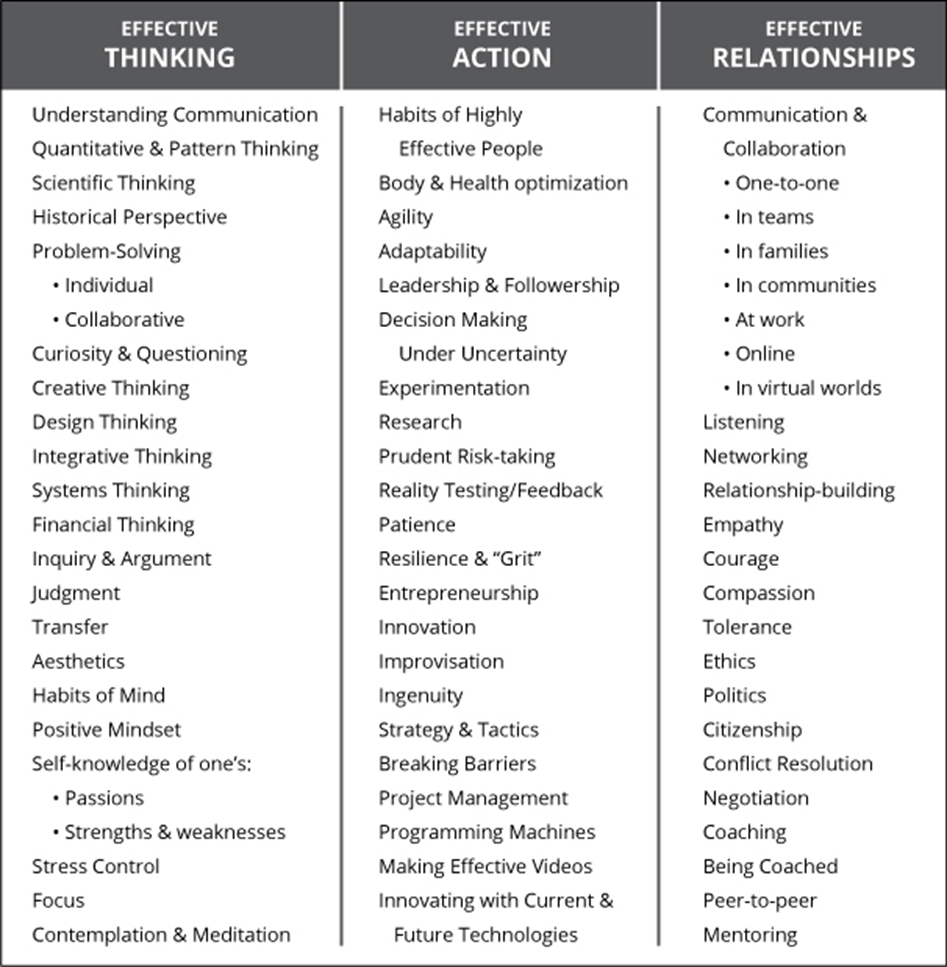
The three core subjects mentioned above are the subjects that we need today (i.e., Math should be replaced by effective thinking, Science should be replaced by effective action, and finally Language should be replaced by effective relationships). The students get evaluated according to the final design or final product of their projects.
For instance, educators spend time teaching numbers and repeating the same process annually. What if a student chose Financial Thinking (i.e., one of the modules related to the Effective Thinking core subject), and asked the facilitator about the possibility of launching a business by the end of the school year? (e.g., they might propose a coffee shop booth or kiosk within the institute that is uniquely designed in shape, concept, and taste, setting it apart from any other coffee shop in the area). Another example could be using LEGOs to design solutions for a real problem, such as the development of a prosthetic arm to support individuals with limb amputations. This initiative exemplifies a meaningful real-world experience that has indeed achieved success.
Project-based Learning (PBL) aligns perfectly with A “Better” World Curriculum
Project Based Learning (PBL) is a pedagogical approach that suits “A better world curriculum” very well. According to Kokotsaki et al. (2016), Project Based Learning (PBL) is a student-centered approach that helps students to be actively involved in the learning process to develop social interaction, knowledge and understanding. PBL encourages collaboration through group work instructions (Think-Pair-Share); it also helps students use multiple senses, allowing the information to stick to their minds as they memorize and recall concepts effectively (i.e., learners could establish meaningful connections between ideas and real-world scenarios). Also, PBL helps learners reduce stress and support their emotional regulation by engaging them in meaningful projects and fostering self-directed learning, which reinforces positive habits (Firdausih & Aslan, 2024; Loyens et al., 2008).
Secondary school students used LEGOs in their projects to foster multisensory learning, problem-solving, and active learning. They constructed a smart city addressing a real-world situation like environmental sustainability and renewable energy. Students worked in groups and, therefore, developed critical thinking and visualized concepts. The main purpose of the activity was to help them promote creativity, teamwork, and social responsibility.
Westhill Institute’s students incorporated digital tools to create a short stop-motion video showing their city’s renewable energy sources and automated traffic systems. The assessment was rubric-based, in which students were evaluated through problem-solving, innovation, teamwork, and real-world involvement. Results detected students’ engagement, collaborative learning, and reasoning skills. Students expressed excitement about hands-on activities, demonstrating satisfaction with their learning outcomes and performance. However, the activity required more time for refinement and iteration, as well as a self-assessment tool to help students track their learning progress.
Another clear example of implementing PBL within the new curriculum is the integration of Minecraft into the American Institute of Monterrey, Mexico curriculum. Students developed skills that are connected to real-life situations. Students got involved in the Coral Crafters Initiative, which exemplifies how PBL is aligned with Marc Prensky’s educational philosophy. Students and marine biologists addressed the pressing issue of coral reef degradation. They used Minecraft to design coral structures, and for each virtual structure constructed a real coral that was planted in the ocean. The project did not only engage students in a meaningful environment but also bridged virtual actions with tangible real-world impact.
Reflection
As a result, education should reform its policies and curriculum to shape the future of the next generation. Otherwise, the world will witness the exact same issue encountered by previous generations. It is crucial to prepare our teachers to become neuro-facilitators capable of leading the youth in the coming decade. To achieve this, schools must first provide learners with opportunities to adapt by helping them transform their daily actions into lasting habits. Second, teachers should shift from being traditional knowledge providers to facilitators who actively partner with their learners in the educational process (Prensky, 2016).
Third, learners should be given the opportunity to design their own curriculum by selecting what they need to implement, create, and produce. Finally, the curriculum should shift its focus from traditional to a Global Developing Life School GDLS, a curriculum that empowers individuals to shape the future and supports community growth, development, and prosperity.
I would like to be contacted regarding any questions, ideas, or suggestions.
About the Author
Mr. Khaled Mabrouk (khaled.mabrouk@outlook.com), is a Mexican-Egyptian citizen, and an IB Diploma Programme Teacher/Educator at Westhill Institute, Santa Fe, Mexico City. He is currently a PhD candidate in Education at UNICAF University and pursuing a second Master of Arts in Secondary Education at The University of Alabama, USA. He earned his first Master of Arts in Education (Leadership & Management) from the University of Derby, UK, as well as a Diploma in Education Innovation from Tec de Monterrey, Mexico.
References
Contagious. (2018, June 22). Campaign of the week: Minecraft Coral Crafters. Contagious. https://www.contagious.com/news-and-views/campaign-of-the-week-minecraft-coral-crafters
Firdausih, F., & Aslan, A. (2024). Literature Review: The Effect of Project-Based Learning on Students Motivation and Achievement in Science. Indonesian Journal of Education (INJOE), 4(3), 1011~1022. Retrieved from https://www.injoe.org/index.php/INJOE/article/view/176
Futurum Careers. (n.d.). If LEGO can take me down a path of success, imagine what STEAM could do for you. https://futurumcareers.com/if-lego-can-take-me-down-a-path-of-success-imagine-what-steam-could-do-for-you
Kokotsaki, D., Menzies, V., & Wiggins, A. (2016). Project-based learning: A review of the literature. Improving Schools, 19(3), 267-277. https://doi.org/10.1177/1365480216659733
Loyens, S. M., Magda, J., & Rikers, R. M. (2008). Self-directed learning in problem-based learning and its relationships with self-regulated learning. Educational psychology review, 20, 411-427. https://doi.org/10.1007/s10648-008-9082-7
Nouri, A. (2016). The basic principles of research in neuroeducation studies. International Journal of Cognitive Research in Science, Engineering and Education (IJCRSEE), 4(1), 59-66.
Prensky, M. (2014). The world needs a new curriculum. Retrieved from https://marcprensky.com/wp-content/uploads/2013/05/Prensky-5-The-World_Needs_a_New_Curriculum.pdf
Prensky, M. (2015). No more subjects! Marc Prensky Archive. Retrieved from https://www.marcprensky.com/wp-content/uploads/2015/12/Prensky-No_More_Subjects.pdf
Prensky, M. (2016). Education to better their world: Unleashing the power of 21st-century kids. Teachers College Press.
Ratey, J. J. (2008). Spark: The revolutionary new science of exercise and the brain. Little, Brown Spark.
Shams, L., & Seitz, A. R. (2008). Benefits of multisensory learning. Trends in cognitive sciences, 12(11), 411-417. https://doi.org/10.1016/j.tics.2008.07.006
Sousa, D. A. (2016). How the brain learns. Corwin Press.
Thunholm, P. (2004). Decision-making style: habit, style or both? Personality and individual differences, 36(4), 931-944. https://doi.org/10.1016/S0191-8869(03)00162-4
Zimmerman, B. J. (2002). Becoming a Self-Regulated Learner: An Overview. Theory Into Practice, 41(2), 64–70. https://doi.org/10.1207/s15430421tip4102_2
Editing
Edited by Rubí Román (rubi.roman@tec.mx) – Editor of the Edu bits articles and producer of The Observatory webinars- “Learning that inspires” – Observatory of the Institute for the Future of Education at Tec de Monterrey.
Translation
Daniel Wetta