)
)
)
)

In a traditional education, students prepare to complete course activities, pass exams with a passing grade, continue their academic training, and eventually graduate. But what if the course does not give a numerical grade for passing the subject? How can we motivate students to perform to their best when they know no numerical grade will assess their performance? It is the challenge we have at the Prepa Tec Morelia campus. The “Tutoring and Integral Wellbeing” classes are the only ones in the curriculum where a numerical grade is not assigned, there is no averaging, and the course performance does not affect the high school students’ final grades. Recently, we observed a decline in student performance in these subjects. So, we researched to determine the reasons for their poor performance and the implementation of a strategy using badges and gamification to improve and motivate student participation in their learning process.
Education goes beyond just memorizing information and getting good test scores. Education is a complex process in which we must consider multiple factors to achieve comprehensive student education and prepare them for adult life and its challenges. At Prepa Tec, we focus on developing the following life skills: 1) Self-management, 2) Critical Thinking, 3) Creativity and Innovation, 4) Collaboration, 5) Communication, and 6) Personal and Social Responsibility. Through the “Tutoring and Integral Wellbeing” classes, students learn how to manage their time better to meet their high school and personal goals. Also, they are trained to communicate better with different audiences, be empathetic, collaborate and work as a team, question and reflect on their environment’s needs, be creative in proposing solutions, and act accordingly in the best possible way.
“Students continuously asked me when they would receive their badges to share on social media for their family and friends to see.It motivated me as a teacher to move forward with the proposed strategy.”
One of the most essential functions of a teacher is to motivate students to participate in class and succeed academically. Therefore, we must encourage them to continue learning, participating, and integrating into their learning process (Jordán-Sierra, 2019). Active participation is essential to achieve the desired competencies and skills; hence, motivating students by encouraging their participation plays a critical role in their academic success (Usmanovna & Oybekovna, 2018).
How can we increase class participation without a numerical grade?
Recently, we observed a drop in student performance in the “Integral Wellness and Tutoring” classes taught each semester at Prepa Tec. The lack of participation was one of the leading causes because students knew they did not need to get a passing numerical grade in these subjects. Also, it explains the high quantity of undelivered and late activities. Therefore, we analyzed the students’ participation in these subjects during the semesters of August to December 2021 and January to May 2022. The study questions were: How much would digital badges and gamification strategy impact student engagement? How can we improve student performance in the “Integral Wellbeing and Tutoring” courses?
Our research found that many students turned in only a little more than half of the class activities and did not care about completing them in full. It is worth mentioning that the classes are evaluated with the letters AA, AB, AC, and AD, unlike the rest of the subjects, which are assessed with a numerical scale from 1 to 100 (see Table 1).
| AA | AB | AC | AD |
| Achieves exceptional performance in their self-management | Achieves the expected performance in self-management | Achieves intermediate performance in self-management | Has elementary performance in self-management |
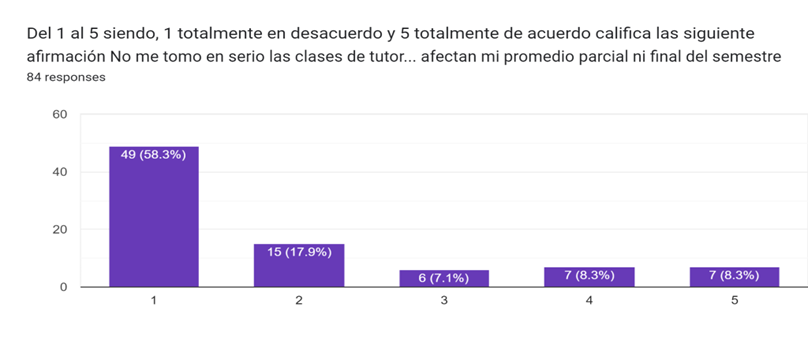
To determine and understand the lack of student participation, we applied a Likert-scale survey, where 1 indicated strong disagreement, and 5 indicated strong agreement with the statement, “I do not take my Tutoring and Integral Wellbeing classes seriously because they do not affect my monthly or semester average.” Fifty-eight percent of the students answered that they completely disagreed with the statement; however, 42% agreed to some degree. See the results in Figure 1.
Given the student feedback from the survey and the percentages of undelivered and late activities, we challenged ourselves to increase the student’s participation to help them perform better in the classes. This research aimed to quantify the impact of using digital badges and gamification to increase participation in the Tutoring and Integral Wellbeing classes.
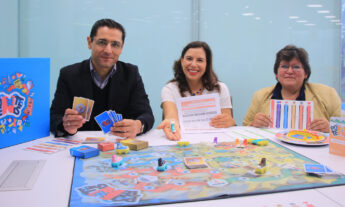
Gamification is widely used to motivate teenagers. It involves playful activities in which the game has specific objectives for students to achieve; these are usually well accepted by the students, with one of the main benefits being student motivation (Escareño & Alanís, 2021) and (Marqués & Supervia, 2019). Likewise, badges are a game element that indicates the participant’s progress in a recreational activity. For this study, we implemented both strategies in an educational environment, evidencing the students’ progress while motivating them to advance and achieve the proposed academic objectives.
“The students shared the badges they earned in the Tutoring and Integral Wellbeing classes through their social media, evidence portfolios, and Curriculum Vitae.”
Digital badges and gamification to encourage student motivation.
Digital badges and gamification are two pedagogical tools that can help increase students’ motivation for learning.
The intervention in this study consisted of using CANVAS Badges to generate and award digital badges when the student met the requirements of a training module. CANVAS is a platform for generating micro-credentials integrated into the Canvas LMS (Learning Management System). CANVAS Badges allows you to track students, issue badges to learners who have completed certain activities, and share badges earned in class through social media and other means of communication.
The students who participated in the study were the entire generation of 100 students distributed in four classes of 25 students taking the Integral Development and Wellbeing class in the August-December 2022 semester.
The distinctions awarded in the class were linked to the training competencies, values, and transversal competencies of the PrepaTec training model. The badges function as micro-credentials so that students have evidence of achieving these skills, can share them on their social networks, and can incorporate them into their academic development plan.
In this research, we considered the academic years before the year of this study. In the first and second years of high school, the students took their Tutoring and Integral Wellbeing classes as usual without using digital credentials. However, they took classes that used digital credentials in their senior year. We compared the participation results (see Table 2).
| Semester | IDENTIFICATION | Period | Year | Class |
| 3rd | PD3012 | August to December | 2020 | Without badges |
| 4th | PD4011 | January to June | 2021 | Without badges |
| 5th | PD5016 | August to December | 2021 | With badges |
| 6th | PD6018 | January to June | 2022 | With badges |
Regarding student performance, Table 3 compares the students’ mean grades in the four semesters indicated in Table 2, showing their performances in the two semesters without badges and those with badges. Note the increase in the student’s grades when the badges were implemented.
| Using Badges | Not using badges | |||
| Tutoring 6 January to June 2022 | Tutoring 5 August to December 2021 | Tutoring 4 January to June 2021 | Tutoring 3 August to December 2020 | |
| Overall Average | 89.71 | 86.77 | 67.58 | 89.57 |
On the other hand, Table 4 shows the average number of activities submitted late and the uncompleted activities with and without badges.
| Using badges | Not using badges | |||
| Missing activities | Late activities | Missing activities | Late activities | |
| Average % | 6.7 | 12.25 | 8.9 | 7.3 |
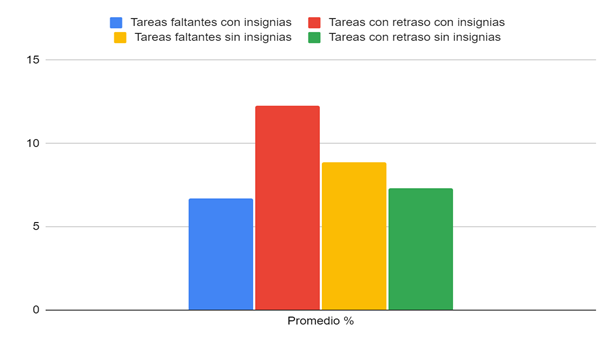
Figure 2 shows that the number of undelivered tasks was reduced from 8.9% to 6.7% with badges. Still, the late activities rose from 7.3% without badges to 12.25% with them.
Students wanted to earn badges. The percentage of undelivered assignments decreased, and the percentage of late assignments increased. It is essential to clarify that a non-submitted assignment has a value of zero. In contrast, a late assignment received a penalty but did not lose all points that comprised the assignment’s grade.
In implementing this project, I experienced the students continually asking me when they would receive their badges to share on social media for their family and friends to see. It motivated me as a teacher to move forward with the proposed strategy.
Reflection
Through this project, we tested the effectiveness of gamification using digital badges as a pedagogical tool to achieve student motivation. However, planning these strategies and specifying how the students will earn these badges is crucial. Students who find earning a badge easy will soon lose motivation and tire of the novelty. On the other hand, a challenged student, realizing that earning a badge is difficult but not impossible and not everyone can earn it, will stay motivated to obtain a badge.
I invite teachers to use the digital badge system, which is intuitive and easy to use as it is integrated into the LMS CANVAS educational platform. In my classes, I helped motivate students to turn in their assignments and improve their performance, even though the tutoring subject did not affect their overall average for the semester in any way.
References
Jordán Sierra, J. A., & Codana-Alcántara, A. (2019). La influencia del docente apasionado en la superación académica y el desarrollo personal de sus alumnos. DOI: https://doi.org/10.22201/facmed.20075057e.2018.27.1725
Usmánovna, N. G. y Oybekovna, D. G. (2018). La importancia de la motivación en la educación. Logros de la ciencia y la educación., (16 (38)), 33-35. https://cyberleninka.ru/article/n/la-importancia-de-la-motivación-en-la-educación
Escareño, C. M., & Alanís, I. F. (2021). La gamificación como propuesta didáctica para el desarrollo de habilidades socioemocionales en adolescentes. REVISTA ACADÉMICA RISEI,1(2), 32-47. Accessed at https://revista.risei.org/index.php/raj/article/view/12
Marqués, A. M., & Supervia, P. U. (2019). Gamificación en las aulas y su relación con la motivación. https://zaguan.unizar.es/record/87232?ln=es
Editing
Edited by Rubí Román (rubi.roman@tec.mx) – Editor of the Edu bits articles and producer of The Observatory webinars- “Learning that inspires” – Observatory of the Institute for the Future of Education at Tec de Monterrey.
Translation
Daniel Wetta

)
)
This article from Observatory of the Institute for the Future of Education may be shared under the terms of the license CC BY-NC-SA 4.0