

Javier is a very excited university student who has just met his classmates and teachers. Even though he is already in the third year of his curriculum, he and his peers have only had a few face-to-face classes. There are millions of situations like Javier’s worldwide because the COVID-19 pandemic forced people to remain in their homes and carry out most of their learning activities in a digital environment, thereby experiencing new ways of connecting. It was no exception in education. Social distancing policies forced new learning modalities requiring technological tools and changed students’ study habits (Jin, Lin, Zhao & Su, 2021).
“87% of students surveyed consider online classes more dynamic and entertaining. Likewise, 88% reported having learned some topics more easily compared to face-to-face classes.”
“Study habits” refers to continuously repeating behaviors of students performing school activities (Bedolla, 2018); these are daily, consistent, often unconscious behaviors of students trying to contend with the demands of university education (Hernández, Rodríguez and Vargas, 2012). These study habits strengthen using technological tools, developing skills, assessing, and making recommendations.
Research
Professors Carlos Enrique George-Reyes, leader of the research group, Development and Use of Technology in Education (DUTE), Leonardo David Glasserman-Morales, Director of the Master’s Degree in Educational Entrepreneurship at Tecnologico de Monterrey, and this work’s authors, collaborated to design and validate a questionnaire called “Survey of Study Habits of University Students 700+ days after the Pandemic in Mexico.” The latter was applied to 3,000 participants from public and private higher education institutions throughout Mexico during the end of the August-December 2021 semester. Like many others, these students were forced to migrate their academic training to online learning models mediated by technology.
The objective of the survey was to know the impact of the COVID-19 confinement on the study habits of Mexican university students. In this Edubit article, we share the following findings:
- The conditions of student access to digital devices and applications.
- Changes in digital literacy, learning experiences, learning motivation, and engagement in virtual education.
- Differences in study habits in various geographic regions.
Conditions of access to devices
According to the survey results, 53% of the students dedicated three to five additional hours a day to their classes to fulfill their academic activities; this allowed them to perform more activities and devote more time to each compared to the traditional learning modality. Private university students spent the most time (more than five hours).
Regarding electronic devices, two-thirds of the students acquired one or two devices. There were no significant acquisition differences by university type (private or public). Students in the North zone mainly acquired two devices. The students reported having knowledge and experience with technological devices, including smartphones, computers, laptops, tablets, and digital televisions, but had not attained mastery (see Image 1 comparative graph). Twenty-seven percent of the students did not buy any device, implying they already had the technological equipment to migrate to the virtual modality. Or on the contrary, they did not have the economic resources to acquire a new device, which made it difficult for them to continue their studies.
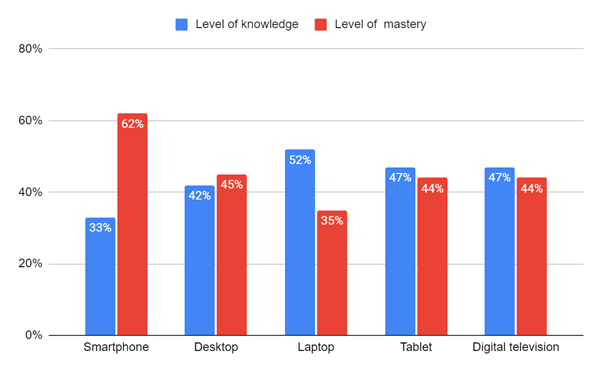
The students expressed high levels of knowledge in using digital devices; however, they only attained a degree of mastery with smartphones, which makes sense because it is the equipment with which the students were most familiar, performing a wide variety of activities connected to the Internet (INEGI, 2022).
Changes in digital literacy
Digital literacy significantly correlated to the learning experience, motivation to learn, commitment, and the pandemic. The more literate the students, the better their learning experiences, motivation, and commitment to their training; they suffered fewer negative consequences from the confinement. The more literate young people also acquired more devices, spent more time on their academic activities, and improved their technological skills. Digital literacy was higher among young people.
The learning experience was very positive for the students; 87% considered online classes more dynamic and entertaining, and 88% even reported that they had learned some topics more easily than if they had taken face-to-face classes. Despite being a digital medium, 89% of the students surveyed reported having the virtual accompaniment of their teachers. Finally, the majority (87%) had a particular learning space in their homes and an exclusive device to take their classes. However, just over one in ten students did not have these facilities, which challenged them to take classes in the new modality because most classes were synchronous. Although the classes were recorded (for asynchronous viewing), they still required a computer and internet connection.
Regarding motivation and the challenges of virtual learning, the university students considered that the lack of face-to-face classes did not impede their learning. Eighty-eight percent dedicated more time to their studies, and 85% performed more activities than before the pandemic. It is noteworthy that the public institution students were the most motivated to learn. However, there were also some negative aspects. The students felt that their privacy was invaded when having to appear on cameras or turning on their microphones. It is a reminder that literacy in security issues is necessary because, just as technologies provide many opportunities for their users, they also increase risks. University students represent a vulnerable sector by spending much of the day connected, taking classes, or doing academic activities.
The survey respondents demonstrated school commitment (engagement): 90% indicated compliance with the teachers’ instructions to participate in the distance modality; 88% recognized that both teachers and classmates had been more committed to participating in this new modality. This student engagement led to time management skills so that their school activities did not interfere with personal ones; 89% of the participants thus improved their self-study skills.
After experiencing learning in the pandemic context, 90% of the students believed the teachers had demonstrated broad technological mastery in distance education. In addition, they believed that universities should balance face-to-face and non-face-to-face activities in the short term. Similarly, 90% wanted to continue using learning platforms and videoconferencing tools to perform particular activities once they returned to the face-to-face format. Eighty-nine percent believed technologies should comprise digital didactic methods such as gamification or flipped classroom to improve teaching.
Diversity among geographical areas
Mexico’s six defined geographical zones showed marked differences. Thus, as proposed by “Mexico Evalúa” (2022), should develop strategies to promote equivalent learning throughout the country’s states; the inequalities at the local level within the country are due to each entity implementing differing educational programs and assessment indicators. In our research, in addition to information previously reported, we found that the North zone had higher values than the other regions in the study habits subscales; in comparison, Mexico City (CdMx) had the lowest values (see Image 2 comparative graph).
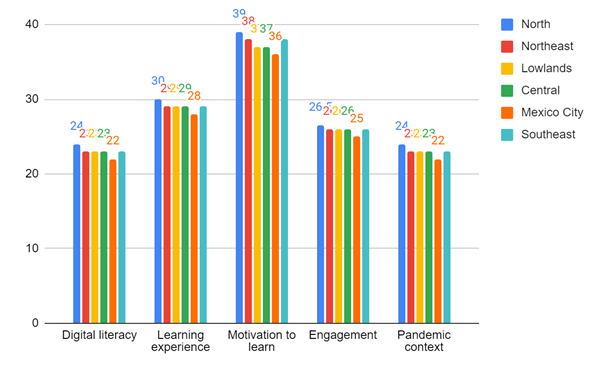
Although the causes of these differences could be very diverse, we can use this information to channel efforts and strengthen the areas of opportunity in each zone. The North region stood out in the acquisition of devices compared to the rest of the country, allowing us to infer that access to technological equipment is determinant in acquiring good study habits. These changes are not exclusive to virtual scenarios; therefore, it is necessary to be attentive to see how study habits evolve and adapt with the return to face-to-face academic learning.
Reflection
To participate in online education, the students had to adopt new study habits, which were strengthened through digital tools. However, with the return to face-to-face education, these new habits must continue to be promoted because using the tools can facilitate access to new learning modalities. Therefore, teachers must maintain an openness toward new trends and be willing to implement innovative pedagogies to leverage the digital capital acquired by both students and teachers during the pandemic.
This Edubit article is part of the “Survey of Study Habits of University Students 700+ days after the Pandemic in Mexico” project. For more information, consult the Edubit “The regeneration of university students’ study habits during the pandemic” and the Webinar.
About the authors
Francisco Javier Rocha Estrada (a00831099@tec.mx) is a Ph.D. student in Educational Innovation research: Development and Use of Technology in Education (DUTE).
Jessica Alejandra Ruiz Ramírez (a00831093@tec.mx) is a Ph.D. student in Educational Innovation research: Development and Use of Technology in Education (DUTE).
References
Bedolla, R. (2018). Programa educativo enfocado a las técnicas y hábitos de estudio para lograr aprendizajes sustentables en estudiantes de nuevo ingreso al nivel superior. Revista Iberoamericana De Educación, 76(2), 73-94. https://doi.org/10.35362/rie7622959
Instituto Nacional de Estadística, Geografía e Informática (2022). Estadísticas a propósito del día mundial del internet (17 de mayo). https://www.inegi.org.mx/contenidos/saladeprensa/aproposito/2022/EAP_Internet22.pdf
Hernández, C., Rodríguez, N. & Vargas, A. (2012). Los hábitos de estudio y motivación para el aprendizaje de los alumnos en tres carreras de ingeniería en un tecnológico federal de la ciudad de México. Revista de la educación superior, 41(163), 67-87. http://www.scielo.org.mx/scielo.php?script=sci_arttext&pid=S0185-27602012000300003&lng=es&tlng=es
Jin, Y. Q., Lin, C., Zhao, Q., Yu, S., & Su, Y. (2021). A study on traditional teaching method transferring to E-learning under the covid-19 pandemic: From Chinese students’ perspectives. Frontiers in Psychology, 12. https://doi.org/10.3389/fpsyg.2021.632787
México Evalúa (2022). Programa de Educación. Accessed from: https://www.mexicoevalua.org/mexicoevalua/wp-content/uploads/2022/06/taller-educacion-pospandemia.pdf
Edition by Rubí Román (rubi.roman@tec.mx) – Edu bits and Webinars Editor – “Learning that inspires” – Observatory of the Institute for the Future of Education of Tec de Monterrey.
Translation by Daniel Wetta.