

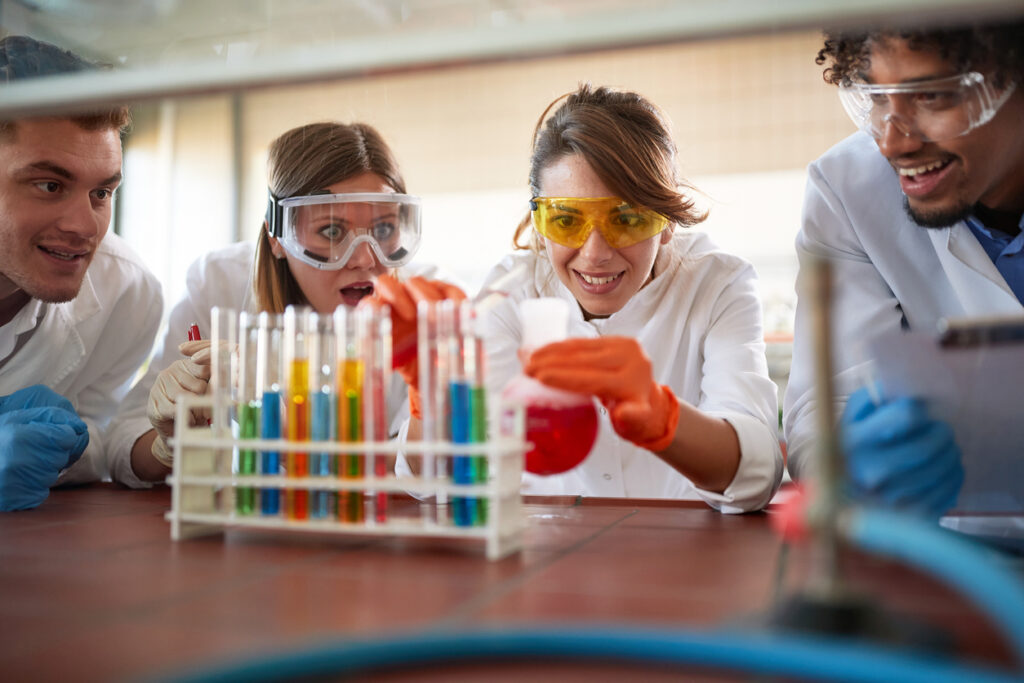
What do molecular processes and humans have in common? In essence, both adapt and respond to external factors. As molecules modify their behavior due to temperature, pressure, or pH changes, humans adjust and evolve according to their experiences and environment. Thus, molecules organize themselves to form larger structures, such as crystals or biological complexes; similarly, human beings group in social structures, such as families and communities, to strengthen their bonds and achieve common goals.
This view of science as a metaphor for human life inspired me to create an innovative pedagogical approach to assist students in establishing their life purpose and setting clear goals for their future through various chemical experiments and profound personal reflection.
“My Life Plan at Tec” is a mandatory class for all first-semester students at Tecnologico de Monterrey. Its purpose is to introduce students to the institution’s educational model, provide tools for their academic success, and establish goals and a life purpose. Beforehand, the course’s traditional methodologies did not always capture their interest or generate memorable experiences. Thus, the need to design active and attractive strategies to enrich the student’s classroom experience arose.
Active learning for science, self-management, and personal reflection
Active learning trains students to interact, analyze, and apply what they have learned in practical contexts instead of passively absorbing information. In the study of science, active hands-on experimentation and team problem-solving reinforce theoretical knowledge and help develop self-management and personal reflection skills. These activities allow students to make deep conceptual connections, facilitating understanding and a sense of purpose and autonomy in their education (Campozano et al., 2024).
As a student mentor, I have observed how active learning improves understanding of academic topics and allows students to explore their self-knowledge meaningfully. Integrating scientific metaphors and simple experiments in class gives them tools to reflect on their personal lives and goals. For example, when conducting an experiment in which a substance changes from solid to liquid phase, students can reflect on how people experience transformations in their lives, adapting to new circumstances or challenges. These experiments are visual, fun, and thought-provoking, discussing the importance of adaptation and personal change.
Scientific experiments to inspire life purpose and goals
Through small science experiments, students work with reactions that simulate real-life situations. The chemistry concepts inspire them. Below, I share the strategies incorporated into the class “My Life Plan at Tec”.
Science experiment: “Erasing your fears”
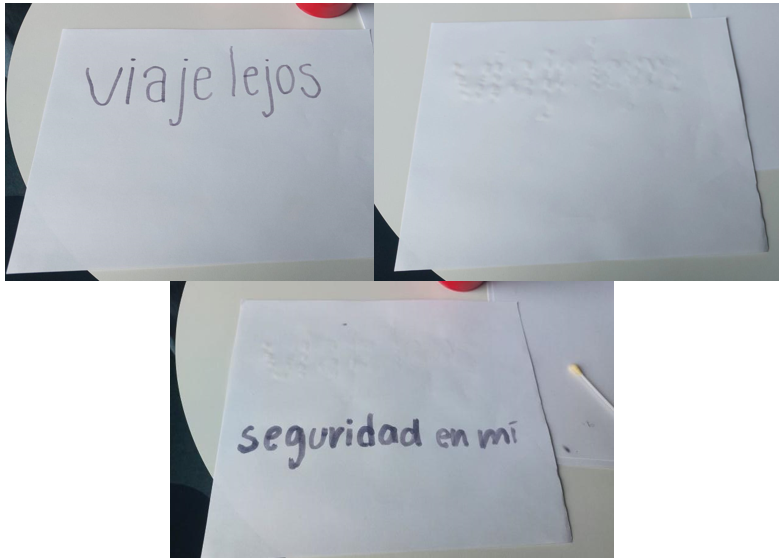
The class participated in an activity in which, using cotton swabs and diluted iodine tincture, they “wrote” one of the fears or insecurities they might have about beginning their university careers. Next, with an aqueous solution of vitamin C (ascorbic acid) diluted in water, they “erased” what was written, representing the process of overcoming those fears. Lastly, they used iodine to write a motivational word to inspire them to overcome those fears.
- Chemical basis: The activity is based on an oxidation-reduction reaction between iodine and ascorbic acid. As an oxidizing substance, iodine reacts with ascorbic acid, which acts as a reducing agent, causing the color to disappear and “erasing” the ink. This process symbolizes the students’ ability to transform and overcome their fears through personal motivation.
Science experiment: “Revealing your life purpose”
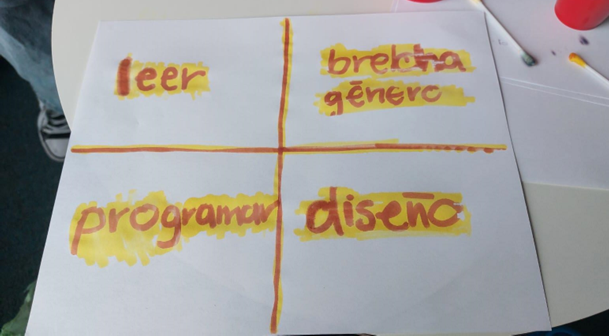
I asked them to section a white sheet of paper into four parts and answer the following questions in each with one word:
- What do you love?
- What do you think the world needs from you?
- What are you good at, and is it easy for you?
- Why would other people pay you?
The students wrote their answers on a cotton swab dipped in baking soda. After letting the paper dry for two minutes, they used a second cotton swab soaked with an ethyl alcohol and turmeric solution to paint over the sheet. As they applied the mixture, the words were “revealed,” symbolizing the discovery of their life purpose.
- Chemical basis: The activity involves an acid-base reaction between a sodium bicarbonate base (NaHCO₃) and turmeric, a natural pH indicator. The bicarbonate in solution acts as an alkaline substance. When turmeric solution is applied to a surface filled with bicarbonate, the turmeric changes color as it reacts with alkaline substances. Turmeric has a bright yellow color in its natural state and changes to more reddish or orange tones when in contact with bases, such as baking soda. This color change causes the initially invisible written words on the paper to be “revealed” visibly.
This phenomenon symbolically reflects that by confronting and understanding our passions, missions, vocations, and professions, we can make our life purpose visible clearly and meaningfully.
Science Experiment: “Reactions to Life’s Challenges”
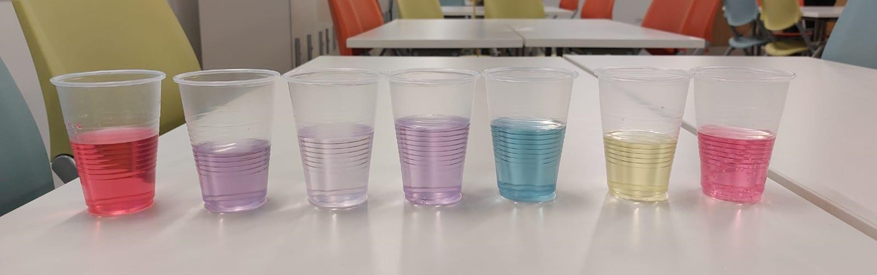
Each student was assigned a different substance in a glass (vinegar, baking soda, lemon juice, pure water, vitamin C solution). These substances represent your being, with all its qualities and areas of opportunity. Then, they received a new substance, purple cabbage juice, symbolizing a problematic situation or challenge in life. After adding the purple cabbage juice, each substance reacted with a color change, symbolizing how each person may react differently to the same adversity. This color change reflected the idea that there is no single right way to face difficulties and that our reactions are part of our individuality. The activity emphasized the importance of not comparing ourselves to others, as each person has their path and challenges, making them unique.
- Chemical basis: Purple cabbage juice contains anthocyanins, which are pH-sensitive pigments. These molecules act as pH indicators, changing color depending on the acidity or alkalinity of the substance they contact. For example, in an acidic medium like vinegar or lemon juice, the color becomes red or pink, while in a basic medium like baking soda, it turns green or blue. This color change symbolizes how life circumstances (represented by purple cabbage juice) can affect each person differently, depending on their personality, experiences, and emotional reactions.
Science experiment: “The DNA of your goals: building your goals step by step.”
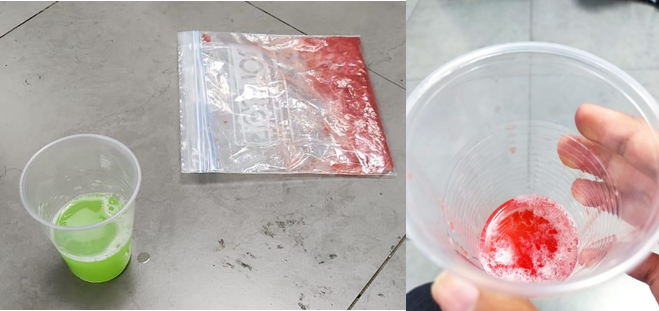
In this activity, the students extracted DNA from strawberries with homemade materials (Taylor, 2012). The objective was to illustrate that concrete and well-planned steps must be followed to achieve a personal or professional goal, similar to the scientific method. Through this experiment, the students learned that, like extracting DNA from a fruit, achieving a goal requires patience, perseverance, and a series of progressive actions. Each step in the extraction represented a step towards the goal, showing how every action counts and that planning and organization are critical to success.
- Chemical basis: DNA extraction is based on chemical principles that separate DNA from other cellular components. Critical steps in the process include:
- Rupture of cell membranes: The detergent acts as a degreasing agent, breaking down the lipid membranes of the strawberry cells and releasing the DNA in the nucleus. This process also breaks down the nuclear membrane, releasing DNA into the medium.
- DNA precipitation: Salt (sodium chloride) helps neutralize negative charges in DNA, allowing DNA strands to clump together and precipitate. Seventy percent ethanol (which must be cold) creates an environment where the DNA separates from the aqueous solution and becomes visible because DNA is not soluble in alcohol. This change in solubility allows DNA to become visible as white strands.
- DNA visualization: Finally, precipitated DNA can be seen with the naked eye as a filamentous white material, resulting from the grouping of DNA molecules that have separated from the rest of the cellular components.
Memorable experiences for self-knowledge through science
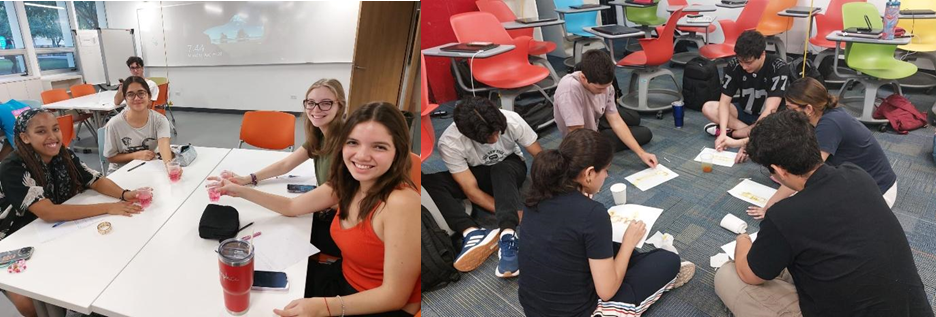
The students’ comments show that the interactive and experimental activities in class play a crucial role in understanding complex topics and reflecting on their lives. The chemistry learning experiences enrich their academic knowledge and allow them to explore their purpose.
One student noted, “The chemistry classes were very dynamic; the analogies emerging from the chemical reactions taught that to achieve success in life, we cannot skip any step, that we all react differently to different situations, and that is okay.” This comment reflects that, like in chemical reactions, people respond uniquely to life circumstances, fostering a deeper understanding of human diversity.
The practical experiments used chemistry as a metaphor to address personal aspects. One student commented, “My mentor Ana María Pinilla always gave us chemistry activities that she enjoyed very much; we saw how strawberries are composed, and when we wrote with fruit inks or vinegar, for example, we saw that each ingredient reacted to the other to change color or texture.” These experiments strengthen subject learning and allow students to reflect on the processes of change and transformation in their lives.
Additionally, activities like writing their fears and then “erasing” them through a chemical reaction or observing how the different components of a mixture react with each other become lessons in self-knowledge. Another student mentioned, “One of the experiments we did that I liked was writing down our fears and then erasing them. Also, I enjoyed our experiment in which each person’s glass produced a different color or tone, demonstrating the personality of each.” These exercises have educational and therapeutic value, helping students connect with their emotions and better understand their identity.
Finally, the comments underscore that integrating chemistry into the “My Life Plan at Tec” class offered students a fun and meaningful way to reflect on their goals. One student recalled, “What was fascinating about the class dynamics was how the elements of chemistry were integrated to associate with the class. For example, we participated in small experiments that enriched our understanding of the subject matter and applied the concepts and topics discussed in class.” This integration of academic content with the process of self-knowledge demonstrates that, by making learning more tangible and applicable to life, students achieve a deeper connection with the topics covered.
Reflection
Growth is a never-ending path for students and teachers. When we share our knowledge and experiences as mentors, we set an example for our students that learning is an ongoing process. The experiments described in this article allow for collaborative learning and mutual growth.
In searching for purpose and defining goals, each student is like a molecule in continuous transformation. Through mentoring and integrating active strategies that connect science with self-knowledge, we can catalyze their personal growth, helping them discover their paths with clarity and determination. Just as molecules find balance in chemical reactions, students can also find their inner balance, allowing them to thrive academically and personally.
About the Author
Dr. Ana María Pinilla Torres (ana.pinilla@tec.mx) is a chemist and holds a Master’s degree in Chemistry from the Industrial University of Santander (Colombia). She obtained a Ph.D. in Materials science from the Center for Research in Advanced Materials (CIMAV), Monterrey sub-campus. Ana María is a student mentor at Tecnologico de Monterrey (Monterrey Campus). In addition to her work accompanying students, she has participated in various projects focused on developing innovative mentoring strategies, some with a STEAM (Science, Technology, Engineering, Arts and Mathematics) approach. These strategies aim to motivate, support, and inspire students to achieve their academic and personal goals, helping them chart a clear path toward their life purpose.
References
Allsop, J., Young, S. J., Nelson, E. J., Piatt, J., & Knapp, D. (2014). Examining the Benefits Associated with Implementing an Active Learning Classroom among Undergraduate Students. International Journal of Teaching and Learning in Higher, 2020(3), 418–426. http://www.isetl.org/ijtlhe/
Campozano, J., García, P., Álava, L., Arana, M., & Inte, J. (2024). Active learning and effective teaching. In Active Learning and Effective Teaching (First Edition). CID – Research and Development Centre. https://doi.org/10.37811/cli_w1043
Dávila-Acedo, M. A., Sánchez-Martín, J., Airado-Rodríguez, D., & Cañada-Cañada, F. (2022). Impact of an Active Learning Methodology on Students’ Emotions and Self-Efficacy Beliefs Towards the Learning of Chemical Reactions—The Case of Secondary Education Students. Education Sciences, 12(5). https://doi.org/10.3390/educsci12050347
Freeman, S., Eddy, S. L., McDonough, M., Smith, M. K., Okoroafor, N., Jordt, H., & Wenderoth, M. P. (2014). Active learning increases student performance in science, engineering, and mathematics. Proceedings of the National Academy of Sciences of the United States of America, 111(23), 8410–8415. https://doi.org/10.1073/pnas.1319030111 Taylor, G. (2012, November 16). Extract DNA from a Strawberry with Basic Kitchen Items. https://science.wonderhowto.com/how-to/extract-dna-from-strawberry-with-basic-kitchen-items-0140302/
Editing
Edited by Rubí Román (rubi.roman@tec.mx) – Editor of the Edu bits articles and producer of The Observatory webinars- “Learning that inspires” – Observatory of the Institute for the Future of Education at Tec de Monterrey.
Translation
Daniel Wetta