)
)
)
)
For many people, board games comprise beautiful memories: classics such as Bingo, Snakes and Ladders, Dominoes, Twister, Monopoly, or Rummikub are several of the possible anecdotal protagonists of long afternoons or nights full of company and fun. Board games are stereotypically associated with children, and sometimes, certain games are attributed to older adults, which is reasonable because, during childhood, cognitive processes begin; in comparison, in older adults, they begin to decline. However, board games are a great way to exercise our brains and potentiate these cognitive processes and other socio-emotional skills at any stage of life, besides offering a way to enjoy one another and spend leisure time.
The board game industry has become more popular over time. This article by Jackson Hill affirms that the increased sales of board games are primarily due to the pandemic, which caused people to resort to this activity to spend time with their loved ones. Many people acquired a liking for these games then and continued playing after the confinements were over.
Also, the number of board games has increased considerably, so there is now a vast repertoire of games with different durations, numbers of players, themes, game modes, dynamics, and other characteristics.
The Internet has boosted these games, as influencers upload themselves to show or play new games. Many board game companies use the Kickstarter platform, which helps independent creators raise money for their projects, resulting in achieving their monetary goals with great success.
Board games exercise different cognitive, social, and motor skills. In kindergarten and elementary grades, it is common to find the occasional games in the classroom as tools to instruct children or calm them down after a long day of school or during recess. For some people, playing board games ends in school; however, they can provide significant benefits for our brains throughout life, including the motivation to continue learning and increasing people’s longevity.
Besides letting us detach from screens for a while, board games give us an analogous opportunity to rest from them and provide an “excuse” to get together, connect, and enjoy pleasant and exciting times with our loved ones.
But how can board games, mainly designed to entertain, benefit us in other ways throughout our lives? In an article published in The Conversation, authors and specialists in psychology or education explain that these types of activities make people use their academic skills and various cognitive processes and, therefore, improve them, such as memory, concentration, mental agility, attention, logical reasoning, verbal fluency, and creativity.
In addition, emotional and social skills are also strengthened by coping with contextual situations depending on the game. It is said that by playing a board game, you can get to know parts of a person’s personality that you probably did not know, for example, if they can take a defeat positively, their level of competitiveness, their management of emotions, among others. Moreover, they are an excellent way to combat stress and mediate negative emotions such as anger or sadness; not to mention, the games’ social spheres encompass teamwork, listening, and effective communication.
Below are some of the many board game benefits and exemplary recommendations (all with my stamp of approval) due to these benefits. However, the listed benefits are not exclusive because more than one skill can be exercised.
Skills that can be developed by playing board games
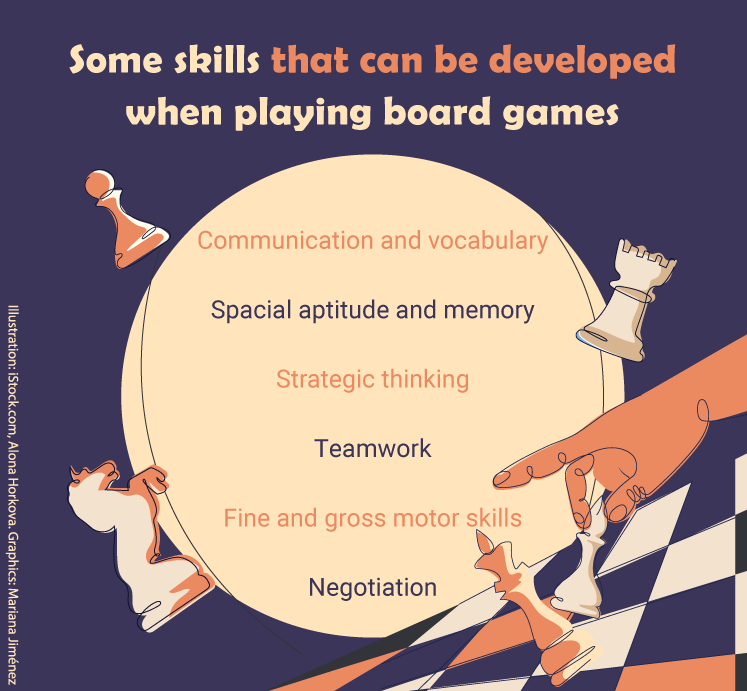
Communication and vocabulary
Scrabble is the most well-known, classic board game related to vocabulary. Still, many more games help you practice grammar differently. In addition to learning new words and conjuring words from limited letters, many games stimulate effective communication through few words and descriptions of images, situations, and feelings, among others.
- Hues and Clues: In this colorful game, a person associates the color of a card with a word. On a board full of colors, other players must connect the announced word with the color tone they think it is associated with.
- Bananagrams: Similar to the classic Scrabble, everyone plays simultaneously to form the largest number of intersecting words in this game.
Fine and gross motor skills
Twister is one of the best-known games for motor skills, but many “party games” incorporate body movements. Fine motor skills involve precise and careful movements of hands, wrists, lips, and tongue. In contrast, gross motor skills refer to moving larger body parts, such as the arms, legs, head, etc.
- Tinderblox: is a portable game you can take everywhere because of its convenient size. The point of the game is to build a structure together without it falling, using tweezers and following the instructions of randomly drawn cards. The winner is the last person standing.
- Happy Salmon: The more people joining, the better. It’s a fast-paced, funny, chaotic game. Everyone has a hand of cards and must simultaneously call the action from the top card of their hand (such as “high-five”), finding another person who has the same one. Eliminating that card, they move to the next. The person who gets rid of their hand first is the winner.
Teamwork
Competition sounds fun or exciting, but it is also amusing when teams form, and each group considers putting aside individual differences to leverage their abilities to attain a common goal. Teamwork is an essential skill in everyone’s life, and practicing it in a lighter environment and outside academia and work is a way to add variety to this practice.
- The Forbidden Island: All players must work together and use their designated abilities to discover all the treasures on an island and escape with them as quickly as possible before the island is completely flooded.
- Codenames: A game comprising two teams that must relate a single word with one or more concepts while simultaneously avoiding obstacles.
Negotiation
Many people do not typically negotiate. However, board games allow us to negotiate without putting anything seriously at risk. Negotiating is an important practice that helps people feel confident, solve conflicts, make appropriate decisions, and improve communication.
- Sheriff of Nottingham: In different turns, one person is the sheriff, while the other players are merchants who must pass their goods to the village with legal or illicit products. The player’s job is to convince the sheriff about the goods they bring, avoid inspections, and finish with the most profits.
- Pit: Although this game has been on the market for years, it is not well-known to many people. It is simple and lasts a few minutes. Players must simultaneously exchange a certain number of cards to get a full hand of a specific card.
Spatial Aptitude and Memory
Spatial aptitude allows people to visualize shapes, spaces, and maps mentally, developing a three-dimensional perspective. This helps give people a sense of direction and place objects correctly in a given space. In some games, it is necessary to arrange cards or tiles efficiently to comply with the rules; they might play on a board that requires creating paths or constructions (such as Settlers of Catan). On the other hand, memory requires retaining information, which can decline over the years, and therefore, exercise through board games can positively impact our brains in the long term.
- Qwirkle: In this game, players must combine colors and shapes to make lines that share the exact attributes. Players accumulate points by placing tiles strategically; the one with the most points wins.
- Twin it!: With three different game modes and incredible art, players compete to identify and remember similar shapes, colors, and patterns. The winner is the first person to collect the most pairs of cards.
Logical and strategic thinking
When a game requires tactics and strategies to be victorious, it is necessary to formulate judgments and sound reasoning. This type of strategy game also stimulates concentration.
- Azul: Having a colorful and charming design, Azul requires players to arrange tiles of the same color in a particular way on a board to make the most points. This game invites each person to think of a unique strategy to be the winner.
- Jaipur: Set in India, this two-player game requires trading goods such as fabrics, spices, and jewelry in a market to garner the most points.
Every board game requires different degrees of attention and patience, which have declined in some people due to the instantaneity and speed in which we receive and consume information. Reading comprehension is significant in various games, including the instructions and dynamics, events, or descriptions on the game cards or boards. After reading, the person must translate what they comprehend into performing the corresponding actions.
Besides these skills, many modern games also incorporate scientific, historical, or pop culture topics, increasing knowledge in different areas. For example, Wingspan has cards illustrating real birds that share information about their distribution, size, and the ecosystem in which they live.
Encouraging older adults to play board games is very important because they experience cognitive declines. This type of game stimulates parts of the brain responsible for various cognitive processes, activating them mentally and physically. Moreover, implementing healthy hobbies in their routines also helps them combat loneliness by interacting with others.
Board games also promote lifelong learning. After acquiring a taste for them, people usually take the initiative to try new titles, where they must learn new game mechanics. Board games prove we can have fun while nourishing our brains. Learning and mental development can occur in pleasant scenarios and leisure time, accompanied by loved ones.
So, what game will you be playing next?
Translated by Daniel Wetta

)
)
This article from Observatory of the Institute for the Future of Education may be shared under the terms of the license CC BY-NC-SA 4.0