)
)
)
)
Are we aware of how our way of talking affects students’ learning? Knowing how to converse is an indispensable skill for teachers, students, and everyone. Knowing how to converse is a basic necessity that we must develop and cultivate, as explained by Professor Miguel Rivera Alvarado in the Webinar of the Observatory of the Institute for the Future of Education at Tecnologico de Monterrey. If you have not had the opportunity to see it, here is a summary and the link to review the full video of this session. According to Professor Rivera, 80% of communication problems within a school system have conversations in common and at its root. The same is true within organizations, families, schools, and among teachers.
This session teaches the six basic conversational skills needed to converse, teach, and learn better. An excellent conversational experience contributes significantly to the socio-emotional well-being of the participants, the organizational climate, and the collaborative work and harmony that achieves the proposed objectives in any context.
“We have to talk.”
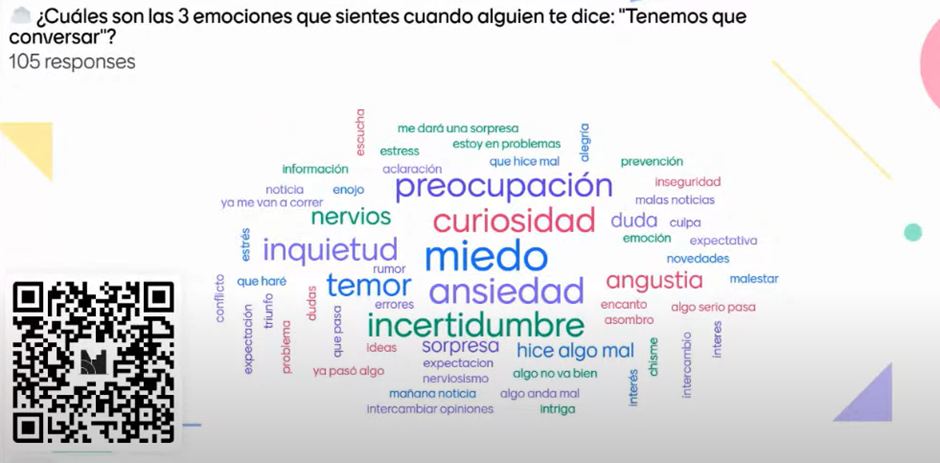
What do we feel when someone says, “We have to talk”? Professor Rivera explains that, although conversation is part of our constitution as social beings, generally, when someone invites us to talk, we imagine something complex. Different emotions, such as uncertainty, fear, curiosity, anxiety, and worry, emerge in the audience’s responses during the webinar (see Image 1). The same happens at work, meetings with friends, meetings to coordinate actions or analyze projects, meetings with family, gatherings at the dinner table, etc.
Conversations, while relevant, can sometimes become complex, considering “what was said, what the other said, or what was not said.” Therefore, conversational skills facilitate generating a more pleasant conversational climate in a school system and practically any context.
The isolation we experienced during the pandemic reduced students’ development of communication skills because everyone had to stay at home and stare at screens, which replaced people’s close physical encounters. However, this confinement allowed us to understand and value the importance of school in transmitting knowledge and connecting with one another. For this reason, in the webinar, Professor Miguel Rivera shared six conversational skills for teaching and learning better.
The Six Conversational Skills
- Create an emotional connection. Our ability to harmonize and tune in with others should occur in an environment conducive to respectful encounters with people. According to the professor, a strong correlation that explains the high academic results of the student body is the emotional bond between teachers and students. The most successful teachers are those who can connect with their students.
- Listening. It is the ability to perceive, inquire, and interpret, using tools that verify listening and allow us to share concerns that make us open to understanding someone different and personally transforming. Good listening requires time, space, quiet, and involvement through asking questions.
- Make requests. It is often difficult to ask for help because we feel vulnerable or perhaps because we do not want to create a dependency, thinking we will have to “return the favor.” However, this is different. Asking for something is very important, especially in the classroom; teachers always make requests, for example, “Let’s do group work; solve this problem; I need you to help me tidy up the room.” We need to ask for things. However, to ask is to recognize that we do not know everything and need others. When we make a request, we motivate others to achieve their purpose; we challenge, encourage, and recognize them; we provoke changes.
- Feedback. It is the ability to offer valid judgments through authentic and fraternal conversation, aiming to expand the other’s range of action and threshold of possibilities. Remember that we are committed to substantiating our assessments with evidence and are open to receiving different perspectives. Professor Rivera tells us that providing adequate feedback requires creating the proper context between people, building a space where people are not interrupted, and referring to actions or evidence rather than people’s opinions or judgments. Focus more on the positive than the negative and share with the other the need to complete the session to give feedback.
- Make fundamental statements. All human beings have a transformative power with their conversational words. It means that what we say can create reality. For example, when a teacher says, “We are going to visit a company,” “We are going to go on an excursion to the mountains,” “Thank you,” “I’m sorry,” “I congratulate you for what you achieved,” the world changes because they decree it. As J.L. Austin says: “Doing things with words.”
- Coordinate actions. At school, all our actions aim to produce results. For example, the students learn, the academic act is successful, the parents’ meeting addresses all the topics, etc. The teacher’s coordination of actions requires guiding people to perform specific actions that produce results by creating the proper context, negotiating, managing contingency, and evaluating.
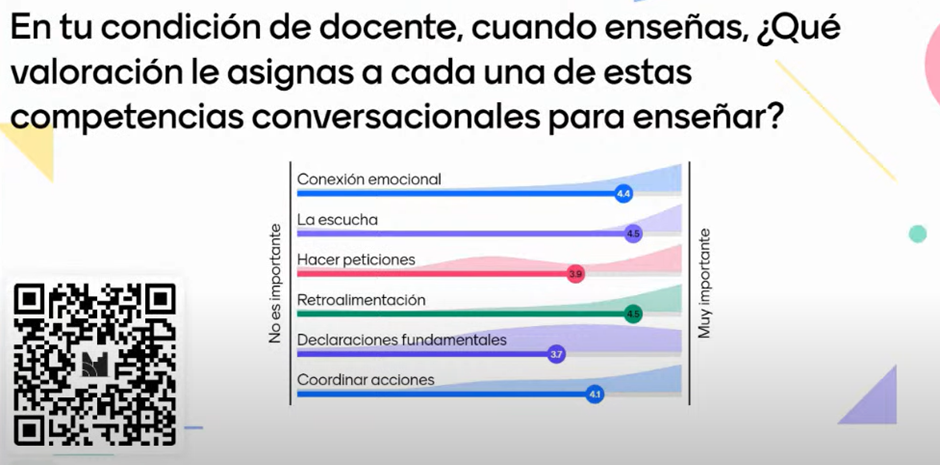
During the webinar, the teachers who participated in the hearing assessed these six competencies (see Image 2). Listening and feedback were firmly positioned as the highest priorities, followed by emotional connection, coordination of actions, and the competency to make fundamental statements.
In this webinar, we discovered the capital that comes from developing our conversational skills and the infinite possibilities when we plan and design our conversations. What is your opinion about the relevance of conversational skills in your professional or personal life? Let us know – we read you in the comments.
Relive this webinar. If your native language is not Spanish, you can turn on YouTube subtitles that translate the webinar. To activate this option, choose the subtitles option on YouTube: Select Settings ->Subtitles -> Translate automatically, and select your preferred language.
Miguel Rivera Alvarado (miguelriveral@hotmail.com) has a Master’s degree in School Management and a Master’s in Quality and Educational Excellence. He is an ontological and educational coach and the author of the book We Have to Talk! Conversational Skills for Personal and Social Well-being.
Miguel is the founder and Executive Director of EDUCAMINO. He has been directing the emblematic Víctor Jara High School in the Colchagua Valley for a year. Miguel has been the director of schools in Chile for more than 25 years. As an ontological and educational coach, he has focused on research, training, and disseminating conversational competencies in organizations. In the coming months, he will launch his second book in Mexico, The School Is Dead, Long Live the School!

)
)
This article from Observatory of the Institute for the Future of Education may be shared under the terms of the license CC BY-NC-SA 4.0