)
)
)
)

Over the years, the discourse about incorporating new technologies and digital tools in the classroom to improve the quality of education has prevailed. But has the promise been fulfilled? In many cases, improving the quality of education through technology is a myth. In the webinar produced by the Observatory of the Institute for the Future of Education at Tecnologico de Monterrey, Dr. Carlos George shares his analysis and suggestions on this topic. In this talk, Dr. George explains that the primary purpose of incorporating new technologies in the classroom is to produce favorable results that enrich the quality of learning and the teaching-learning process. This article summarizes the webinar.
“The greatest educational challenge to appropriately use technologies in education is to create in practice an intersection of two concepts, the pedagogical and the technological part. Otherwise, we are only ‘simulating’ an improvement in learning with technologies.” – Carlos George.
There are many promises surrounding the use of technology for learning. Some studies indicate that many emerging technologies are piloted in the classroom and then discontinued because, from the perspective of students and teachers, they do not offer results that transform or improve the quality of education. In this Observatory webinar, Dr. George recounts the technological promises for education. Here’s a brief review.
Promises associated with the use of technologies in education
- The quality of the information. The massification of the Internet has allowed students and teachers to access knowledge and resources that would otherwise be difficult to obtain. This access contributes to improving the quality of education. However, it does not mean that the information is appropriate or sufficient to be incorporated into students’ training processes.
- Personalized learning implies appropriate learning for each student’s style, profile, and way of learning. Using technologies in the classroom has promised customized learning, which has been achieved in some cases through learning management systems and, recently, with artificial intelligence software. We can identify learning needs through an initial diagnosis and provide the most appropriate content for each individual. However, there is still much room for improvement.
- Distance learning. Distance learning is another promising technology in education (e-learning). The pandemic (in the best of cases) privileged the continuity of teaching in this period of contingency.
- Interactive learning. Another promise of technology in the classroom was interactive learning. Previously, Internet content was static, consisting of 2D pages with hyperlinks, but it did not offer us the dynamics of today with virtual, augmented, and mixed reality.
- Automated assessment. Student assessment is a fundamental activity for teachers. Previously, they had to evaluate and grade a significant number of tests with the support of a guide for closed items; in the case of open items, they had to analyze each of the answers. With automated assessment options built into learning management systems, these and even qualitative assessments can be more expeditious.
- Teacher training. Teacher training in digital skills is another promise of technology for education. We can find two different situations. The first is when institutions do not offer teachers a training plan in digital skills. In this case, teachers must seek training options in the way they think can best help them. The other situation is when institutions offer teacher training programs in digital skills. Still, the training is so bureaucratized that it seems to be only for “reaching out” some indicators rather than a dedication to increasing the digital skills that teachers need to implement in the classroom.
In the session, Dr. George told us that using technology in the classroom may become an obstacle if we don’t have clear educational goals. An example of this is the inappropriate use of WhatsApp, which distracts teachers and students. Another example is using mobile devices for leisure rather than for learning purposes. In this context, the main problem is the need for methodologies punctually incorporated into educational training.
Considerations for Successfully Incorporating Technologies into the Classroom
Below are the aspects recommended by Dr. George in the Observatory’s webinar that are necessary to incorporate technologies successfully into the teaching-learning process.
- Digital literacy is a continuous, not finite, process. We must continuously review our digital literacy because new technologies frequently emerge or are updated, and we must be aware of the latest technological trends.
- Attitude. When considering technology for the classroom, one must look beyond its trendiness. First, it is imperative to analyze its impact on education.
- Access and equity. The lack of access and equity significantly limits the incorporation of technologies.
- Accompaniment. When implementing a digital strategy in the classroom, it is crucial to consider the students’ perspective on the teacher’s support. Teachers often take for granted that students know how to use technology for educational purposes when this is not the case. Teachers must accompany students, providing clear instructions regarding what students will do and why, the objectives to achieve, and timely feedback.
- Experimentation. Before implementation, a pilot exercise with an experimental group is valuable. The group can even include colleagues and other teachers. Another good suggestion is a self-pilot in which teachers put themselves in the students’ shoes.
- Evaluation. We must evaluate the impact of using technologies in training experiences from the student’s perspective; otherwise, we won’t know if it helped. A good option is an observation methodology evaluation to verify that the student effectively developed and strengthened a new skill or competency after participating in a technology-mediated experience.
According to Dr. George, using technologies in the classroom should be fun, motivating, helpful, and challenging. Therefore, knowing how to generate learning using technological tools is essential.
Hyperbole or Reality
In the webinar, Dr. George explained the concept of “Hyperbole” in education. Hyperbole refers to excessive expectations about the impact of digital applications and tools intended to improve education. It means exaggerating or overvaluing their benefits.
Image 1 shows Gartner’s graph, representing technologies’ stages and expectations over time.
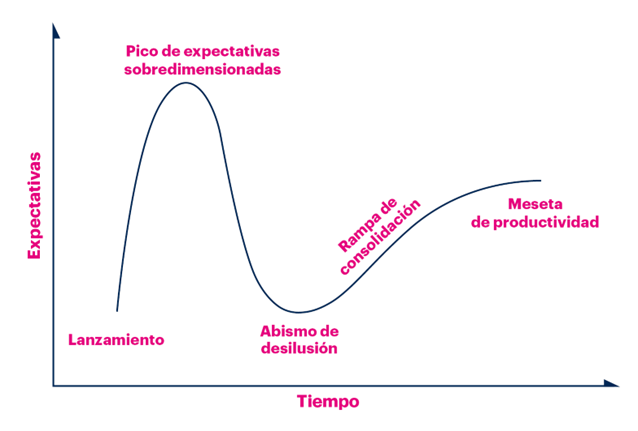
Consulting companies like Gartner speak about the “hype cycle” of technologies, i.e., the expectations they generate and their evolution over time. Technology often disappoints us (abysm of disillusionment) because they do not produce the desired results. Subsequently, other stages, such as the consolidation ramp and productivity plateau, come into play.
Image 2 displays the same graph but with the 2023 evaluation of different technologies and the cycle of expectations for each through time evolution.
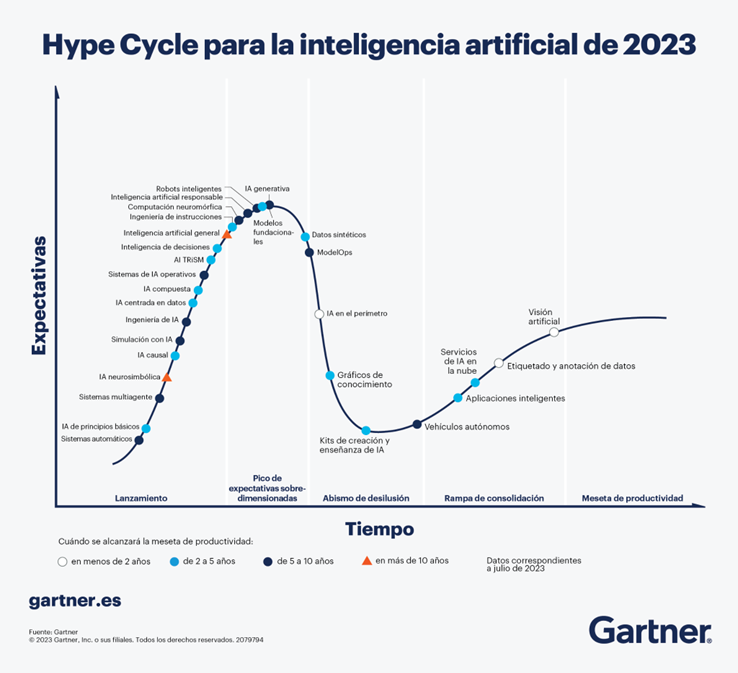
Image 2. Hype Cycle for AI 2023’s Emerging Technologies (Gartner 2023).
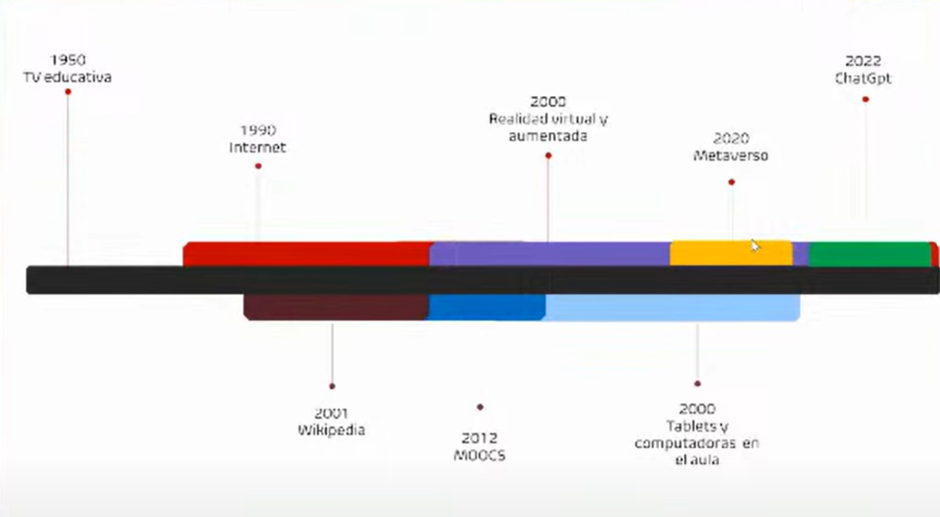
Image 3 presents a few examples of hyperbole throughout history where a technology or an application was given by people more importance than it merits. Has this happened to you as a teacher? In the comments section at the bottom of this article, you can share your experiences and comments.
What should we do to avoid hyperbole? To prevent the current of “expecting great things” from incorporating technologies in education, Dr. George suggests the following:
- Work on digital training. Be aware of technological trends as they come with emerging literacies.
- We should ensure that teacher training is conviction-based and not just for compliance. We want to use technologies in the classroom to improve knowledge, not just to comply with institutional indicators.
- Participate in learning communities. Inviting colleagues to pilot training experiences before implementing them in the classroom is a way of learning and socialization, and it promotes critical thinking to improve teaching practice.
- More Pedagogy and less technology
- Dare to design your methodologies.
- Experiment with other methodological proposals.
- Evaluate methodological experiences.
- Document and publish methodological experiences.
- Define your priorities
- Consider “What Do My Students Need?”
- Reflect: “It is essential for these issues to use emerging technologies?”
- Evaluate and socialize
- Only the assessment tells us the success of the technological implementation.
- Sharing your findings lets others know about your experience.
In the Observatory’s webinar, Dr. George explained that because technology will continue to play a central role in education, finding the right balance between its use and actual scope is crucial. The webinar video offers more information, suggestions, and recommendations. Remember to check out the full video anytime and share it with your colleagues.
Watch this webinar. If your native language is not Spanish, you can turn on YouTube captioned translations. To activate this option, select the Subtitles option on YouTube (the subtitles will appear in Spanish), then choose the options “Settings ->Subtitles -> Translate automatically” and the language you prefer.
Dr. Carlos Enrique George Reyes (cgeorge@tec.mx) is a postdoctoral researcher at the Institute for the Future of Education at the Tecnológico de Monterrey. He participates in the Interdisciplinary Research Group: Scaling Complex Thinking for Everyone. Carlos is a member of the National System of Researchers (SNI) in Mexico, the Mexican Council for Educational Research (COMIE), the Mexican Society of Comparative Education (SOMEC), and the Research Group on #Emerging Technologies for Learning (GITEMA-Cuba). He participates in multidisciplinary research projects along the lines of reasoning for complexity, educational innovation and entrepreneurship, literacy, and digital skills. He published articles in international impact magazines, book chapters, and presentations at international conferences.
Translated by Daniel Wetta

)
)
This article from Observatory of the Institute for the Future of Education may be shared under the terms of the license CC BY-NC-SA 4.0