)
)
)
)
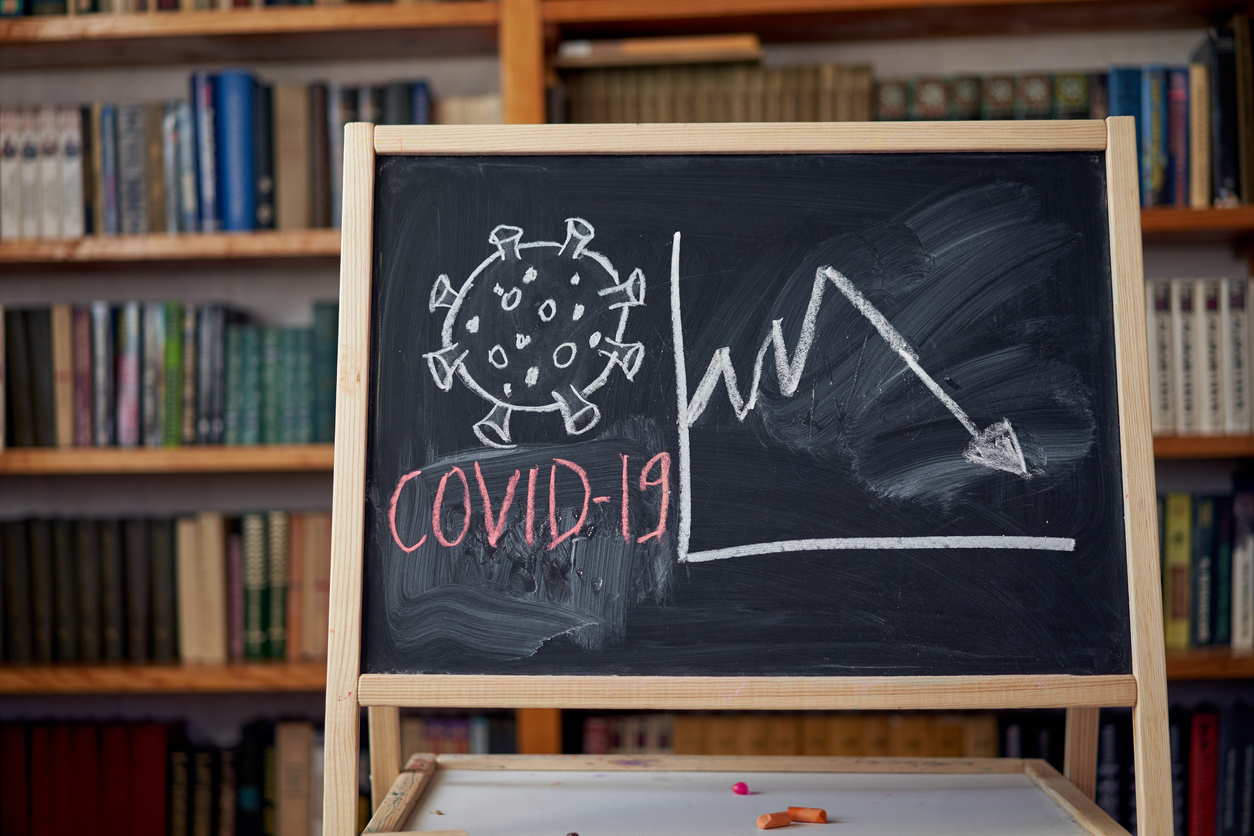
In modern history, the differences between before and after the start of the COVID-19 pandemic are undeniable: streets were empty, schools closed, and face-to-face social interactions were minimal, affecting all industries and people. Almost six years after the pandemic began, many of its consequences are still felt. However, some are not so obvious or perceptible: what havoc did it wreak on education?
What was the outlook?
On March 11, 2020, the World Health Organization (WHO) declared that the international health crisis caused by the SARS-CoV-2 virus was a pandemic and urged governments to take stringent containment measures. Thus, confinement became a reality for billions of people worldwide. Moreover, what was thought would be a few weeks of isolation turned into months in which life was paralyzed.
That same year, in July, UNESCO estimated that 24 million students, from preschool through higher education, were at risk of not returning to school. The organization stated that five main factors contributed to this situation:
- financial constraints and pressure to seek employment,
- household chores,
- child care, mainly because family members or caregivers were ill or deceased due to the pandemic,
- early and forced marriage and/or early and unwanted pregnancy, with girls particularly vulnerable,
- fear of the virus’s resurgence.
Furthermore, it highlighted that impoverished or marginalized students, as well as those affected by political and migratory conflicts, would be disproportionately affected.
The main education provisions of the ECLAC-UNESCO report Education in Times of the COVID-19 Pandemic were the suspension of face-to-face classes and the use of various distance-learning modalities, including online learning (using virtual asynchronous or synchronous platforms) and offline modalities (traditional media such as radio or television).
Additionally, it referred to a study by the International Institute for Educational Planning (IIEP, 2020), which shows that, in terms of financing, the crisis would have a significant impact on two areas resulting in: 1) a decrease in investment in education during the crisis, as well as the additional cost caused by the pandemic, and 2) an expected reduction in the financial resources available for the future of the education sector.
Furthermore, García Jaramillo (2020) pointed out the potential implications for children due to the prolonged closure of educational institutions, coupled with the economic and health impact on the population. Beyond school dropouts, impacts such as physical and emotional abuse, food insecurity, and learning loss were considered, which would have devastating consequences on an entire generation.
This author discussed strategies developed by UNESCO to address the health emergency and prevent an even greater gap. These covered six lines of action, the first four related to the well-being of children and adolescents:
- plan to reopen schools as soon as possible;
- develop a strategy to ensure learning for all students;
- preserve the protective function of the school and resume services;
- ensure the emotional well-being of the educational community (teachers, families, and students);
- plan the financing and coordination between the education sector and other sectors to take necessary actions; and
- manage the health emergency with a long-term vision, so that the investments made would contribute to rebuilding the education system.
These strategies were intended to address the urgency of the five UNESCO factors discussed above: the suspension of face-to-face classes affected the teaching and learning processes; in many cases, school meals for children ceased; teachers’ and students’ stress increased; and the chances of domestic violence, teenage pregnancy, and child labor rose.
New findings
Latin America and the Caribbean were some of the regions most affected by the suspension of face-to-face classes during the health emergency. According to The Urgency of Educational Recovery in Latin America and the Caribbean(2024), countries in the region kept schools closed or partially open for an average of 62 weeks, i.e., more than a year and a half without classes. UNESCO explains that it is difficult to measure the extent of the setback that this entailed in the main educational variables.
Moreover, Guillermo Parás Treviño, Kumón’s Expansion Manager and educational specialist, explains that up to 80% of students in Latin America have a low educational level due to the aftermath of the COVID-19 pandemic, which includes the inability to concentrate, lack of ability to study, and self-perception problems, such as confidence.
The report Education in Latin America and the Caribbean in the Second Year of COVID-19, issued in December 2022 by UNESCO, indicated that at least 160 million students were affected by what it considers “the worst and longest educational crisis in the recent history of Latin America and the Caribbean,” a region already stressed before the pandemic in terms of availability of educational resources, coverage, equity, and quality.
It also stated that in 79% of these countries, proposals for remote teaching had not reached all basic education students, and that 17% reported that at least one in four students had been excluded. The approach to remote teaching, they explained, disproportionately affected the already vulnerable and marginalized student body, with unequal access to technology a key factor in widening pre-existing gaps. In addition, the report stated that education had not been a priority in post-pandemic recovery plans and called for it to be given a central place on the public agenda with adequate financing.
Moreover, the United States experienced a slow recovery across all states, with schools unable to regain the ground lost during school closures. For example, in California, the number of new teachers dropped sharply, while early retirement increased. In addition, students were half an academic year behind pre-pandemic levels, which is equivalent to 31% of a grade below 2019 levels. In other states of the country, the gap was close to a one-year delay.
What do we do with what we have?
While we will never know precisely the extent of the damage caused by the pandemic in the educational field, it is essential to acknowledge it because, according to researchers from Harvard, Stanford, and Dartmouth, many schools have not been entirely honest with families about the learning loss; many have the false impression that their children were not affected, despite that the international closures of schools was a precipitous break from the traditional socializing role of the institutions.
Despite the apparent problems the pandemic imposed on education, we must not forget the pre-existing barriers and work to close these gaps. Educational recovery actions must not lose sight of the main problems that have arisen since the pandemic, while also attending to historically marginalized communities. A study conducted by the Espinosa Yglesias Study Center (CEEY in Spanish) shows that between 2016 and 2024, the share of young people aged 18 to 24 who exceeded their parents’ level of schooling fell from 72% to 67%, indicating a decline in educational social mobility.
The pandemic changed the world and, with it, the vision of the traditional student, who had dedicated his time solely to schoolwork. According to the UNAM Secretariat, in its report Education at UNAM in the Post-pandemic, it is necessary to recognize students in their living contexts, whether they are workers, have care responsibilities, or belong to ethno-racial, cultural, or gender-diversity minorities. Supporting these students would be a big step (of many still to be taken) toward guaranteeing quality education for all.
Translation by Daniel Wetta

)
)
This article from Observatory of the Institute for the Future of Education may be shared under the terms of the license CC BY-NC-SA 4.0