

In education, some concepts transform not only how we teach but also how we understand human learning. The forgetting curve, identified by Hermann Ebbinghaus in 1885, is one of these. Although it emerged in a 19th-century psychological laboratory, today it is indispensable for understanding why students seem to “forget everything” after a class: why studying a day before the exam does not work, and why assessment practices need to be transformed to align with the brain’s actual functioning.
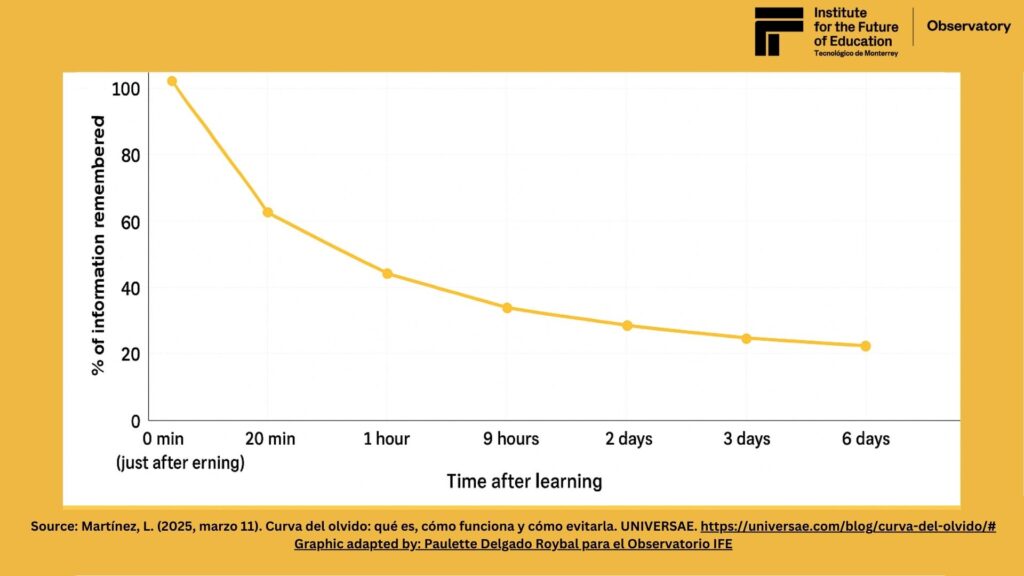
The forgetting curve shows that after an initial learning, information retention declines rapidly and continues to decline if it is not intentionally reviewed or applied. Various publications, such as iSpring, explain this pattern: the most significant loss occurs in the first hours and days, and then the curve stabilizes, leaving only the most important memories for the person. In other words, memory is a dynamic system that strengthens or weakens according to its use.
Understanding this phenomenon is key to improving teaching and assessment in contemporary educational settings. In a world saturated with information, multiple screens, accelerated class cycles, and students with cognitive overload, the question that every teacher must ask themselves is not what to teach, but how to distinguish what remains in the memory after teaching.
For teachers, this has direct implications for the way they teach, provide feedback, and evaluate. For students, it implies that studying at the last minute is not only inefficient but also contrary to the natural functioning of memory. This article analyzes how the forgetting curve affects teaching practice and evaluation processes and offers learning design strategies to promote more representative and lasting learning experiences.
Memory is a dynamic system, not a container
Ebbinghaus showed that, after initial learning, memory drops abruptly. In the first 24 hours, a person may forget up to half of what they learned. In the following days, the loss continues, although more slowly. This pattern is universal: it occurs regardless of age, educational level, or content type. The human brain prioritizes what is repeated, what is used, and what connects with prior knowledge.
Various studies on memory, including the classic explanation of the forgetting curve, show that the retention of information decreases rapidly shortly after initial learning and, over time, stabilizes, leaving only the most relevant.
The evidence on the forgetting curve is consistent: after learning something for the first time, people can forget between 50% and 80% of the content in a few days if there is no conscious effort to review. The classic Ebbinghaus graph shows a pronounced initial decrease, followed by a gradual stabilization as the remaining knowledge becomes more resistant to the passage of time.
Several factors directly influence retention and the speed of forgetting:
- Cognitive overload: When the student receives too much information in a short time, their working memory is unable to process it or transfer it to long-term memory.
- Dispersed attention: Noisy environments, multitasking, and continuous use of screens decrease the likelihood of consolidation.
- Absence of meaning: Isolated concepts are forgotten faster than those connected to authentic experiences, emotions, or previous knowledge.
- Lack of active practice: Reading or listening passively does not consolidate memory; instead, actively using knowledge reinforces it.
- Sleep and health: Sleep deprivation, fatigue, or stress are factors that directly affect consolidation processes.
Cognitive science is clear: memory improves with use. For this reason, a precise and well-designed class does not guarantee retention of learning unless it incorporates strategies that enable students to remember, apply, and reconstruct their knowledge. This implies that a well-taught class does not guarantee learning if the content is not revisited, used, or retrieved in the days that follow.
This pattern shows that memory deteriorates rapidly at first and then slows, which implies that classes focused solely on content exposition, without time for practice, revision, or active retrieval, do not promote the consolidation of long-term learning. To retain as much information as possible, it is imperative to review the topics through spaced review strategies, meaningful connections, and active retrieval exercises.
Curriculum design and class rhythms can be allies or enemies of memory
The forgetting curve highlights one of the most profound weaknesses of the traditional educational model: the tendency to move quickly from topic to topic, as if comprehension were an immediate act, rather than a process that requires strategic pauses to review, integrate, and reflect on what has been learned.
Many academic programs are built under the logic of “coverage,” that is, covering as much content as possible in a given time. However, research on memory has shown that coverage does not equate to effective learning. The speed at which information is presented does not ensure its retention; in fact, it often has the opposite effect, accelerating forgetfulness and creating a false sense of mastery of the topics covered in class among both students and teachers.
The stability of knowledge depends on repeated, meaningful, and varied interactions with content. Educational platforms such as iSpring and Universae highlight that systematic reviews should not be an optional accessory at the end of a unit, but rather a structural component of instructional design. Teaching that regularly returns to previous concepts, invites us to retrieve information without consulting materials, and connects new learning with previously retained knowledge, helps combat the brain’s natural tendency to forget what it does not consider useful.
In this sense, teaching less content in greater depth is more cognitively effective than saturating students with large amounts of information. This idea is reinforced by explanations in TechRxiv and Whatfix, which describe how working memory has well-defined limits: When the curriculum is overloaded, not only does teaching pressure increase, but it also triggers a cognitive collapse that prevents processing, organizing, and consolidating information.
Oversaturation causes most of what is taught to be lost almost immediately. Conversely, when fewer topics are prioritized and explored from multiple angles with discussion, application, contrast, and retrieval, the likelihood that they will become lasting knowledge increases considerably.
Another pertinent element is the pace of instruction. A strategy known as interleaving, as explained by Scientists in the Making, favors retention over intensive work on a single block. Alternating types of problems, concepts, or skills forces the brain to distinguish, categorize, and compare, processes that strengthen learning by activating deeper cognitive mechanisms. This interspersed rhythm contrasts with traditional linear logic, where content is taught in closed blocks that are not reviewed again until the exam, allowing forgetting to advance without resistance.
The way information is presented also determines how much is retained. When content is complex, abstract, or disorganized, working memory becomes overloaded, making it difficult to transfer to long-term memory. Therefore, courses that use concrete structures, examples, and sequenced explanations help students better organize the information.
Clarity, in this sense, is not only aesthetic: it is a cognitive mechanism that facilitates learning. This is why frequent opportunities to retrieve information, even through brief questions at the beginning or end of class, help retain knowledge.
Moreover, the forgetting curve completely transforms how we understand evaluation. Assessing immediately after teaching, as if learning were stable, is insufficient. If much of what has been learned fades away within the first 24 to 72 hours, then a traditional test measures more what the student can remember at the time than what they have learned. Evaluation focused solely on specific moments tends to capture short-term performance, temporary memory, and recent activation of content, without reflecting genuine retention.
Better is a learning assessment that focuses on what students can remember and use over time. This perspective, highlighted by Edutopia, emphasizes the evaluation of progressive consolidation and knowledge transfer. Formative assessment allows for the evolution and stabilization of knowledge through multiple approaches. It implies that single, high-consequence exams are a poor measure of learning and a pedagogically weak practice, rewarding superficial memorization and penalizing those who require more time to consolidate what has been learned, ignoring what we know today about human memory.
The evidence indicates that to counteract the forgetting curve, it is necessary to introduce continuous practices. Various sources highlight the value of short quizzes presented throughout the learning unit, self-assessments that help the student recognize what they remember and what they need to reinforce, oral explanations that facilitate the reconstruction of information from scratch, active retrieval exercises that test memory without external supports, application tasks that connect the content with real situations, and rubrics that show progress, not just the bottom line. Each of these practices activates memory, strengthens neural connections, and slows down the natural rhythm of forgetting.
In this sense, the practice of retrieval is perhaps the most powerful strategy to improve learning. Every time students try to remember something on their own, without reading or copying it, their memory is strengthened. In the brain, this effort activates neural pathways that make memory more resistant, accessible, and facilitatory of transfer to new contexts. Active retrieval is not only used to assess but is also one of the most effective and studied learning techniques today.
Finally, when we evaluate only once, learning is not evaluated; instead, the instant is assessed. The forgetting curve reminds us that knowledge is not an event, but an ongoing process that requires exposure, review, use, and feedback. Teaching so that knowledge lasts implies designing courses that recognize the real functioning of human memory and evaluating with practices that accompany, reinforce, and sustain that learning beyond the day’s class.
Timely feedback is one of the most effective mechanisms to counteract the natural advance of the forgetting curve. Various publications emphasize that effective feedback must be specific, timely, and oriented towards improvement. When the student receives feedback while still retaining a clear mental representation of their work, they can rearrange their ideas, correct mistakes, and build new conceptual connections. This process interrupts the natural decay of memory originally described by Ebbinghaus.
The opposite effect occurs when feedback comes late. As mentioned above, memory is especially vulnerable during the first hours and days after learning; therefore, when the teacher returns assignments weeks late, the forgetting curve has already done its job. The student vaguely remembers what he did, but he cannot reconstruct the reasoning that led to his answers. At that point, any attempt at feedback becomes more of an administrative comment than a meaningful pedagogical intervention.
Research has shown that immediate feedback combined with regular practice improves performance and directly modifies the shape of the forgetting curve. When students receive feedback at the right time, memory consolidation is strengthened, and knowledge lasts longer. These studies confirm that feedback is not a complement to teaching, but a central mechanism for retention.
Integrating evidence-based strategies is critical to reinforcing this effect. Spaced repetition is one of the most scientifically supported practices. It consists of reviewing information at increasing intervals, of one day, three days, a week, or more, and allows the forgetting curve to be “reset” at strategic moments. By doing so, the student reactivates the memory just before it is lost, thereby strengthening its storage in long-term memory.
Remembering without direct support from the material, either through questions at the beginning of class, spontaneous explanations among peers, or brief exercises without grading, activates neural pathways that make memory more resistant and accessible. What is painstakingly retrieved is retained more deeply than what is reread.
Another outstanding practice is intercalated learning, also known as interleaving. This technique involves alternating between types of exercises or concepts rather than studying a single block of content intensively. When mixing tasks, the brain must distinguish between procedures, sort information, and compare ideas, which strengthens comprehension and retention. Interleaving activities produces a more flexible and adaptable memory, which can be transferred more easily to new situations.
Other strategies also directly influence memory. iSpring highlights the usefulness of mnemonics, which facilitate memory by linking the new information to knowledge, experiences, or practices the mind has already integrated, creating mental connections that make information more accessible and visualizations that “anchor” concepts in long-term memory through images, metaphors, or meaningful associations. Microlearning allows information to be presented in short, manageable chunks that reduce mental overload and facilitate consolidation. In addition, students have better retention when learning is connected to personal experiences, emotions, or real problems, because memory retains what is contextually meaningful more strongly.
Today’s educational technology amplifies the effect of all these practices. Platforms such as learning management systems, self-assessment apps, or digital cards enable automated spaced repetition, facilitate frequent assessments, and store evidence of progress. These tools not only facilitate continuous practice but also allow personalization of the learning pace for each student, optimizing information retention.
The forgetting curve compels us to rethink evaluation from a more human, cognitive-science-aligned perspective. Evaluation should not occur through an isolated exam; rather, it must be a process sustained over time. Continuous assessment practices reduce anxiety, strengthen deep understanding, foster student autonomy, and favor the transfer of knowledge to other contexts. Several examinations over time with different instruments yield fairer assessments than a single examination, because consolidation occurs gradually; learning does not take root immediately.
Finally, the forgetting curve reminds us that the objective of evaluation is not to punish the error or capture an ephemeral moment of performance, but to accompany the progressive stabilization of knowledge. Forgetting is a natural and predictable phenomenon, but it is also manageable. The educational challenge is not to avoid forgetting, but to overcome it through deliberate pedagogical practices. Timely feedback, spaced practice, active retrieval, interleaving, microlearning, and the intelligent use of technology integrated into everyday teaching transform the forgetting curve. It ceases to be an obstacle and becomes a guide for creating more meaningful, longer-lasting, and more human learning experiences.
Translation by Daniel Wetta