)
)
)
)

There are times in life when we are forced to make decisions. One comes at an early age when we have to choose which career to study. This decision carries enormous weight, shaping and influencing the future of every young person, as Professor Yadira Díaz explains. However, some decisions are more voluntary and carefully considered, such as pursuing a postgraduate degree. Choosing to study postgrad can be simple; the problem is selecting the master’s or specialization program that is best for you, which will depend on the reasons that led you to decide to continue your education and what you hope to get out of it.
Tips for Choosing a Graduate Program
Currently, a wide variety of master’s degrees, specialties, and doctorates are available in both public and private institutions. Therefore, choosing a program requires considering various aspects so that pursuing the academic degree does not lead to regrets halfway through, wasting your time and resources.
Your best option will be the one that enables you to fulfill your purposes in the medium and long term, since a postgraduate degree may lead to a career change, a salary increase, or simply personal satisfaction. Thus, you should consider the focus of the postgraduate degree you will undertake, as well as the time required and the ways to obtain it.
Are you interested in a postgraduate research degree or one that trains for a profession? Traditionally, research programs are oriented toward generating new knowledge, while professional programs focus more on practical application, technical updating, and practical skills required in the labor sector.
Notably, many research graduate programs require exclusive dedication to the program, so defining your objectives will help you find the one that best aligns with your schedules and goals. For example, do you plan to quit your job and dedicate yourself entirely to your degree, or are you looking for classes that will let you continue working and growing professionally at your current company? It is also necessary to consider how much time you want to dedicate to obtaining the degree, because beyond the duration of the degree program, other considerations include the time required for class attendance, homework, and reading, as well as travel time if classes require face-to-face attendance. In addition, if the university is in another city, you must assess the location and cost of living; if it is in another country, you must make sure that you meet the residency requirements, as the case may be.
Thus, it is essential that you verify the validity of the studies you want to pursue in either public or private institutions. If the study will be abroad, verify that the degree program is valid in the place where you want to practice. Obtaining your postgraduate degree abroad offers many advantages, such as expanding your international network and learning about other cultures and contexts.
On the other hand, for online distance programs, you must ensure your computer equipment meets the requirements of that modality. Also, you should have a quiet space where you can attend classes with full attention.
Moreover, the program’s quality is one of the most important factors to assess. The Harvard Division of Continuing Education has a list of considerations when evaluating a program’s quality. These include the quality of the program’s faculty and access to the university’s resources and facilities.
Other aspects to consider
If the above points have not convinced you how to choose a postgraduate degree, other elements can help you with the decision.
In Mexico, the cost of studying for a master’s degree ranges from 21,000 to 800,000 Mexican pesos; however, it has been shown that future labor wages correlate directly to educational level. Thus, it is relevant to view it as a medium- and long-term investment; however, when choosing the program of interest, take into account the program’s cost and the financing options or scholarships available to you.
In Mexico, institutions such as SECIHTI (Secretariat of Sciences, Humanities, Technology, and Innovation) award scholarships to excellent, full-time graduate students. Not all programs have this support; however, some universities have agreements with companies that may make partial or total discounts accessible. Thus, considering the program’s total cost and how it fits your budget will help you make an informed decision.
Another helpful input is to talk to students or alums of the institution, principally those who are studying or have obtained the degree in the program of your interest; this way, you can learn more about whether or not it meets your expectations, considering, for example, campus life, which may be important to you, or ascertaining that the program allows academic and work balance. Also, talking to graduates may give you an idea of how the degree helped their working lives, as well as information about other support resources universities offer their students and how they benefited from them, for example, access to research internships, scholarships, or academic exchanges.
Once you find a program that interests you, investigate its entry requirements, as many demand more qualifications than just a bachelor’s degree. Such requirements can include foreign-language certifications, minimum scores on various exams, letters of recommendation, or even evidence of your research skills.
Prepare for the selection process
If the postgraduate degree you plan to apply to has entrance tests, prepare for them, as you will compete with people in similar situations to yours.
Preparing for the graduate selection process requires a strategy as meticulous as choosing the program itself. Once you have defined your research or professional path, the first step is to organize your documents and academic materials. Gather your degree certificates and GPA evidence in advance, as well as your foreign language certifications if required. Prepare in time for the standardized test presentation, as achieving the required score may take several practice test attempts and months of preparation.
You should also focus on building your candidate profile, aligning it with the institution’s expectations. If the program has a research focus, you must prepare a solid proposal or protocol that demonstrates your critical and methodological capabilities. On the other hand, for a professional postgraduate degree, your resume should highlight tangible achievements and relevant experience that demonstrate your ability to apply knowledge in the labor sector. For this, letters of recommendation are key; approach academics or direct bosses who know your career performance and give them enough time to write a letter that truly adds value to your application.
Likewise, preparing for the admission interview is crucial and should not be underestimated. The interview is the ideal opportunity to demonstrate that your profile aligns with the program’s philosophy and that you are clear about how this degree will advance your medium-term goals. Practice articulating your motives to explain why this program and this university fit. Being familiar with the professors’ research lines or the faculty’s engagement agreements will allow you to engage in a deeper, more professional dialogue with the evaluation committee, demonstrating your genuine interest and prior research into the quality of their academic offering.
Consider financial and logistical planning as an integral part of the selection process. If you plan to apply for scholarships of excellence, such as those awarded by SECIHTI, make sure that the chosen program is duly accredited and, if necessary, meets the requirements of exclusive dedication. Have the closing dates for funding calls mapped, as they are usually independent of entry dates to the university. Assess whether you have the means to continue with your studies if the support is not granted.
Go for that degree!
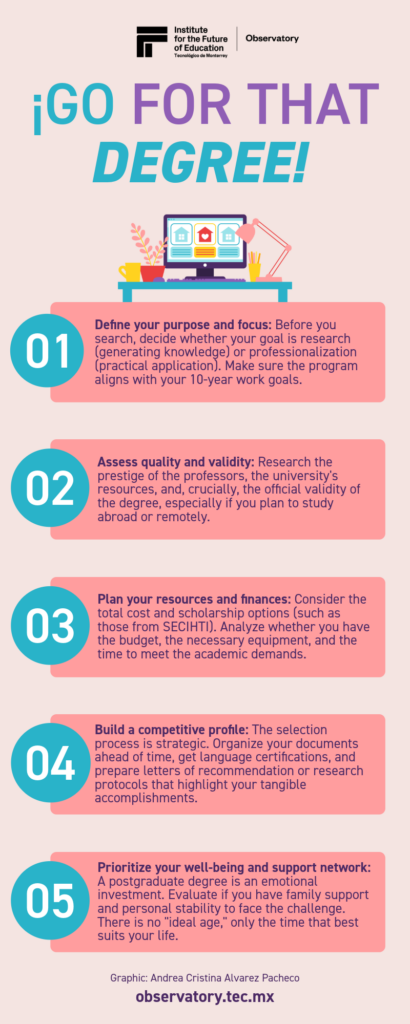
Ultimately, success in a postgraduate degree is not only measured by obtaining the degree, but by the professional and personal transformation you experience during the process. By integrating sound financial planning, rigorous academic preparation, and clear alignment with your long-term goals, you’ll be turning a simple application into a strategic investment. Remember that the right choice is one that not only describes who you are today, but who you aspire to be in the next decade.
At Tecnológico de Monterrey, the postgraduate offering includes professional impact programs where you can deepen your skills, executive programs to create business solutions, and even scientific and medical specialization programs. Including a university like this in your profile will be a great competitive advantage in the labor market since, according to the QW World University Rankings 2026, it is considered the best university in Mexico and the fourth in Latin America. Its offering includes many of the benefits established throughout this article, such as links with international universities and research centers, and even access to institutional or government scholarships.
While all of the above aspects are important, the most important one is to evaluate your personal resources, that is, if you have the time, money, and emotional and family support required to go through a situation that can be very rewarding, yes, but stressful. After all, there is no ideal time to pursue a postgraduate degree; there is no age or stipulated date to achieve it. It depends entirely on your personal and professional circumstances and the goals you want to achieve. The market is constantly evolving; Make sure you choose a program that gives you the tools to evolve along with it.
Translation by Daniel Wetta

)
)
This article from Observatory of the Institute for the Future of Education may be shared under the terms of the license CC BY-NC-SA 4.0