)
)
)
)

In the current IFE Observatory of Tec de Monterrey webinar, Professor Verónica Caputi explains how teachers can integrate ChatGPT to design and prepare didactic plans that cover the intended topics and contribute the necessary knowledge for students to acquire.
Two significant variables for class planning are time and class organization. Time is a valuable resource that should be optimized even when teaching. Below is a summary of this practical session; for a detailed explanation, please refer to the full video.
If you are beginning to use Artificial Intelligence (AI) tools in education, I invite you to familiarize yourself with the following basic information, which will help you better understand some key terms. ChatGPT is an artificial intelligence language model developed by OpenAI. This chatbot generates text in natural language, answers questions, and learns to communicate as if it were human. ChatGPT communication works best with carefully crafted prompts, questions, or instructions given to an AI system to perform an action or generate a response. A prompt can be a question, phrase, or request that triggers the answer needed or the task you want done.
To follow Professor Caputi’s practice, you must create an OpenAI account at https://openai.com to interact with the chatbot.
“The expert in the subject is the teacher, but ChatGPT can serve as an educational assistant.” – Veronica Caputi.
Improve your didactic planning through ChatGPT
For this practice, it is essential to clarify that the objective is not for the chatbot to impersonate the teacher but to utilize technology (in this case, ChatGPT) as a personal assistant that advises on didactic planning design, contrasting and testing our preparations for the class. In other words, ChatGPT can make suggestions as an advisor. Still, the teacher uses critical judgment to determine the quality and relevance of the chatbot’s responses to prompts. In the IFE Observatory Webinar, Professor Caputi explains that it is also essential to consider the confidentiality of the information entered into ChatGPT or any other AI technology.
“The foundations of teacher training are always fundamental. If you are not well-trained as a teacher and do not ask the right questions, ChatGPT will give incorrect responses.” – Veronica Caputi.
To explore the scope of ChatGPT in our teaching practice, we can use an activity, a class, a learning unit, or even the entire academic program. To do this, consider the topics to be addressed, the time, and the formal bibliography. The objective is to determine how to distribute this content within the time allotted by the school calendar to teach the subject effectively. To fulfill this objective, follow these steps:
A practical activity to improve didactic planning with ChatGPT
1. Go to ChatGPT.
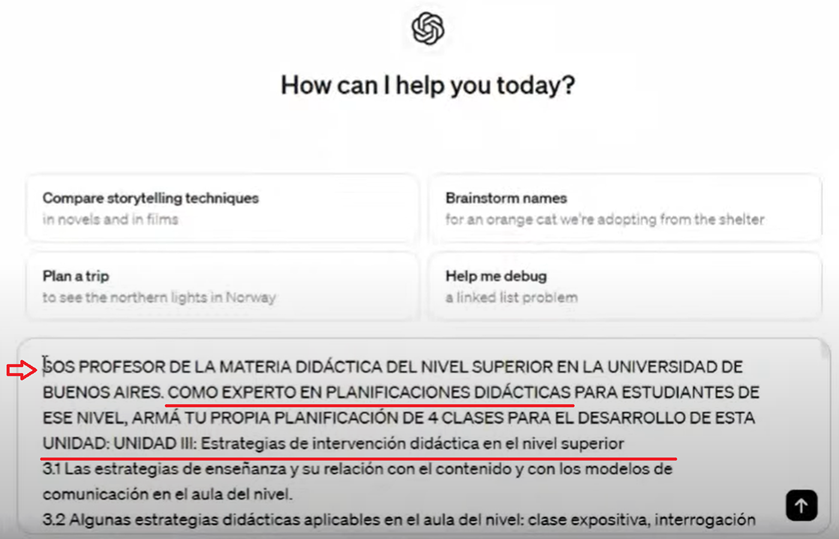
2. Before any query, we must position or indicate to ChatGPT that it is a teacher and expert in teaching so from that perspective, it can provide the information we need, using the following instruction: “You are a teacher of the (corresponding) subject at the (corresponding) educational level of basic, middle, high school, or higher education. As an expert in didactic planning at this level, prepare your didactic plan for four classes, developing this unit. Subsequently, in the same prompt field, you, as a teacher, copy and paste the program of the subject you want ChatGPT to consider in the planning. See Image 1. See the complete video.
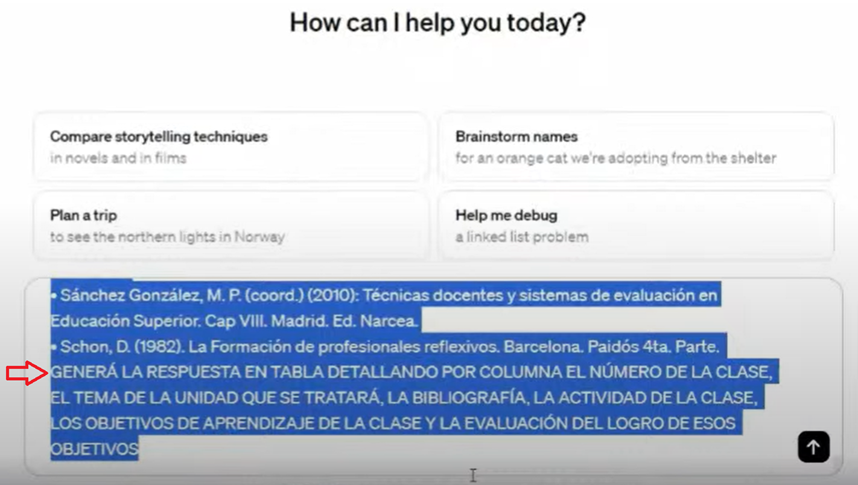
3. Once you have added the program, in the same instructions, you need to tell ChatGPT how you want it to return the requested information. For example, in the video, Professor Verónica Caputi told ChatGPT to “Generate an answer in table format detailing by column 1) the class number, 2) the topic of the unit to be discussed, 3) the bibliography, 4) the class activity, 5) the learning objectives of the class, and 6) the evaluation of achieving those objectives”. See Image 2. See the complete video.
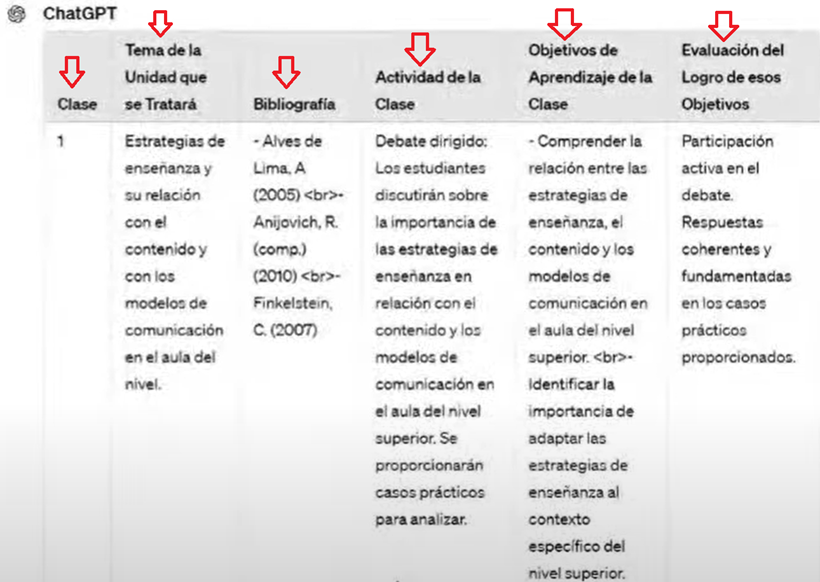
4. The result is that ChatGPT yields a table with 1) the class number, 2) the learning unit topic that will be covered, 3) the suggested bibliography, 4) the activity for that class, 5) the learning objectives to be achieved, and 6) the suggested evaluation to assess the achievement). See Image 3. See the complete video. Image 3: From the Tecnologico de Monterrey IFE Observatory webinar.
5. The teacher can delve more into the topic or correct the ChatGPT responses for peace of mind or satisfaction. See Image 4. See the complete video.
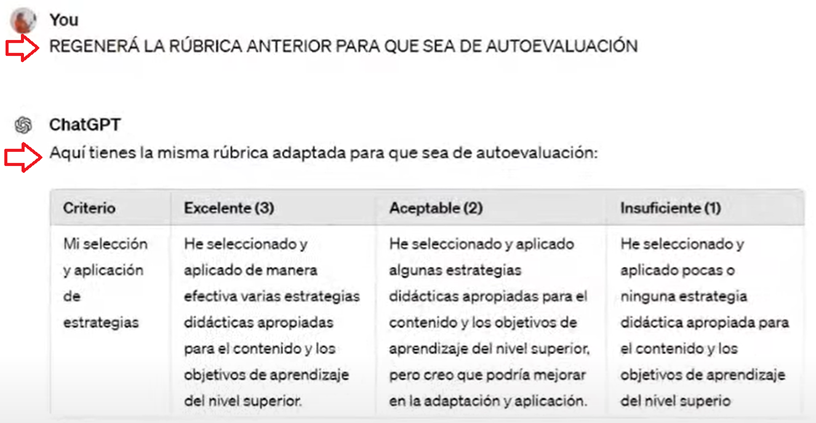
The teacher must know what they are asking. Suppose the teacher asks about the topic of evaluation. In that case, they must be familiar with evaluation and any other topic they request from ChatGPT. In other words, if our teacher training is not solid, we will not be able to ask the right questions, and ChatGPT will give faulty answers. Thus, the teachers must know the information they request and why. Moreover, they must be able to detect errors in the information to prompt ChatGPT to generate a correct answer.
“The teacher must apply their critical thinking skills to know whether or not to use the information provided by ChatGPT.” – Veronica Caputi
Accelerate improvement processes with ChatGPT
Using ChatGPT, we can accelerate improvement processes. In a short time, it enables us to organize a class program that respects the content and bibliography, but with new suggested activities and times, while generating new tools that we can implement for learning. For example, we do not always have time to train simultaneously on educational or technological trends, new evaluation models, etc. However, even if we are not experts, we can use ChatGPT to explore what this class would be like with a “particular” educational trend. See Image 5. See the full video.
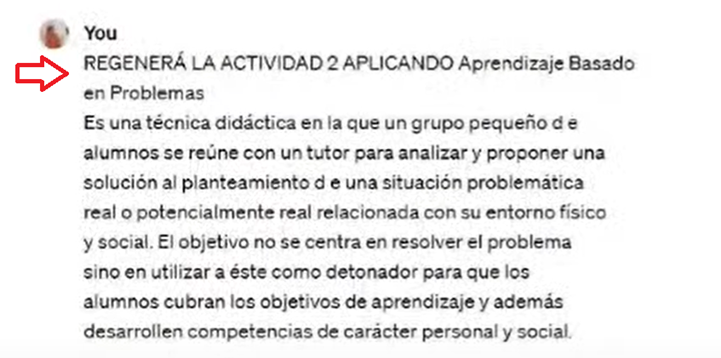
You can also explore other educational trends with ChatGPT. See Image 6. Watch the full video.
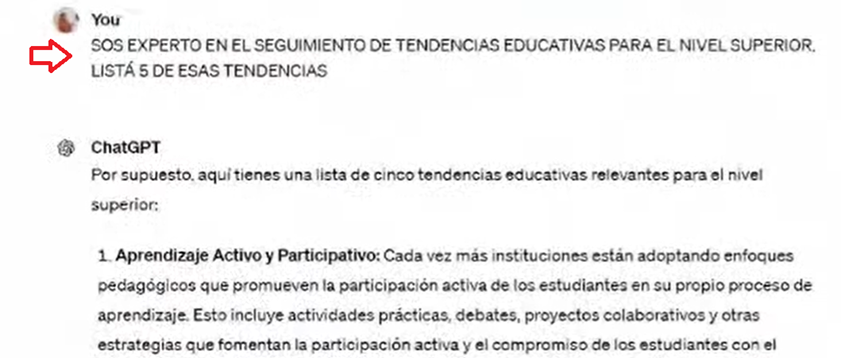
Technologies like ChatGPT enable us to provide students with better instructions, more effective tools for self-assessment, and new proposals that facilitate collaborative work or group association based on shared interests in class activities. Therefore, ChatGPT is an assistant that helps accelerate these processes.
ChatGPT as an ally to integrate the UN 2030 Agenda into curriculum designs
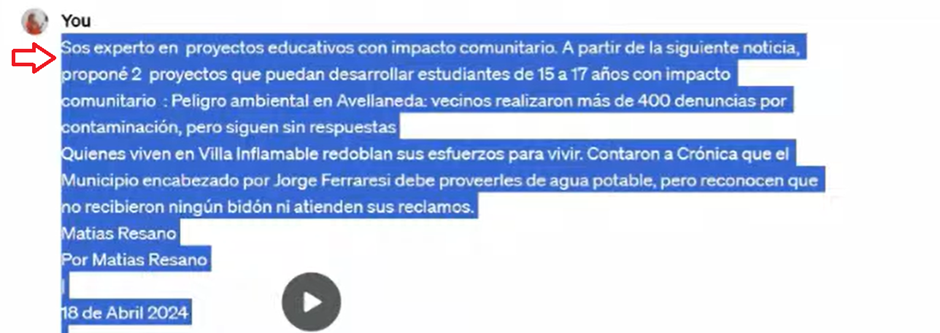
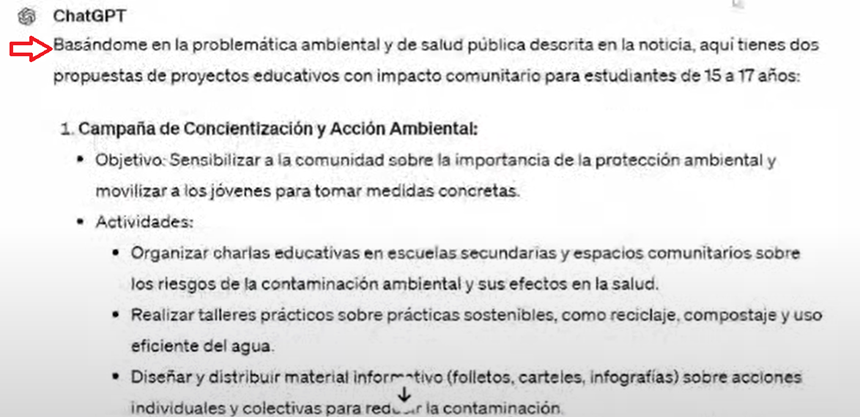
We often want to do different things in class, but we don’t know how. For example, ChatGPT can be a valuable ally in integrating the UN 2030 Agenda for Sustainable Development into curricular designs. We can ask ChatGPT, “How can we bring the UN 2030 Agenda to the classroom and subsequently impact the community through an educational project involving students between 15 and 17 years old? (See Image 7.) In this example, teachers must know what they are asking, be familiar with the Sustainable Development Goals (SDGs), and understand the 2030 Agenda for Sustainable Development. Why is the project relevant to the world, and what does it mean to have an educational impact? All this information must be well-understood by the teacher before prompting the chatbot. In the webinar, Professor Caputi asked ChatGPT this question; see ChatGPT’s response in Image 8. See the complete video.
Risks or disadvantages of using ChatGPT
One of the most significant risks is forgetting that ChatGPT produces biased responses. Accepting all its responses as accurate without questioning or contrasting them with other sources is too delicate. Remember that ChatGPT can provide guidance, but the final decision remains with the teacher. Discernment requires that we educate ourselves and apply critical thinking.
This tool complements our existing efforts. When designing our lesson plans, we must remember that we also have biases. If we do not rely on new technologies, we can limit our offerings to our students due to our biases. With ChatGPT, we can test and improve our plans.
The tools discussed in this article are not issued, operated, or administered by Tec de Monterrey. The use of the applications mentioned in this document is intended to illustrate what can be achieved by utilizing open artificial intelligence applications.
The IFE Observatory webinars at Tec de Monterrey are free materials to consult and share with your colleagues. All the videos can be found on The Observatory’s website https://observatorio.tec.mx/edu-tube/
Watch this webinar. If your native language is not Spanish, you can turn on YouTube instant translation subtitles for the content in this webinar. To activate this option, select the Subtitles option on YouTube (the subtitles will appear in Spanish). Then, select Settings> Subtitles> Translate automatically and choose your preferred language.
About Verónica Caputi
Verónica Caputi – Director of Educational Innovation at the Victoria Ocampo Institute in Buenos Aires, Argentina.
Contact emails:
- veronicacaputiconsultora@gmail.com
- veronica.caputi@institutovictoriaocampo.edu.ar
She holds a degree in Psychology (USAL), a Specialist in Education and Technology (FLACSO), and a Diploma in Educational Innovation (Siglo 21 University). She is currently a student in the Specialization in Educational Policies (Torcuato Di Tella University).
She has worked as a Secondary School Principal (Argentina) for 25 years and is now the director of Educational Innovation at the Victoria Ocampo Institute (Buenos Aires, Argentina).
She is a TED-ED Club facilitator (TEDxRiodelaPlata) and a Philosophy for Children sessions coordinator. She participates in conferences as a speaker on topics related to innovation management with and without digital technology. She recently participated in the IFE Conference 2024, presenting her poster “Plena Moon Educación.” She trains teachers and administrators.
Translation: Daniel Wetta

)
)
This article from Observatory of the Institute for the Future of Education may be shared under the terms of the license CC BY-NC-SA 4.0