
This article was originally published in Conecta on the17th of June, 2024
Marite Barrios lives in Spain and is a Chemical Engineering student at Tec. He sits at his desk in Madrid to take his distance learning class in Biological Systems.
This is thanks to Tec de Monterrey’s digital education strategy, which uses technologies to facilitate academic training. Tec de Monterrey (Tec) now has 35 years of digital and distance education experience, demonstrating that learning is not limited to a physical space; in these years, TEC has impacted more than 4 million people.
“Digital Education is one of our institutional pillars,” says Ignacio de la Vega, Executive Vice-Rector for Academic Affairs, Faculty, and Internationalization at Tecnologico de Monterrey. “Tec uses technology to innovate, always with clear strategies for its incorporation and with the educational model at the center,” he emphasizes.
Thirty-five years ago, Tec’s use of satellite technology marked the beginning of its distance education. Over the years, distance education experiences have incorporated virtual classrooms, classes with hologram teachers, and virtual reality, among other technologies. “Our history goes hand in hand with global technological evolution, always reflecting on how to improve remote teaching,” says Beatriz Palacios, Director of Educational Innovation and Digital Learning.
Palacios believes that digital education at Tec rests on three pillars: technological evolution, adaptation to students’ changing profiles, and teachers’ contributions.
“For me, Tec de Monterrey is a world leader, if not the world leader, in digital learning,” said Tony Bates, a pioneer in the field of distance education. He made this comment in the ceremony celebrating 35 years of digital and distance experiences at Tec, highlighting the university’s drive to adapt to the world’s educational needs.
Tec de Monterrey’s expansion and the need for interaction among its campuses
Tec de Monterrey was founded in 1943. During the 70s and the first half of the 80s, its geographical expansion transformed it into a multi-campus system with 26 campuses in various cities throughout Mexico. This required improvements in its communication system to interconnect its students, faculty, and staff at the different campuses.
One of the most emblematic achievements of this goal occurred in 1986 when Tec was integrated into the BITNET network (Tec’s first approach to what is now the Internet) to offer email and file-sending services. In 1987 a satellite network was installed for voice and data transmission between all campuses. That same year, Tec began the accreditation process by the Southern Association of Colleges and Schools (SACS).
Accreditation arrived with specific recommendations to implement in subsequent years; among them, Tec should comply with the requirement that a faculty member have at least a master’s degree in their specialty in all undergraduate courses and a doctorate in 25% of the courses taught at the end of the careers (disciplinary programs). Thus, in 1989, satellite technology channeled for communication became applied to meet the need for teacher training.
Satellite education: starting point for training and distance classes
In 1989, the SEIS (Interactive Satellite Education System) was created so Tec professors could obtain their postgraduate degrees. In June of that year, the first course (“Programming Systems”) was offered in the Master’s Degree in Computer Science program. In August, Tec implemented the Master’s Degree in Education with specialties in priority areas for teacher training.
This distance education model designed for postgraduate programs gave way in 1990 to two courses common to all professional careers: “Values for Professional Practice” and “Sociocultural Values in the World.” The first six-year cycle in the distance modality impacted more than 15,000 professional students, more than 4,500 master’s students, and more than 300 professors.
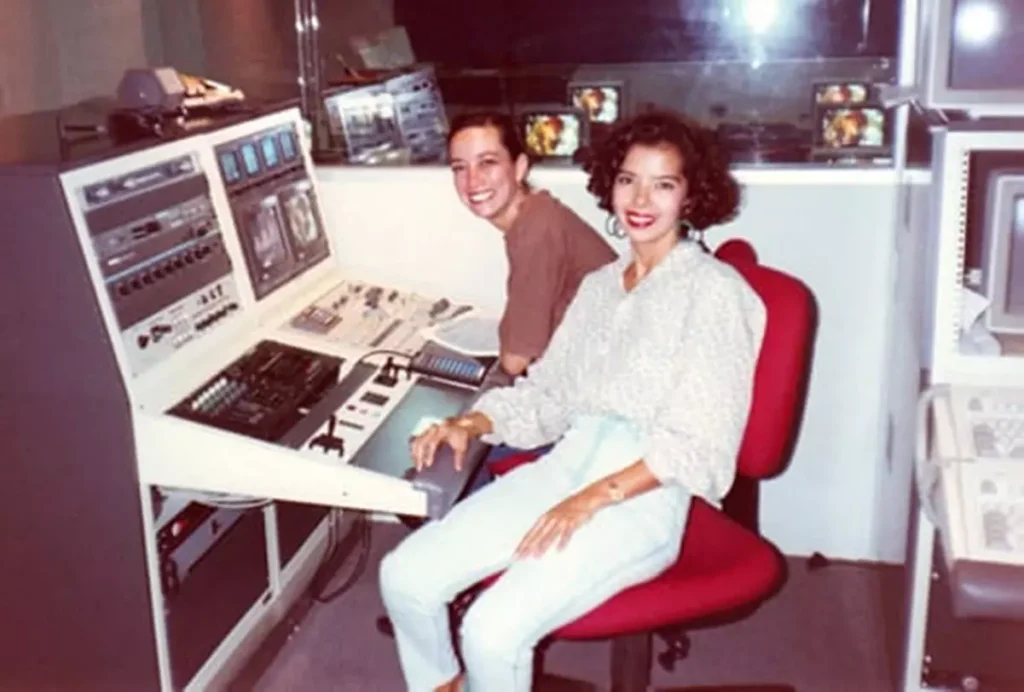
Patricia Aldape, Director of Innovation and Learning Experiences, explains that SEIS allowed classes to “take a leap” outside Tec. At that time, she had a significant role in the Virtual Business Classroom, offering continuing education programs for companies. The SEIS offerings were “intense and continuous,” in the words of Aldape. “We operated two television channels from 7 in the morning until 9 at night, recorded seminar programs, and transmitted diplomas; it was continuous,” Aldape describes.
Boosting distance education with the Virtual University
Satellite classes evolved hand-in-hand with technology. The next big step was the Universidad Virtual (Virtual University) in 1997. “Consolidation was key, allowing us to use distance education to reach new markets and sectors that had been inaccessible in person,” says Palacios.
The expansion of the internet and online platforms in the early 2000s further revolutionized distance education at Tec. Maribell Reyes, Director of Digital Education, recalls these years of continuous innovation and development. “We modeled ourselves technologically, making adjustments and contributing significantly to education,” Reyes reflects.
The deployment of the Virtual University also made it possible to reach new audiences, offering digital experience solutions to disadvantaged communities through the CCA (Community Learning Centers) and then Prepanet, a 100% online high school.
Tec’s Virtual University increased and diversified its offerings, integrated new technologies and pedagogical models, consolidated e-learning, expanded its geographical coverage, and considerably augmented the number of this modality’s users.
Tec de Monterrey’s open programs and innovations for the world
In 2015, Tec implemented Massive Open Online Courses (MOOCs), which are open to anyone with an Internet connection worldwide. Norma Lara, Director of Dissemination and Content Channels, highlights the importance of Tec opening its courses, explaining, “MOOCs allowed our digital education to be shared with the world, reaching thousands of students who otherwise would not have had access to our educational offerings.”
A couple of years later, in a quest to improve the educational experience, Tec professors marked an educational milestone: implementing “hologram teachers.” In August 2018, Tec gave its first formal class with a two-dimensional hologram to more than 160 students on five campuses.
This technology, perfected over the years, allows students to see, hear, and interact in real-time with a projected life-size and two-dimensional teacher. This breakthrough emerged from teachers’ desire to be closer to their students, even at a distance. “The Hologram Professor” has crossed borders: in 2022, Tec and Technological University of Delft (TU Delft) in the Netherlands held the first intercontinental class using this innovation.
Digital experiences as part of the Tec Model
Tec de Monterrey began overhauling its educational model, calling it Tec21 (now Modelo Tec). One of its pillars is customization and flexibility (where and when to acquire learning).
To comply with this pillar, Tec considered the digital technologies it has employed over the years and the evidence from research on digital skills, evaluation, and pedagogical trends to develop its unique concept of “digital education.”
Tec’s proposed digital education:
- Gives students the power to decide how, when, and where to study.
- Incorporates innovative teaching strategies, cutting-edge technology, and interaction with students at the different campuses
- Offers the opportunity to interact with nationally and internationally recognized professors.
Responding to a pandemic: adaptability through experience
Worldwide, the COVID-19 pandemic put established educational models to the test. Reyes, Director of Digital Education, reflects on the institution’s adaptability to ensure that its students can continue their academic activities effectively. “In the face of the pandemic, we responded quickly with a Flexible Digital Model,” Reyes points out. She adds that Tec’s experience in digital and distance education is the model’s strength.
The Tec Metaverse, a “digital twin” of Tec’s campuses, exemplified the resources Tec promoted. It was a digital-world experience of collaboration, socialization, and impartation of knowledge. Moreover, due to the pandemic, immersive learning experiences began to boom, supported by technologies such as augmented reality, mixed reality, or remote laboratories.
The present and future outlook for Tec’s Digital Education
“Technology helps us break down distance barriers, now with greater closeness and immersion in education,” says David Garza, Rector and Executive President of Tec, in the video celebrating 35 years of digital experiences.
Digital education in Tec de Monterrey’s educational model is defined as: “An educational ecosystem that allows us to enrich the learning experiences of our students through integrated, innovative pedagogies grounded in the growing use of digital media and technologies.”
In addition, digital education makes possible:
- Potentiating learning and complementing face-to-face education.
- Generating deep and lasting learning.
- Enriching the teaching-learning process with value-added value offerings.
- Boosting learning flexibility and personalization.
- Fostering high-value international experiences
- Developing disciplinary, transversal, and digital competencies
Today, it is difficult to conceive of education without technology, even in its most basic form. For Maribell Reyes, the future is uncertain due to the acceleration of Artificial Intelligence and rapid technological evolution, but these also lead to exploring opportunities. “Before, our classes were limited to Spanish or English, but now, we can reach people with various languages and dialects thanks to artificial intelligence. This presents a significant opening for us as an institution and the world in general,” she explains.
Since 2023, Tec has been developing tools to improve the teaching-learning process through intelligent advisors and improved student assessment models. Although there are still challenges to overcome, such as the cost of some technologies, the Director of Digital Education believes that AI promises to democratize access to education and improve the quality of learning.
For Lara, Director of Dissemination and Content Channels, Tec will continue to pioneer digital and distance learning. “We are shaping education for students who may not yet be born. We must be prepared to design educational models that fundamentally support their learning,” she stresses.
Finally, Palacios, Director of Educational Innovation and Digital Learning, envisions a scenario where technology and education are fused. “The future of education is marked by an increasingly close integration of modalities. More and more, the barriers between face-to-face and digital education modalities will fall,” she visualizes.
Timeline: 35 years of innovative digital experiences

Learn more about the timeline and milestones of these first 35 years of digital education at Tecnologico de Monterrey.
This article was originally published in Conecta on the17th of June, 2024
Translated by Daniel Wetta